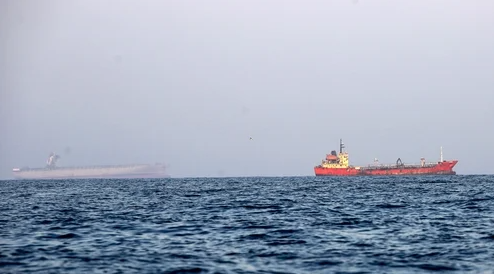
A merchant vessel was struck early Sunday off the coasts of Hengam and Qeshm islands, leaving one person dead and three others injured, according to Iranian authorities.
Qeshm city governor Amir Teymouri, quoted by state television, said the vessel was hit at around 5am. He did not specify the source of the strike.
Several explosions were also reported overnight around Qeshm, the largest island in the Strait of Hormuz.
The incident occurred a day before Iran and Gulf states were due to meet in Oman to discuss the future of the strategically important waterway, which is vital to global oil and gas shipments.
Control of the Strait of Hormuz has emerged as a major flashpoint in the six-month conflict between Iran and the United States.
Iran blocked the waterway following US and Israeli attacks that began on February 28, requiring vessels to obtain authorisation before passing through the strait. Tehran has cited security and sovereignty concerns and is also considering introducing service fees for vessels using the route.
Vessels that do not comply with the restrictions have faced Iranian attacks, while the United States has periodically carried out strikes along Iran’s coast in an effort to challenge Tehran’s control over the waterway.
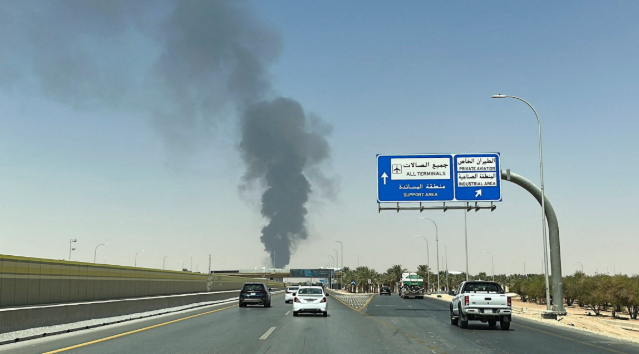
Separately, Houthi fighters on Sunday claimed responsibility for a drone and missile attack on a military base in southern Saudi Arabia, as renewed clashes with Yemen’s government forces triggered a fresh wave of civilian displacement.
Houthi military spokesman Yahya Saree said the attack targeted weapons depots and command-and-control centres at the Sharurah military base. He did not provide a date for the operation.
Fighting between the Houthis and Yemen’s government forces, which are backed by Saudi Arabia, has intensified in recent days.
Yemeni government forces said on Saturday that they had carried out strikes against Houthi fighters in the Red Sea port city of Mocha and later targeted additional Houthi positions in southwestern Yemen.
The Yemeni military said on Sunday that its air force had conducted three strikes against Houthi positions and barracks in the Taiz region.
US media outlet Axios reported that Saudi Crown Prince Mohammed bin Salman had twice asked US President Donald Trump last week to launch strikes against the Houthis, but the requests were rejected.
Trump confirmed that he had spoken with the Saudi crown prince but said the Houthis had also contacted Washington and expressed a desire to avoid confrontation with the United States.
The United States conducted a seven-week bombing campaign against the Houthis in 2025 in response to repeated attacks on Red Sea shipping carried out in support of Hamas during Israel’s offensive in Gaza. The campaign ended following a ceasefire.
The latest escalation follows a week-long Houthi offensive that resulted in the group taking control of the remaining sections of Yemen’s Red Sea coast and several strategically important islands, strengthening its position around the Bab al-Mandab Strait.
The waterway has gained greater importance for Saudi oil exports after Iran restricted shipments through the Gulf by imposing a blockade on the Strait of Hormuz.
The Houthis have also announced a maritime blockade targeting Saudi ports along the Red Sea.
Yemen’s government news agency Saba reported that government forces had destroyed Houthi vehicles and weapons and killed fighters near Mocha. The agency also said government forces had targeted Houthi positions outside the port city.
The Houthis, meanwhile, claimed that Saudi aircraft had carried out 129 airstrikes over a 48-hour period against areas under their control.
Saudi authorities said on Saturday night that a Houthi projectile had landed near the border, causing two injuries and damage to a mosque, buildings and vehicles.
Yemen’s civil war, which began in 2014 after the Houthis seized the capital, Sanaa, had remained largely dormant following a 2022 ceasefire but has intensified again since July.
The latest fighting has displaced thousands of civilians, adding to the millions already uprooted by the conflict.
The capture of Mocha by the Houthis on Thursday prompted many residents to flee towards Aden, where Yemen’s internationally recognised government is based.
Displaced residents described being forced to leave their homes at short notice, with many struggling to find shelter in Aden.
The UN migration agency said on Saturday that around 76,000 people had fled the fighting since July, with the number of displaced people quadrupling over the previous week.
Around 1,400 people have also crossed into Djibouti, according to the country’s minister of economy and finance, Ilyas Moussa Dawaleh.