
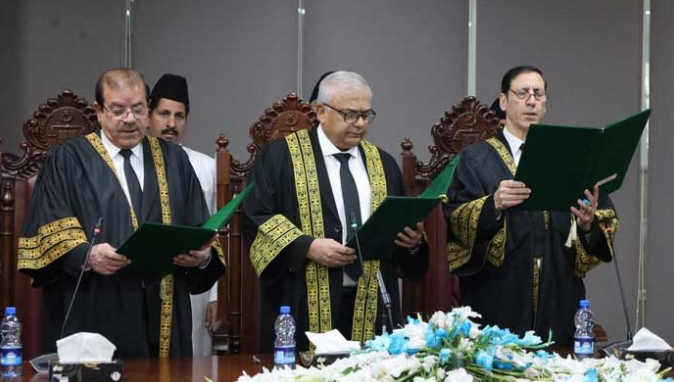
Federal Constitutional Court (FCC) Chief Justice Aminuddin Khan has stressed that the Constitution must remain supreme and that all exercises of public authority must remain within constitutional limits.
“The Constitution must remain supreme, and every exercise of public authority must remain within its constitutional boundaries,” he said while addressing an event in Islamabad.
Justice Aminuddin described the Constitution as the “supreme expression of the collective will of the people”, saying every institution established under it derived its authority from the Constitution and remained bound by its limits.
He said this principle should serve as the fundamental philosophy guiding the FCC in carrying out its constitutional responsibilities.
The FCC was established as part of judicial restructuring under the 27th Constitutional Amendment, which was passed by Parliament in November 2025. The amendment faced strong opposition and criticism from sections of the legal community, with some experts arguing that it altered the Supreme Court’s position as the country’s highest judicial forum by assigning constitutional jurisdiction to the newly established FCC.
Justice Aminuddin said that since the FCC was established under the 27th Amendment, it was required to follow the relevant rules of the Supreme Court until its own rules and regulatory framework were developed.
He described the establishment of the FCC as an “important institutional development in the constitutional history of Pakistan”, stressing that constitutional adjudication held a distinct position within the justice system.
According to the chief justice, constitutional cases involve more than disputes between individuals, as they can concern the structure of the state, the distribution of constitutional powers, fundamental rights and the protection of the constitutional order.
Justice Aminuddin also recalled the challenges the FCC faced when it began functioning, saying the court did not inherit a fully developed institutional infrastructure.
“We had to build an institution while simultaneously performing the judicial responsibilities entrusted to us by the Constitution,” he said, adding that the court had started its institutional journey “from scratch”.
He noted that there was no lengthy preparation period before the FCC began hearing cases. The court was established, its judges took their oaths and constitutional adjudication began immediately.
Three FCC benches started proceedings on the same day the judges took their oaths, which Justice Aminuddin described as a reflection of the spirit in which the institution was established.
The FCC initially operated from the Islamabad High Court building before relocating to its present premises, which had previously housed the Federal Shariat Court.
Justice Aminuddin described the transition as a major institutional undertaking. He said the current building was constructed around 46 years ago and was originally designed to accommodate approximately 100 employees.
The premises now house nearly 400 officers, officials and attached staff of the FCC, he said, adding that limited space and strained facilities remained significant challenges.
Some officials, he noted, were working from improvised cabins and compact workstations due to the shortage of space.
Despite the difficulties, Justice Aminuddin said the court had continued its work, emphasising that institutions were built through people, commitment, discipline and collective sacrifice rather than physical infrastructure alone.
He also outlined the FCC’s progress during its first 10 months, saying the court had established key judicial and administrative infrastructure while continuing to perform its constitutional duties.
The court has also developed an information technology directorate and established specialised bodies dealing with research, judicial translation, in-house training and media affairs, he added.