US President Donald Trump, seeking to revive the relationship he says he established with North Korean leader Kim Jong Un during his first term, said last month that he planned to meet Kim later this year.
Trump also stressed the importance of maintaining good relations with Kim, saying North Korea now possessed 57 “very powerful” nuclear weapons. South Korea estimates that Pyongyang has between 80 and 120 nuclear weapons.
North Korea, which has received significant support from Russia in recent years, has not given a clear response to Trump’s overtures.
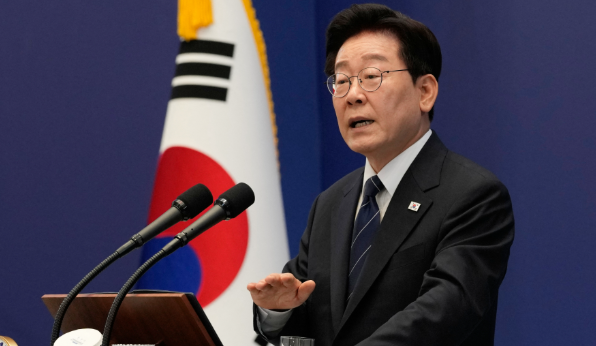
South Korean President Lee Jae Myung said on Friday that it was “clear” Trump wanted dialogue with North Korea and that he was also urging the US president to pursue talks with Pyongyang.
South Korea, which North Korea has repeatedly described as an adversary, is continuing “preliminary coordination efforts” to facilitate dialogue between Washington and Pyongyang, Lee told reporters at the presidential Blue House.
He acknowledged that arranging such a meeting “remains difficult” but said it was “not impossible”.
“I cannot say for certain how likely it is, but it is also clear that we must make every possible effort to turn that possibility into reality,” Lee said.
South Korea and the United States held a shortened version of their annual Ulchi Freedom Shield military exercises last month after Trump ordered the drills to be scaled back.
The reduced exercises, along with Trump’s renewed outreach to Pyongyang, have raised concerns in Seoul that South Korea could be sidelined in any future nuclear negotiations involving North Korea.
South Korea has also agreed to invest $350 billion in the United States under a deal reached last year to avoid the most severe impact of Trump’s tariffs. However, the two countries are still negotiating specific projects and the final terms of the agreement.
Lee said the negotiations had been “very complex and difficult”. Although the two sides were reportedly close to reaching an agreement, he said some terms remained difficult for South Korea to accept and discussions were continuing.
Lee also ruled out sending South Korean troops or military assets to intervene in the war involving Iran.
“There will be no involvement or intervention in the war. We will not deploy troops or military assets in that manner,” Lee said.
His remarks came after reports that Seoul was considering a possible deployment to the strategically important Strait of Hormuz, a major flashpoint in the conflict.
Lee said South Korea would instead undertake only the “minimum necessary activities” to protect its merchant vessels and oil shipping routes.
He reiterated three times that South Korea would not deploy troops in a manner that could result in military intervention.
“We have upheld the principle of non-involvement and non-intervention in the war until now,” he said. “And we will continue to uphold it going forward.”
Trump complained in an interview late last month that Washington had received “very little help” from other countries, citing South Korea, a key US security ally in Asia, as an example.
“We help them, but when it came to helping us, I didn’t put on a heavy sell, but I just said, ‘Would you like to participate?’” Trump said in an interview with Fox News.
“And they all said, ‘No, thank you.’ And I said, ‘I’m going to remember that to myself,’” he added.
The United States has about 28,500 troops stationed in South Korea to support the country’s defence against nuclear-armed North Korea.
Trump’s repeated criticism of longstanding alliances has, however, raised questions about the future of US security commitments in East Asia.
Lee also ruled out seeking to extend his constitutionally limited single term in office amid criticism following discussions by him and some allies about possible constitutional reforms.
His approval ratings have declined to record lows in recent weeks amid growing dissatisfaction over his real estate policies, controversial personnel appointments and concerns about volatility in the stock market.