
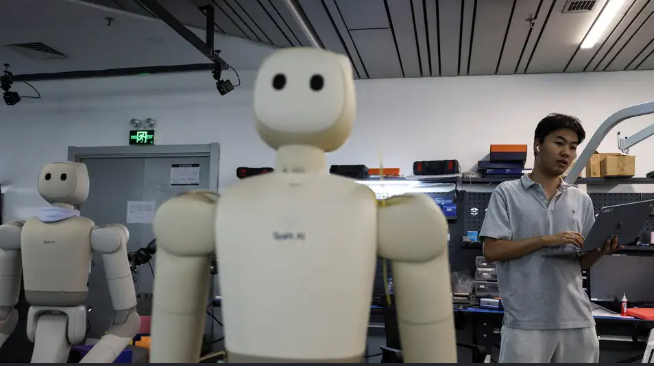
Chinese humanoid robot companies are increasingly shifting their attention from hardware capabilities to artificial intelligence systems that control robots’ decision-making, learning and ability to perform useful tasks in real-world environments.
Despite rapid advances in robotics hardware, including humanoids capable of running, dancing and performing acrobatic movements, developing reliable AI systems remains one of the industry’s biggest challenges.
Industry experts expect a major advancement in robot intelligence within the next two years, potentially paving the way for wider commercial use. Robots are already demonstrating high success rates when performing simple tasks in controlled indoor environments, while more complex and unpredictable situations remain difficult.
Commercial deployment is expected to expand initially in industrial and service environments, where robots can perform relatively simple and repetitive tasks. Household applications are considered more challenging because robots must operate in constantly changing environments and handle a wide variety of objects and activities.
One rapidly growing Chinese robotics startup has already deployed dozens of wheeled humanoid robots on production lines and in retail operations. The company, which has raised more than $670 million since its establishment in 2024, is valued at around 20 billion yuan ($2.9 billion).
The company says robot capabilities have advanced significantly, moving from performing isolated tasks such as pouring water or folding clothes to handling more complex workflows across larger spaces.
However, challenges remain in areas requiring precise movements, such as opening bottle caps, handling flexible objects and completing unfamiliar tasks. Researchers are also debating the effectiveness of simulated training environments compared with data collected from real-world activities.
The startup relies heavily on real-world data to train its robot AI systems, arguing that simulations have difficulty accurately reproducing flexible and unpredictable objects such as electrical cables.
To collect training data, the company employs around 1,000 contractors across China who use wearable equipment to record human movements in homes and industrial settings.
At a robotics training centre, workers were observed repeatedly performing everyday activities such as opening refrigerators, unlocking safes and cutting vegetables. Such movements are then used to improve robots’ ability to carry out similar tasks.
In some facilities, operators repeat individual movements dozens of times to produce highly precise training data. Researchers are also increasingly using more varied and imperfect movement data, which they say can help AI models learn more efficiently.
The developments highlight a broader shift in China’s robotics industry, with companies increasingly focusing on artificial intelligence and real-world learning as they seek to move humanoid robots from demonstrations into practical commercial applications.