
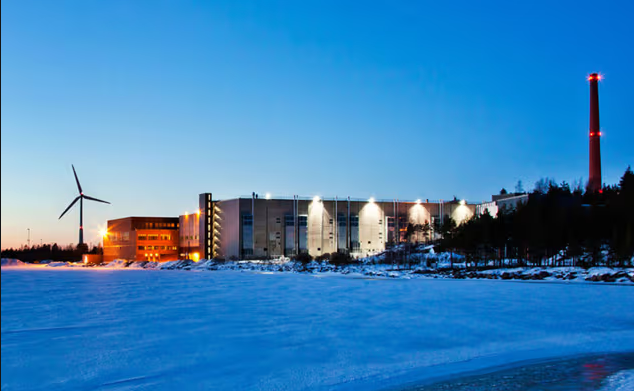
A rural Finnish municipality is bracing for major economic and social changes as Google moves ahead with a massive expansion of its data centre network in the country.
The planned facilities form part of Google’s announced €13 billion ($15 billion) investment in Finland over the next two years, described as the US technology giant’s largest investment in Europe.
Near a farm in Muhos, forests have already been cleared on land acquired by Google, while excavators and trucks are preparing the site for construction close to major electricity transmission lines.
Local farmer Pitkanen said the scale of the project was difficult to comprehend, even for residents living close to the construction site.
Google’s expansion plans cover the Finnish municipalities of Kajaani, Muhos and Vaala, as well as Hamina, where the company already operates a data centre.
The investment has generated optimism among some residents and officials, who expect new business activity, employment opportunities and increased demand for local services.
Muhos, a municipality with a population of around 8,800, is expecting thousands of workers from different countries during the construction phase. Local authorities are preparing for increased demand for housing, transport and other services.
Muhos Mayor Kimmo Hinno said the investment would significantly transform the municipality and the wider Oulu region, noting that the area currently has no comparable industrial project.
Residents have also expressed hopes that the development could encourage young people to remain in the area instead of moving to larger cities for employment.
However, the project has also triggered environmental concerns.
The Finnish Supervisory Agency (LVV) is investigating whether more than 300 hectares of forest were cleared in Muhos without a required environmental impact assessment.
The Finnish Association for Nature Conservation has called for construction activities to be suspended until the project’s compliance with environmental regulations is established.
The organisation’s chair, Hanna Halmeenpaa, said satellite images indicated that areas considered important for nature conservation had also been cleared. She compared the size of the deforested area to around 420 football fields.
Google has rejected claims of unlawful activity, saying the tree-clearing operations complied with the requirements of Finland’s Forestry Act.
The company said it had also carried out extensive environmental surveys as part of the zoning and environmental impact assessment processes and had taken measures to protect areas with significant ecological value.
Google said it was awaiting further guidance from the Finnish authorities regarding the matter.
Finland has emerged as an increasingly attractive destination for data centre investments because of its cool climate and relatively stable electricity supply.
A large share of the country’s electricity is generated from low-carbon sources, including nuclear, wind and hydropower, making the country appealing to technology companies seeking energy-intensive computing infrastructure.
The Finnish government has actively encouraged data centre investment as the country faces weak economic growth and historically high unemployment.
However, the rapid expansion of energy-intensive facilities has sparked a growing national debate over electricity prices, grid capacity and environmental impacts.
Several dozen data centres are currently under construction, while companies including Microsoft and TikTok are also planning further projects.
Public concerns over the environmental and energy consequences have intensified. A citizen initiative calling for stricter regulation of data centre energy consumption and environmental impacts collected more than 50,000 signatures within three days, triggering a requirement for parliamentary consideration.
The developments have placed Finland at the centre of Europe’s growing competition to attract large-scale data centre investments while balancing economic growth with energy and environmental concerns.