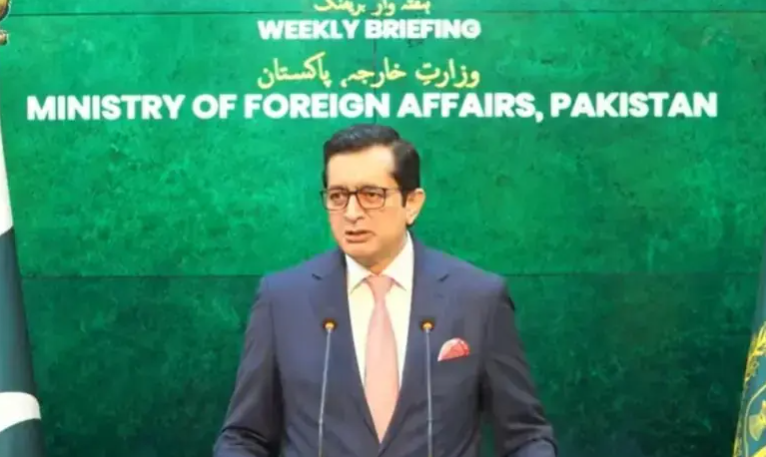
Pakistan has a “substantial number of forces, as well as resources” stationed in Riyadh, the Foreign Office (FO) said, as tensions escalate between Saudi Arabia and Yemen’s Houthi movement.
The FO spokesperson made the remarks during a weekly media briefing in response to a question about Pakistan’s active support for Saudi Arabia under the Makkah Defence Alliance.
The trilateral arrangement, which also includes Turkiye, was signed on August 7 to strengthen collective deterrence and establish a framework under which an attack against one member could be treated as an attack against all.
Recalling a joint statement issued by the three countries, the spokesperson said it clearly demonstrated their unity in deterring threats and protecting Saudi Arabia’s sovereignty and territorial integrity.
He said the member states had agreed to mobilise and contribute resources swiftly, adding that Pakistan already had a substantial military presence and resources in Riyadh.
“It is now up to the organisation to assess the threat perception and operate in accordance with its own mandate,” he said.
The spokesperson declined to provide further details about the alliance’s operational plans or speculate about which countries might become directly involved in any military action.
Addressing the escalating conflict involving the Houthis, the FO spokesperson described the group as a militia engaged in proxy activities that had contributed to regional instability. He said it had been fighting Yemeni government forces for an extended period but did not identify specific sources of its resources.
Yemen’s civil war has emerged as a major front in the wider regional conflict that followed US and Israeli attacks on Iran beginning on February 28.
Saudi Arabia’s civil aviation authority said on Friday that three Saudi nationals had been killed and several others injured in two attacks on King Khalid International Airport in Riyadh on Thursday.
The attacks reportedly damaged a Saudia Airlines aircraft and sent smoke rising over the airport. Several airlines cancelled flights to the Saudi capital ahead of a major meeting of global oil industry leaders scheduled to take place there.
Meanwhile, Houthi officials and affiliated media reported that Saudi airstrikes had targeted positions in Yemen’s capital, Sanaa, overnight. The strikes were part of an intensifying Saudi air campaign against the Iran-aligned group, which Riyadh accuses of making territorial gains, threatening international shipping and carrying out attacks against the kingdom.
The Houthis have said their attacks on Saudi Arabia are linked to Riyadh’s support for Yemeni government forces in the renewed conflict. Saudi Arabia, in turn, says it is backing an offensive by Yemen’s internationally recognised government to regain territory held by the group.
Against this backdrop, Pakistan’s role under the Makkah Defence Alliance has drawn considerable attention. Islamabad has expressed solidarity with Saudi Arabia while maintaining that the alliance is defensive in nature and intended to strengthen collective deterrence.
Prime Minister Shehbaz Sharif on Friday condemned the recent Houthi attacks on Saudi Arabia and reaffirmed Pakistan’s commitment to the kingdom’s sovereignty, territorial integrity and security under the alliance.
The Ministry of Information also rejected a media report on Thursday alleging that Pakistan Air Force aircraft were being used against the Houthis in Yemen, describing the claim as “fake and fabricated”. Earlier in the week, the ministry called a report suggesting that between 30,000 and 40,000 Pakistani troops had been deployed to Saudi Arabia “speculative”.
However, Pakistan, Saudi Arabia and Turkiye agreed on Monday to accelerate the deployment of military forces and capabilities to the kingdom during an emergency meeting of the Makkah Defence Alliance in Riyadh. The meeting focused on security developments and threats facing Saudi Arabia.
According to a statement issued by the Foreign Office, the three countries agreed to implement their collective defence commitments and take the necessary steps to provide agreed military forces and capabilities for rapid deployment in Saudi Arabia. The measures would be carried out under approved arrangements and each country’s national legislation, with the aim of improving military readiness, integration and collective capacity to counter threats.
Defence Minister Khawaja Asif, who attended the meeting as part of Pakistan’s delegation, told Geo News programme Aaj Shahzeb Khanzada Kay Saath that Pakistan and Turkiye had a military presence in the region, while Saudi forces alone were involved in combat operations.
Asif also said on Thursday that the alliance did not contain any provision preventing member states from becoming directly involved if one of them faced a threat.
The Foreign Office spokesperson also explained why no joint statement was issued after the latest Moscow Format meeting, attributing the development to the Afghan Taliban delegation’s change in position on language concerning terrorism.
He said Pakistan had participated constructively in the meeting and clearly conveyed its concerns about militant activity originating from Afghan territory, which Islamabad considers a serious security threat to neighbouring countries.
Khan noted that these concerns had been reflected in the joint statement issued after the previous year’s meeting. However, he said, the Afghan Taliban delegation had declined to retain the previously agreed wording during this year’s discussions.
Pakistan believes that a joint statement failing to adequately address its security concerns would not accurately reflect conditions on the ground, he added, emphasising that the issue was a substantive security matter rather than a disagreement over wording.
The spokesperson said the absence of a joint statement should not diminish the importance of regional dialogue. He added that Pakistan had time to consult relevant stakeholders before deciding on its participation in the next Moscow Format meeting, which is scheduled for the following year.
He described any definitive decision about future participation as premature, while leaving open the possibility of continued engagement.
The Foreign Office also rejected a newly issued Indian political map depicting parts of Indian-administered Jammu and Kashmir as falling within India’s territorial jurisdiction.
Khan described the move as an act of “cartographic aggression” and said unilateral changes to a map could not legitimise India’s control over the disputed region.
“Pakistan categorically rejects India’s latest act of cartographic aggression,” he said.
He maintained that unilateral cartographic measures were legally void and contrary to relevant United Nations Security Council resolutions, adding that they could not confer legitimacy on India’s occupation of parts of Jammu and Kashmir.
The spokesperson further said that such actions could not alter the internationally recognised disputed status of the territory or undermine the Kashmiri people’s right to self-determination.
He called on India to comply with international law and relevant UN Security Council resolutions and allow the people of Indian-administered Jammu and Kashmir to exercise their right to self-determination through a free and impartial plebiscite under UN auspices.