
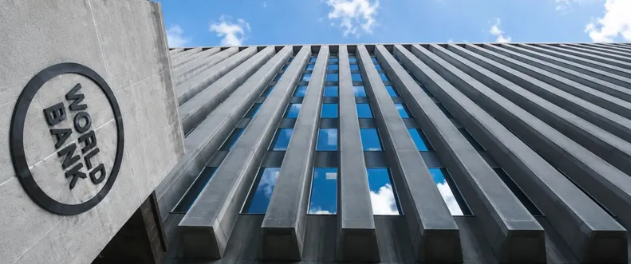
The Sindh government has sought $350 million in financial assistance from the World Bank for a flood resilience project aimed at protecting vulnerable areas, strengthening urban infrastructure and improving preparedness for climate-related disasters.
The proposal was discussed during a meeting between Sindh Irrigation Minister Jam Khan Shoro and a World Bank delegation, which reviewed measures to mitigate flood risks, safeguard urban centres and support the development and rehabilitation of major cities and towns across the province.
The World Bank delegation included Lead Urban Specialist Saleem Rouhana, Task Team Leader and Disaster Risk Management Specialist Bilal Khalid, and Amparo Semper Heraldo.
Irrigation Secretary Zarif Khero, Planning and Development Board Chairman Najam Ahmed Shah and other provincial officials also attended the meeting.
Speaking at the meeting, Shoro said the provincial government was prioritising the development of resilient infrastructure in both rural and urban areas to reduce the impact of future floods and climate-related threats.
He emphasised that sustainable urban planning, efficient drainage systems, improved governance and modern technology were essential to strengthening the province’s ability to withstand natural disasters.
The meeting also reviewed the devastation caused by the 2022 floods, ongoing rehabilitation initiatives and proposed measures to mitigate the effects of future climate-related emergencies.
Officials were informed that the floods affected approximately 14.6 million people, caused an estimated $9.1 billion in financial and infrastructure losses, and damaged or destroyed 1.71 million houses.
The meeting was informed that ongoing projects supported by the World Bank had mobilised $1.6 billion in funding.
Under these initiatives, more than 848 kilometres of roads and 205 kilometres of protective embankments have been restored. More than 900,000 houses have also been repaired or reconstructed, while 26 modern Rescue 1122 stations have been established across 14 districts.
For the fiscal year 2026-27, the provincial government presented a proposal seeking $350 million in financial assistance under the Sindh Flood Resilience Project (SFRP).
Officials provided a detailed briefing on the project’s first pillar, which focuses on basin-level flood resilience to protect Sindh’s right bank from future flood disasters. The proposed measures were identified through research conducted by the Asian Institute of Technology.
The second pillar focuses on urban resilience, with the objective of making secondary cities across Sindh safer, more sustainable and better equipped to withstand flooding, extreme heat and other climate-related risks.
Investment priorities for urban areas will be determined by assessing flood exposure, population vulnerability, gaps in essential services and the preparedness of individual cities.
Proposed investments include improvements to urban drainage systems, roads, streets and public spaces, alongside environmentally friendly infrastructure and green solutions designed to strengthen climate resilience.