Federal ministers have accused the Pakistan Tehreek-e-Insaf (PTI)-led Khyber Pakhtunkhwa government of allegedly maintaining links with militant groups, as the federal government moves to introduce emergency measures in the province over its deteriorating security situation.
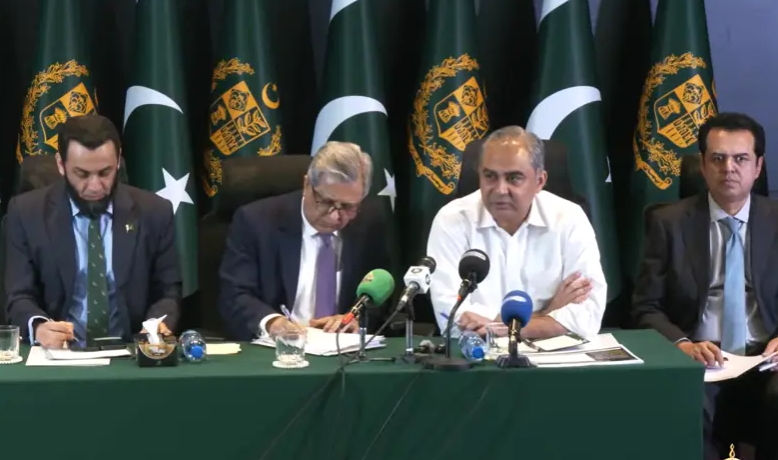
The press conference, addressed by Information Minister Attaullah Tarar, Interior Minister Mohsin Naqvi, Law Minister Azam Nazeer Tarar and Minister of State for Interior Tallal Chaudhry, followed the federal government’s decision to impose an emergency in Khyber Pakhtunkhwa, citing what it described as the provincial administration’s failure to adequately address terrorism.
The federal government and the PTI have remained at odds over several issues, particularly counterterrorism policy. Differences over the matter were among the key factors behind the collapse of negotiations between the government and opposition on October 3.
Speaking to the media in Islamabad, Information Minister Attaullah Tarar alleged that members of the federal cabinet believed the PTI-led provincial government had developed an understanding with militant groups.
He claimed that intelligence reports from the Intelligence Bureau and law enforcement agencies indicated that militants were exerting influence over the administration of several districts.
Tarar alleged that while political parties in the region had faced militant attacks, the PTI had been able to hold political activities without comparable incidents because of its alleged links with such groups.
He also questioned reports of militant influence over police facilities in certain districts, arguing that the situation went beyond administrative negligence and amounted to the alleged empowerment of militant elements.
According to the minister, an alleged power-sharing arrangement between militants and the provincial government had gradually expanded from southern districts to other parts of Khyber Pakhtunkhwa.
He further claimed that the alleged arrangement had contributed to attacks on civilians and public infrastructure.
Tarar described the militants as foreign-funded elements seeking to destabilise Pakistan and argued that any facilitation of such groups by a provincial government would constitute a serious constitutional concern.
Referring to proposed legislation concerning police appointments, he alleged that the provincial government wanted to recruit individuals associated with militant groups into the police force. He claimed that evidence was available to support the government’s allegations.
These allegations were presented by federal ministers during the briefing; they were not independently established in the material provided.
Interior Minister Mohsin Naqvi called on groups gathered in parts of Khyber Pakhtunkhwa, apparently referring to PTI supporters participating in the party’s march, to disperse. He warned that individuals found violating the law would face legal action.
Naqvi said the federal government intended to restore law and order in the province and would take whatever measures it considered necessary to normalise the situation.
Responding to questions about reports of provincial ministers being arrested, he said preventive detention could be used where required to maintain public order, while individuals wanted by authorities would be arrested in accordance with the law.
Commenting on the security situation in Balochistan, the interior minister said recent counterterrorism operations had helped improve conditions there.
Law Minister Azam Nazeer Tarar said the federal government had established an Area Development Secretariat (ADS), overseen by the governor, to administer 12 districts considered to be facing serious security challenges.
He said the provincial assembly’s legislative functions would be assumed by Parliament under the emergency arrangements while the normal constitutional functioning of the provincial government remained affected.
The federal government has also formed an 11-member KP Advisory Council to assist the governor in carrying out provincial government functions during the emergency.
The council comprises individuals with backgrounds in public administration, finance, law, healthcare, education, energy, infrastructure and other fields.
The federal government has also appointed Advocate Sanaullah as the provincial advocate general.
Former prisons chief Kifayatullah Khan has been assigned responsibility for home affairs, while former Federal Board of Revenue chairman Tariq Mahmood Pasha will advise on finance.
MNA Samar Haroon Bilour has been appointed information adviser, and retired Lieutenant General Nigar Johar has been assigned health affairs.
Former advocate general Amir Javed will advise on legal matters, while former senator Osman Saifullah Khan will oversee energy and power affairs. Asif Rafiq Afridi has been assigned communication and works, and Maulana Tayyab Qureshi will oversee religious affairs.
Other appointments include Dr Muhammad Irshad for industries and commerce, Dr Sarfraz Ali Shah for mines and minerals, and Dr Syed Amir Abdullah for education.
Tarar said the selected advisers possessed academic qualifications or substantial experience in public service.
An order issued by the federal government under Article 232 of the Constitution stated that the provincial government could no longer be carried on in accordance with constitutional provisions following the proclamation of the emergency.
Under the order, an Area Development Secretariat is to be established under the supervision of an Area Representative and Development Council (ARDC), with the stated objectives of restoring law and order, protecting citizens and improving governance and development.
The 12 designated districts are Dera Ismail Khan, Tank, Lakki Marwat, Bannu, Bajaur, Mohmand, Khyber, Kurram, Orakzai, North Waziristan, South Waziristan Upper and South Waziristan Lower.
The ARDC will comprise local notables from the designated districts and will be headed by a chairman. Its members, chairman, vice chairman and spokesperson will be appointed according to arrangements determined by the federal government.
The ADS will be headed by an additional chief secretary serving as administrator for the designated areas. Officials of the provincial government and other relevant authorities posted in these districts will come under the secretariat’s operational and administrative control.
The order authorises the administrator to exercise executive, administrative and law enforcement powers otherwise held by the provincial government in the designated districts.
These powers include establishing administrative and security structures, issuing binding directions to civil, police and military authorities, allocating funds, coordinating with federal agencies and the armed forces, reorganising departments and taking measures related to public safety, economic stability, relief operations and essential services.
The administrator may also direct transfers and postings in the designated areas through the prescribed process. Orders issued under these arrangements will carry the same legal effect as orders of the provincial government, according to the notification.
The order further states that specified constitutional provisions concerning provincial governments and the separation of the judiciary from the executive will not apply in the designated districts. The KP Government Rules of Business, 1985, will also be inapplicable there.
Interior Minister Mohsin Naqvi said the federal government had spent more than a month attempting to bring the KP government on board in the fight against terrorism, but those efforts had failed to produce an agreement.
He said he had remained in contact with PTI leaders behind the scenes, with the objective of developing a joint strategy against militancy.
Naqvi claimed he was communicating with PTI representatives until 11:45pm on the night before the briefing and had discussed a specific paragraph of the proposed agreement throughout the day. According to him, the opposition did not respond.
He said the government had warned the PTI that an agreement could still prevent the situation from escalating, despite the decision on emergency measures being close to implementation.
The interior minister also acknowledged efforts by veteran politician Maulana Fazlur Rehman to ease tensions, but said those initiatives had not produced a breakthrough.
Naqvi maintained that the federal government had no objection to the PTI’s