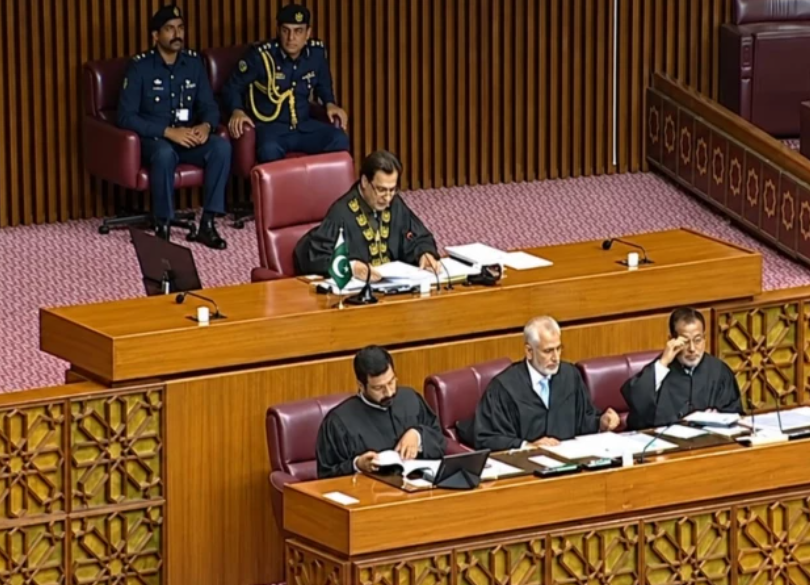
The National Assembly and Senate have passed resolutions endorsing the federal government’s decision to impose emergency in Khyber Pakhtunkhwa (KP), amid strong opposition from Pakistan Tehreek-e-Insaf (PTI) lawmakers.
The federal government imposed governor’s rule and emergency in KP on Sunday, citing what it described as the provincial government’s “deliberate disengagement” from counterterrorism efforts. The decision came amid escalating political tensions between the Centre and the PTI, following the party’s announcement of a long march to Islamabad seeking the release of its incarcerated founder, Imran Khan.
Minister for Parliamentary Affairs Tariq Fazal Chaudhry tabled the motions concerning the proclamation of emergency in both Houses of Parliament.
The Senate passed the resolution amid protests and sloganeering by opposition members, with PTI senators staging a walkout.
The approval followed a heated debate between government and opposition lawmakers, during which Law Minister Azam Nazeer Tarar defended the constitutional and procedural validity of presenting the resolution before the House.
Tarar said the resolution had been introduced in accordance with the Senate’s Rules of Procedure and Conduct of Business. He maintained that Article 232 of the Constitution required the proclamation of emergency to be presented before the House.
He rejected objections concerning the seven-day notice requirement, arguing that the provision did not apply to a resolution presented under constitutional necessity.
“If its opponents have any objections, they should reject the resolution through their vote after the debate. We cannot deviate from the Constitution and rules of the House,” he said.
As opposition members continued their protest, Senate Chairman Yousuf Raza Gilani urged them to maintain order, remarking that the House was not a classroom.
PTI Senator Humayun Mohmand alleged that the federal government had planned to impose governor’s rule months earlier, adding that terrorism was being used as a pretext to target the PTI.
He referred to earlier remarks by independent Senator Faisal Vawda, who had reportedly predicted the imposition of governor’s rule. Mohmand also criticised the federal government’s decision, arguing that previous major political decisions had produced negative consequences.
PTI-backed Senator Hamid Khan alleged that the move had objectives beyond counterterrorism. Referring to negotiations between the Centre and opposition parties before the emergency was imposed, he described the talks as an attempt to mislead the public.
Khan said Jamiat Ulema-i-Islam-Fazl (JUI-F) chief Maulana Fazlur Rehman, who had attempted to mediate between the two sides, had indicated that a decision had been taken while negotiations were still underway.
He also questioned the independence of the judiciary following the 26th Constitutional Amendment, arguing that the weakening of judicial independence had reduced the avenues available to challenge allegedly unconstitutional measures.
PTI Senator Mohsin Aziz defended the people of KP against allegations of facilitating terrorism, highlighting the sacrifices made by residents and security personnel in the fight against militancy.
He argued that unemployment, poverty and inadequate access to healthcare, clean water and education contributed to the conditions in which terrorism flourished.
PTI Senator Zeeshan Khanzada also condemned the imposition of emergency and governor’s rule, accusing the federal government of detaining former KP chief minister Sohail Afridi and other PTI lawmakers.
JUI-F Senator Kamran Murtaza objected to the handling of the proceedings, saying an opposition resolution against governor’s rule should have been included in the day’s agenda but had been returned with objections.
He further argued that the government had not provided senators with the documents and supporting material relating to the invocation of Articles 232 and 234 of the Constitution. According to Murtaza, lawmakers had been forced to obtain relevant information through social media.
He maintained that parliamentarians could not properly assess the decision without access to the complete record.
In the National Assembly, the question hour was suspended to allow lawmakers to debate the emergency proclamation. The resolution was subsequently adopted by a majority vote following remarks by Law Minister Azam Nazeer Tarar.
According to the National Assembly’s official account, the resolution approved the proclamation of emergency issued by President Asif Ali Zardari on October 11, 2026, in KP under the second proviso of Article 232(1) of the Constitution.
Under Article 232, a proclamation of emergency issued by the president must be placed before both Houses of Parliament for approval within 10 days when the president acts on his own initiative.
A proclamation issued under Article 234 concerning the failure of constitutional machinery in a province must be placed before a joint sitting of Parliament. It ceases to remain in force after two months unless its continuation is approved by the joint sitting, subject to the constitutional limit of six months.
Opposition members participated relatively calmly during the National Assembly proceedings, avoiding the disruptive protests seen during previous sessions.
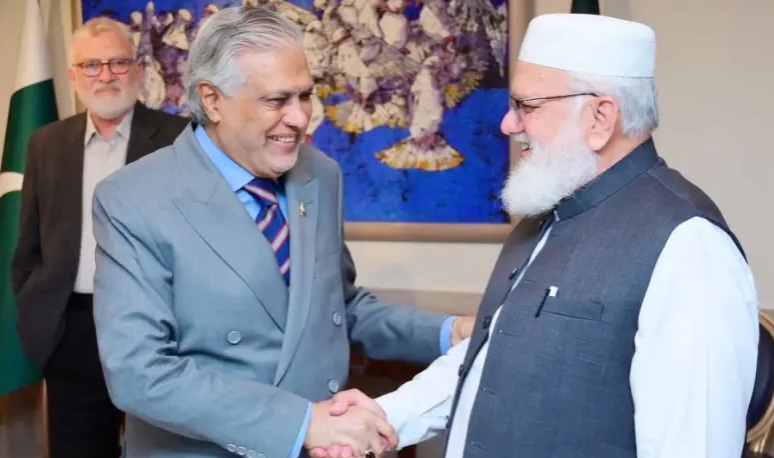
Prime Minister Shehbaz Sharif attended part of the sitting. Images released by the National Assembly showed him shaking hands with Opposition Leader Mehmood Khan Achakzai.
Government ministers defended the emergency proclamation, accusing the PTI-led provincial administration of failing to demonstrate sufficient commitment to counterterrorism efforts.
Pakistan Peoples Party (PPP) Chairman Bilawal Bhutto-Zardari blamed the PTI for the circumstances that led to the federal government’s decision, describing the party’s conduct as a “political suicide attack” on its own provincial government.
However, Bilawal also urged the government and opposition to resume dialogue and work together to counter terrorism.
National Assembly Speaker Ayaz Sadiq recalled the October 3 negotiations between the two sides, praising their efforts to reach an agreement despite political differences.
He said some matters had been beyond the control of the negotiating parties and expressed support for reviving the same committees if further talks became necessary.
Addressing PTI lawmakers, Sadiq said both sides had supported continuing the dialogue process, while acknowledging that the opposition had faced certain constraints.
The speaker also took note of PTI complaints concerning the jail conditions of Imran Khan, saying he had provided details about the facilities available to the incarcerated former prime minister.
The National Assembly session was adjourned until 11am on Friday, October 16.
Addressing the National Assembly, Bilawal said the imposition of emergency and governor’s rule in KP had been carried out under the Constitution.
He maintained that the federal government had attempted to engage the opposition to avoid taking the step but had ultimately proceeded because of its concerns over counterterrorism cooperation.
“The PTI itself carried out a political suicide attack on its KP government,” he said, arguing that the party’s leadership, particularly in the province, had contributed to the political and constitutional circumstances surrounding the decision.
Bilawal said the PPP believed the government should have exhausted all avenues of engagement before resorting to what he described as a “constitutional atomic bomb”.
He stressed that restricting political space for one party could eventually affect other political parties, political workers and citizens.
The PPP chairman acknowledged that the government also bore responsibility for the situation but maintained that the PTI could not completely disassociate itself from the consequences of its actions.
Referring to alleged remarks by Sohail Afridi that he would not conduct counterterrorism operations in the manner demanded by the Centre, Bilawal questioned whether the provincial leadership had left the federal government with sufficient political or legal grounds to reject the emergency proclamation.
He also questioned whether President Asif Ali Zardari, who has previously highlighted his role in the passage of the 18th Amendment, had any viable basis to refuse to approve the proclamation under the circumstances described by the government.
Despite defending the decision, Bilawal urged the federal government to make another attempt to negotiate with the opposition and seek a political compromise.
He described emergency as a temporary measure, stressing that it could not remain in place indefinitely.
While arguing that the measure could strengthen counterterrorism efforts, he said eliminating militancy required a coordinated response involving the entire country and all segments of society.
Referring to the October 3 talks involving government and PPP representatives and the opposition, Bilawal said he had initially been informed that the negotiations were progressing successfully.
He claimed the PTI had been willing to designate areas in KP experiencing increased terrorist activity as terrorism-affected areas. According to Bilawal, the opposition was also close to agreeing to a joint agreement between the federal and provincial governments on counterterrorism cooperation.
However, he said the negotiations ultimately collapsed.
Bilawal added that Pakistan’s security challenges had become more complex, alleging that India continued to support terrorist activity in Pakistan following the May 2025 conflict.
Referring to Indian Prime Minister Narendra Modi’s remarks about Operation Sindoor, Bilawal alleged that India was sponsoring terrorist incidents through the Tehreek-i-Taliban Pakistan (TTP) and separatist militant groups. He reiterated Pakistan’s position that India was involved in militant activities originating across the Afghan border.
The former foreign minister also referred to Pakistan’s mediation efforts in the US-Iran conflict, alleging that forces opposed to these diplomatic initiatives were interfering in Pakistan’s domestic politics.
Concluding his speech, Bilawal called for a broader political consensus on fundamental national issues and urged opposition lawmakers to begin discussions within Parliament.
PTI Chairman Barrister Gohar Ali Khan rejected the federal government’s decision to impose emergency in KP, questioning the justification for the move and raising concerns over the detention of party leaders and members of Imran Khan’s family.
He asked what allegations of terrorism had been levelled against Imran Khan’s wife and sisters, who he said had been imprisoned, and questioned the detention of PTI members of the National and provincial assemblies.
Gohar said he would disclose further details about the negotiations when a particular individual attended a joint session of Parliament.
He maintained that the PTI had consistently opposed terrorism and called for counterterrorism measures to be implemented in accordance with the National Action Plan (NAP).
The PTI chairman also criticised the government for restricting his party’s political activities, claiming that the PML-N had organised numerous long marches during the PTI’s tenure but was now preventing the opposition from holding a similar protest.
Recounting the October 3 negotiations, Gohar said the government had demanded that the PTI immediately call off its planned long march to Islamabad. He questioned why terrorism had suddenly become a central issue in the negotiations.
He said the government had raised five reservations and claimed that the PTI was willing to consider amendments to the KP Police Act to bring it in line with legislation in Punjab and Sindh.
Gohar also reiterated his party’s demand for the production of several lawmakers whom the PTI alleges were taken into custody.
He welcomed Bilawal’s proposal to resume negotiations, indicating that dialogue remained a possible route towards resolving the political dispute.
Responding to Gohar, Bilawal argued that the PTI was prioritising its long march while residents of KP continued to face terrorist attacks.
He said the opposition could continue to challenge the emergency proclamation, but maintained that the decision had a constitutional basis.
Bilawal added that he could not insist that the government continue negotiations indefinitely after what he described as repeated setbacks.
He said he did not believe that Gohar or Achakzai supported terrorism, but argued that the PTI could not ignore statements attributed to its former chief minister that appeared inconsistent with the party’s stated commitment to counterterrorism.
The PPP chairman again called on political stakeholders to unite against militancy and urged the authorities to ensure that Imran Khan received all facilities to which he was entitled in custody.
Law Minister Azam Nazeer Tarar told the National Assembly that the emergency had been imposed because the security situation in KP had increasingly become a threat to national security.
He said Article 232 required Parliament to approve the proclamation after it had been issued by the president.
Tarar recalled that the federal cabinet had reviewed material concerning terrorism in the province during its October 11 meeting before advising Prime Minister Shehbaz Sharif to recommend the imposition of emergency.
Responding to comparisons with the emergency imposed by former military ruler General Pervez Musharraf in October 1999, the minister highlighted what he described as internal disturbances and cross-border infiltration.
He argued that the security situation had deteriorated significantly since Sohail Afridi’s government came to power in KP on October 15, 2025.
Tarar said militant attacks had increased in the province, particularly after 2021, and attributed the deterioration partly to the provincial government’s approach. He suggested that political and other factors had contributed to the worsening situation.
According to figures cited by the minister, KP recorded 2,911 terrorist incidents between 2021 and 2024, while 3,787 incidents were reported between October 15, 2025, and October 9, 2026.
He criticised the provincial leadership for allegedly neglecting the sacrifices of police officers and security personnel while pursuing political activities, including plans for a march on Islamabad.
Tarar thanked National Assembly Speaker Ayaz Sadiq for facilitating negotiations between the federal government and the opposition. He alleged that the PTI had repeatedly changed the draft agreement during the talks before withdrawing from the process.
The law minister also said the PTI’s demands concerning Imran Khan’s release and treatment at a private hospital could not be fulfilled through political negotiations alone, as such relief was subject to judicial decisions.
He described the developments as a troubling episode in the country’s democratic history.
Tarar further said a special administrative mechanism had been introduced for 12 districts of KP as part of the federal government’s response.
Opposition Leader Mehmood Khan Achakzai criticised the law minister’s account, questioning the government’s electoral mandate and challenging the claim that the PTI-led provincial administration had failed to combat terrorism.
Achakzai said the opposition would accept the government’s position if the minister could establish that the ruling coalition had won the February 2024 general elections fairly. He alleged that the incumbent government had been formed unlawfully.
Defence Minister Khawaja Asif also criticised the PTI’s record during its tenure in the federal government.
Referring to former prime minister Imran Khan’s proposal to resettle members of the TTP, Asif said the PTI had attempted to persuade the then-opposition that bringing the militants back to Pakistan would benefit the country.
He also recalled the 2019 episode involving the capture of an Indian pilot, alleging that the then-prime minister had expressed reluctance to respond militarily to India.
Asif urged the opposition to reflect on its past decisions, including Imran Khan’s public praise for former army chief General Qamar Javed Bajwa.
He argued that inconsistencies between political rhetoric and actions continued to undermine national stability.
The defence minister also recounted his imprisonment during the PTI government, saying he had received assistance from then-opposition leader Shehbaz Sharif during his time in custody.
Asif claimed that he had not responded to his imprisonment by organising protests or staging demonstrations at D-Chowk, nor had his party targeted police and law enforcement personnel.
“You demand equity when you have clean hands. You do not have clean hands, you cannot demand equity,” he said.
He also referred to his detention at Attock jail under the Musharraf administration, saying he had remained loyal to his party and former prime minister Nawaz Sharif.
Turning to the current security situation, Asif alleged that Afridi had received instructions from an individual based in Afghanistan. He also cited a statement by the TTP condemning the emergency proclamation and the deployment of troops in certain areas, questioning the relationship between the militant group and the PTI.
The defence minister rejected the PTI’s claim that its leaders had been unable to meet Imran Khan, saying meetings had taken place but some had not been made public or formally recorded.
Muttahida Qaumi Movement-Pakistan (MQM-P) leader Farooq Sattar expressed support for the prime minister’s decision to impose emergency and governor’s rule in KP, describing it as difficult but unavoidable.
Sattar said his party trusted the prime minister’s experience, political judgement and assessment of the national interest.
He argued that the PTI had failed to present convincing grounds to establish that the decision was baseless or motivated solely by political considerations.
Sattar said the central issue was the PTI’s political approach, referring to statements attributed to Imran Khan that the war against terrorism was not Pakistan’s responsibility.
He questioned whether the KP government had published reports identifying terrorist hideouts or taken adequate action against suspected militants.
The MQM-P leader warned that allegations of political complicity in terrorism would have serious consequences if substantiated through an inquiry.
Drawing on his own party’s experiences, Sattar said political leaders sometimes struggled to defend narratives emerging from their leadership, adding that Gohar appeared to face a similar challenge in explaining the PTI’s position on KP.