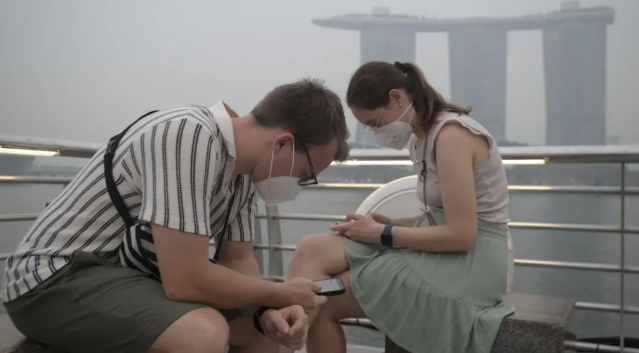
Residents across Singapore have been collecting free protective masks as thick smoke haze continues to affect air quality, prompting authorities to distribute masks to vulnerable groups and open designated community shelters.
The People’s Association (PA) announced the mask distribution programme and the opening of haze shelters on October 14, after concentrations of fine particulate matter, known as PM2.5, climbed above 200 in several parts of the country.
By 5pm on October 15, Singapore’s Pollutant Standards Index (PSI) had reached unhealthy levels, recording 188 in the western region and 186 in the central area. PM2.5 concentrations were also high nationwide, measuring 205 in the central region, 155 in the west, 161 in the east and 157 in the south.
Singapore’s National Environment Agency (NEA) warned that the haze could continue through October 18 as smoke from fires in Indonesia’s Kalimantan region drifted towards the island under prevailing south-easterly winds. Smoke haze was also reported over Sumatra.
In its October 15 evening update, the agency said showers were expected in Singapore and surrounding areas on October 16. However, southern Sumatra and parts of Kalimantan were likely to remain dry, allowing smoke to continue travelling towards Singapore.
The outlook for the weekend suggested that rainfall over Singapore and parts of Kalimantan could help limit the movement of smoke. Winds were expected to blow from the south or south-east, although the agency cautioned that haze from Sumatra could still reach the city-state.
Authorities said mask distribution had become necessary after PM2.5 concentrations entered the very high category, exceeding 250 in certain locations.
At Punggol 21 Community Club, distribution began at 10am in the multipurpose hall, where around 20 people were waiting to collect their supplies. Eligible recipients include older adults, pregnant women, young children and people with existing medical conditions, with each person entitled to two masks.
A 73-year-old coffee shop assistant identified only as Tan said he collected the masks as a precaution, despite not having experienced any haze-related health problems. He said he had reduced his outdoor activities and now headed straight home after work.
At Jurong Spring Community Club, approximately 15 residents were in line by 10.20am. Among them was Elien Chan, a woman in her 50s who said she had experienced nasal irritation and headaches when pollution levels rose sharply in western Singapore on October 14.
Although she welcomed the free masks, Chan questioned whether two would be enough because each mask could last only about three days and could not be washed. She said she planned to purchase an air purifier with her husband after collecting the masks.
Meanwhile, 68-year-old retired aviation officer K.C. Tan said he had visited several pharmacies but found that N95 masks were out of stock. The Punggol resident reported a sore throat and said the haze had prevented him from maintaining his usual morning exercise routine for several days.
He has been using air purifiers and air-conditioning more frequently at home to minimise exposure to polluted air.
Small queues were also reported at other distribution locations, including Kallang and Sengkang community clubs.
At Yuhua Community Club in Jurong East, several residents, mostly senior citizens, arrived shortly after 8pm to collect masks.
Real estate consultant Joel Tan, 40, collected supplies for his primary-school-aged children as a precaution. He said limited mask availability in the market had made the government distribution programme particularly useful, while air purifiers and air-conditioning were helping his family manage conditions indoors.
His 11-year-old daughter, Chloe, who was developing a cough, said pupils at Clementi Primary School would eat their recess meals in classrooms using their own food containers.
Retiree Chew Lai Fong also collected masks for herself and her husband before offering to pick up supplies for neighbours and friends, particularly those living alone.
While demand for masks remained noticeable, designated community haze shelters appeared to attract fewer residents.
The shelters, located at selected community clubs and Residents’ Committee centres, provide air-conditioned indoor spaces where people can take refuge from polluted outdoor conditions. At Yuhua Community Club, one room was equipped with drinking water, beverages and snacks for visitors seeking relief from the haze.
At One Punggol Community Club, only one person was present when the shelter was visited at around 11am on October 15. The visitor, a retired ship captain who identified himself as Sarun, said he was waiting to collect his granddaughter from childcare.
Authorities continue to monitor pollution levels and weather conditions as smoke from Indonesian fires threatens to prolong the haze. Residents, particularly vulnerable groups, are being encouraged to limit outdoor exposure and take appropriate precautions while air quality remains poor.