Deputy Prime Minister and Foreign Minister Ishaq Dar has urged Shanghai Cooperation Organisation (SCO) member states to accelerate the use of national currencies in bilateral settlements and establish regional financial institutions to strengthen economic cooperation and protect their economies from global financial disruptions.
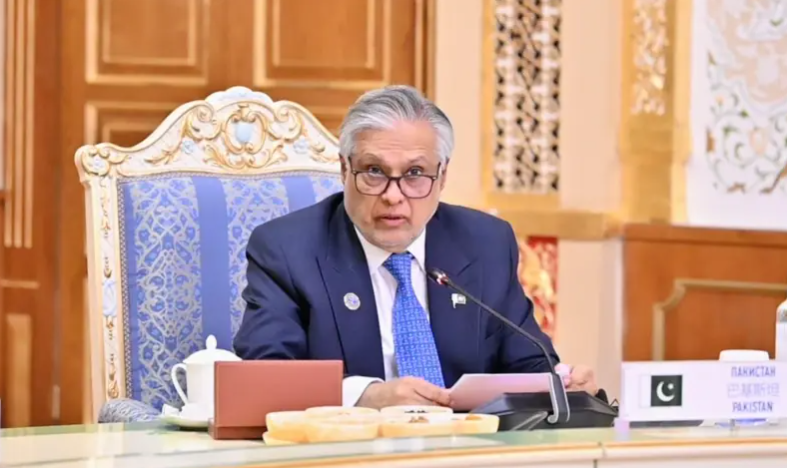
Dar made the remarks while addressing the SCO Council of Heads of Government (CHG) meeting in Tajikistan’s capital, Dushanbe, where he called for advancing initiatives such as the SCO Development Bank, SCO Development Fund and SCO Investment Fund.
He said these mechanisms could support development projects, strengthen regional financial cooperation and help member states withstand external economic shocks.
Dar reiterated the need to promote settlements in local currencies during an expanded-format session of the meeting. Russia and Iran, both SCO members, face Western sanctions that have restricted their access to international markets and placed pressure on their economies.
At the 2024 SCO Council of Heads of Government meeting hosted by Pakistan, member states reaffirmed their commitment to gradually increasing the share of national currencies in mutual settlements. The participating countries also stressed the importance of protecting the multilateral trading system under the World Trade Organisation and promoting inclusive global economic growth.
Prime Minister Shehbaz Sharif had previously highlighted growing support among SCO members for using national currencies in trade, saying the shift could help protect participating economies from international financial disruptions.
Addressing the gathering, Dar described the China-Pakistan Economic Corridor (CPEC) as an opportunity for all SCO partners to contribute to deeper regional economic integration.
He emphasised that investment in key sectors, particularly energy and transport, was essential to improving connectivity and strengthening economic ties across the region.
The deputy prime minister criticised protectionist policies and unilateral coercive measures, arguing that they ran counter to international law, hindered economic growth, restricted technological advancement and widened inequality.
He called for reforms to the global financial architecture and international trade arrangements to promote more equitable development.
Dar also urged SCO members to increase investment in high-potential sectors, including agriculture, mining, minerals and information technology, to build more resilient and interconnected economies.
He identified artificial intelligence, digital transformation, innovation, energy cooperation and international information security as important areas for future collaboration.
The foreign minister also recalled the priority areas outlined by Prime Minister Shehbaz Sharif for the SCO Council of Heads of State summit scheduled to be hosted by Islamabad in 2027. These include peace and security, regional connectivity and trade, digital transformation and artificial intelligence, climate resilience and sustainable energy, and people-to-people exchanges.
Dar stressed that strategic investment in transport and energy infrastructure was essential for meaningful regional economic integration.
Dar also raised concerns about cross-border terrorism originating from Afghanistan, emphasising that sustainable economic development required lasting peace and security across the region.
He said stability in Afghanistan was vital to safeguarding regional peace and reiterated Pakistan’s desire for a peaceful, prosperous and regionally integrated Afghanistan that maintained stable relations with its neighbours.
Islamabad’s primary expectation from the Afghan Taliban authorities, he said, was that Afghan territory should not be used for terrorist activities against Pakistan or other countries.
Dar reaffirmed Pakistan’s commitment to a peaceful neighbourhood, describing regional stability as a fundamental requirement for development and prosperity.
Pakistan has repeatedly called on the Taliban administration to take verifiable action against terrorist groups operating from Afghan territory, particularly the banned Tehreek-i-Taliban Pakistan (TTP), which Pakistani officials accuse of carrying out attacks inside the country. Islamabad has maintained that addressing these concerns is essential to improving bilateral relations and regional security.
Concluding his address, Dar congratulated Tajikistan and the heads of the SCO’s permanent bodies on the successful conclusion of the meeting. He also congratulated Uzbekistan on assuming the organisation’s chairmanship and acknowledged the role of national coordinators in finalising the meeting’s documents.
He said the SCO’s strength rested not only on its shared history but also on its collective determination to build a prosperous future. Pakistan, he added, remained committed to contributing to regional connectivity and economic development across Eurasia.
During a subsequent expanded-format session, Dar reaffirmed Pakistan’s commitment to regional harmony, trade, transit connectivity and economic integration, describing the country as a natural link between South Asia, Central Asia and Eurasia.
He said dialogue and diplomacy remained the most effective means of resolving regional tensions and highlighted Pakistan’s efforts to promote de-escalation in the Middle East, including its engagement in mediation efforts involving the United States and Iran.
Dar said Pakistan would continue supporting dialogue and peaceful dispute resolution, stressing that regional challenges required collective, sustainable and multilateral responses.
He observed that the SCO had evolved from a regional confidence-building platform into a major transcontinental organisation representing more than 40 per cent of the world’s population.
According to Dar, the expansion of trade among member states demonstrated how multilateral cooperation could promote stability and sustainable development. He said the organisation was well positioned to benefit from its strategic location along major international trade corridors, extensive natural resources, technological capabilities and human capital.
To strengthen cooperation, Dar proposed several measures aimed at expanding commercial links, improving financial coordination and broadening international partnerships.
Dar called for empowering the SCO Chambers of Commerce and Business Council by establishing direct business-to-business connections and organising joint trade exhibitions. He also urged member states to simplify customs procedures to facilitate trade, particularly for small and medium-sized enterprises.
He proposed strengthening the SCO Interbank Consortium (IBC) and accelerating settlements in national currencies to reduce exposure to external financial risks, improve cross-border payment systems and facilitate trade financing.
Pending the establishment of the SCO Development Bank, Dar said the IBC could assume a more active role in financing infrastructure improvements.
He also highlighted the potential contribution of Habib Bank Limited, which currently chairs the consortium, in advancing the proposed initiatives through coordination with other member institutions.
Dar urged the SCO to develop structured partnerships with international and regional organisations, including the United Nations, the Association of Southeast Asian Nations (ASEAN), the Economic Cooperation Organisation (ECO) and relevant financial institutions.
He said stronger partnerships could help reinforce an open, inclusive and rules-based regional order.
The foreign minister also called for a forward-looking strategy focused on technological innovation, climate resilience, energy security and reliable supply chains. He stressed the importance of making Eurasian energy and transport corridors operational while expanding cultural exchanges, educational partnerships and people-to-people contacts.
Dar said Pakistan looked forward to welcoming heads of state to the SCO Council of Heads of State summit in Islamabad in August 2027, reaffirming the country’s commitment to a peaceful, connected and prosperous SCO community.
On the sidelines of the meeting, Dar held talks with Tajikistan’s Foreign Minister Sirojiddin Muhriddin.
According to Pakistan’s Foreign Office, the two ministers reaffirmed the longstanding ties between Pakistan and Tajikistan, which are rooted in shared history, culture and faith.
They discussed ways to expand bilateral trade and economic cooperation, improve regional connectivity and strengthen collaboration in energy, security and people-to-people exchanges.
The ministers also exchanged views on regional and international developments and emphasised the importance of continued coordination at regional and multilateral forums to advance common objectives of peace and prosperity.
Ahead of the SCO gathering, Dar also called on Tajikistan’s President Emomali Rahmon alongside other heads of delegations. Rahmon welcomed the visiting representatives and underscored the importance of strengthening economic cooperation within the SCO to promote connectivity, stability and shared prosperity.
Dar and other delegates were also received by Tajik Prime Minister Qohir Rasulzoda.
During his visit, Dar was scheduled to hold additional bilateral meetings with counterparts from SCO member states. Earlier, he met Tajikistan’s prime minister, Chinese Premier Li Qiang and Mongolia’s First Deputy Prime Minister Jadambyn Enkhbayar on the sidelines of a banquet hosted for the visiting delegations.
Pakistan hosted the SCO Council of Heads of Government meeting in October 2024 and is scheduled to host the Council of Heads of State summit in Islamabad in 2027. The country assumed the chairmanship of the Council of Heads of State for the 2026–27 period.
On September 30, Dar reviewed preparations for the upcoming summit during a meeting with SCO national coordinators visiting Islamabad. Pakistan also hosted the 12th meeting of the heads of border services of the competent authorities of the SCO in July.