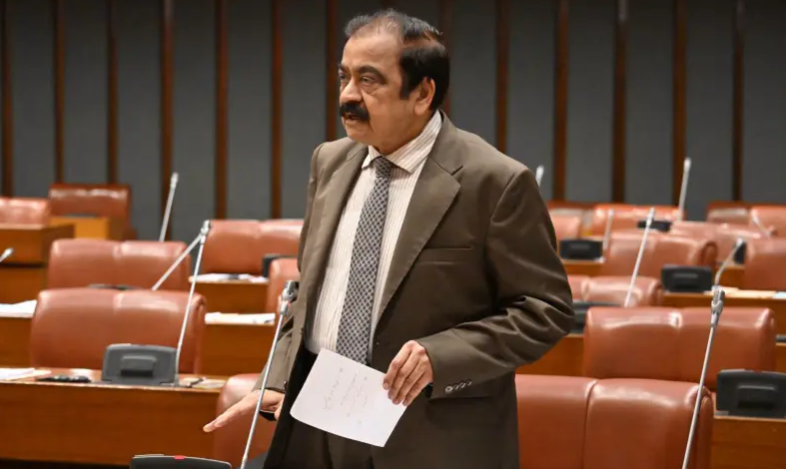
Prime Minister Shehbaz Sharif is prepared to engage opposition parties in talks to develop a national consensus on counterterrorism, provided they are willing to participate, Pakistan Muslim League-Nawaz (PML-N) leader Rana Sanaullah told the Senate.
Sanaullah urged political parties to set aside their other demands and unite against terrorism, stressing that national security should take precedence over political differences.
“If all parties are willing to sit together and discuss this issue, Prime Minister Shehbaz Sharif is ready to invite them and work out a way forward on counterterrorism, including how the entire nation can support security operations,” he said.
His remarks come amid heightened political tensions following the federal government’s imposition of emergency measures and governor’s rule in Khyber Pakhtunkhwa (KP) on October 11. The Centre justified the decision by accusing the Pakistan Tehreek-e-Insaf (PTI)-led provincial government of deliberately disengaging from counterterrorism efforts. Parliament subsequently endorsed the measures amid strong opposition protests.
During his Senate address, Sanaullah criticised National Assembly Opposition Leader Mehmood Khan Achakzai, questioning his refusal to meet the prime minister and his reported reluctance to sit with him in the National Assembly speaker’s chambers.
He noted that Achakzai’s appointment as opposition leader had been approved by the speaker, yet he was unwilling to recognise the speaker’s authority, according to Sanaullah.
The PML-N leader also condemned what he described as opposition propaganda against the military leadership, expressing grief over the martyrdom of an army officer a day earlier.
Addressing opposition members, he criticised their remarks against the head of the military institution and called for greater responsibility amid the country’s security challenges.
Sanaullah further accused members of the now non-functional PTI-led KP government of failing to participate regularly in apex committee meetings. He claimed that the provincial chief minister had attended only one such meeting in 11 months and referred to earlier remarks by Interior Minister Mohsin Naqvi about the circumstances surrounding that attendance.
Recalling recent negotiations between the federal government and the PTI, Sanaullah said both sides had agreed to establish a political committee comprising representatives from each camp. However, he maintained that the talks collapsed over a disagreement concerning the PTI’s role in supporting federal counterterrorism efforts.
Federal Minister for Parliamentary Affairs Tariq Fazal Chaudhry also renewed the government’s invitation to opposition parties to develop a joint strategy against terrorism.
Speaking to the media, Chaudhry said Pakistan’s peace and the future of its children depended on a united national response to the threat.
He questioned why political parties could not reach an agreement on an issue of such importance, urging them to place the national interest above political differences.
Chaudhry argued that efforts to curb terrorism in KP could not succeed without full cooperation between the provincial administration, federal institutions, the Pakistan Army and security agencies.
He accused the provincial government of failing to cooperate with the Centre on Afghanistan-related policy, particularly measures aimed at preventing cross-border infiltration. He described this lack of cooperation as the principal reason behind the imposition of emergency measures in the province.
The minister also criticised the PTI for what he described as its reluctance to condemn terrorism, arguing that the party’s position was particularly significant given its previous tenure in power in KP.
He attributed the persistence of terrorism in the province to networks associated with militant groups, smuggling operations and influential figures allegedly providing them with support.
However, Chaudhry said the provincial government was now cooperating with the relevant authorities and expressed hope that the improved coordination would produce results. He added that counterterrorism operations would continue until the threat was eliminated.
Rejecting suggestions that the federal government’s decision was motivated by a political struggle for power, he insisted that restoring peace was the primary objective.
“This is not a power game; it is a peace game,” he said.
Chaudhry also disclosed that advisory councils comprising tribal elders had been established in 12 districts. He said the councils were intended to strengthen community participation and support intelligence-based operations through consultation with local residents.
Drawing a comparison with Balochistan, he praised the provincial administration and Chief Minister Sarfraz Bugti for working alongside federal institutions and law enforcement agencies against terrorism. He said the Balochistan government had not refused to cooperate with the Centre, contrasting its approach with the situation in KP.
Relations between the federal government and the opposition had deteriorated in the days before the imposition of governor’s rule in KP. The tensions intensified after the PTI announced a protest march to Islamabad seeking the release of its jailed founder and former prime minister, Imran Khan.
Negotiations between the government and opposition also failed to produce an agreement. Counterterrorism policy was among the major points of disagreement, alongside disputes over the PTI’s demands and access to its incarcerated leader.
The PTI maintained that it was being excluded from decisions concerning security in KP, an allegation rejected by the federal government. The party called for a review of the country’s counterterrorism policy, while federal officials questioned the provincial government’s performance against militant groups and its position on engagement with the Afghan Taliban.
Following the emergency decision, the Centre also authorised the deployment of Pakistan Army troops and assets in KP in aid of civil power.
Federal ministers have additionally alleged that elements of the provincial administration maintained links with terrorist groups, arguing that the deteriorating security situation required extraordinary measures. These allegations have been disputed amid the broader political confrontation between the federal government and the PTI.
The government has continued to call for political unity against terrorism, while opposition parties have raised concerns over the measures taken in KP and their implications for provincial governance.