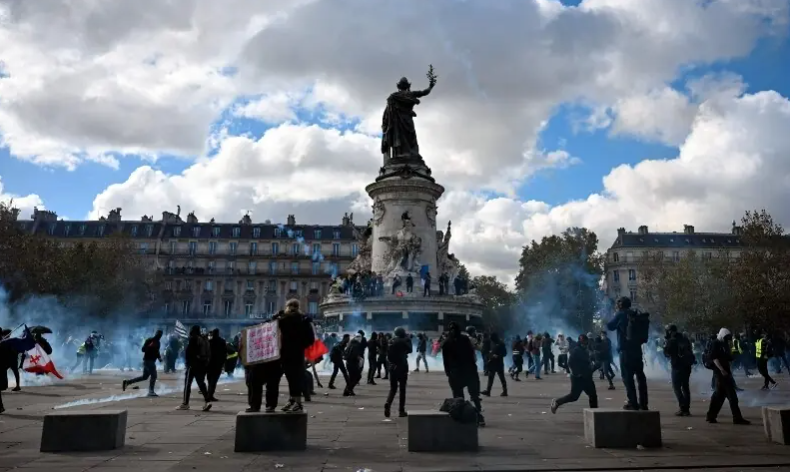
Escalating fuel prices and the growing cost of living are intensifying public discontent across Europe, triggering demonstrations and strengthening far-right political movements ahead of elections scheduled next year in France, Italy and Poland.
Economic pressures are increasingly driving voters to seek alternatives to established political parties. From motorists in rural France to young men in eastern Germany, sections of the electorate are turning towards political groups that promise changes to existing economic and energy policies.
The US-Iran war, which began in February and sent energy prices soaring, has further complicated the situation for European governments already struggling to control inflation, stimulate economic growth and manage public spending.
The growing frustration has spilled into the streets, with protests over living costs, public services, housing and employment reported across several countries.
In France, demonstrations initially sparked by deteriorating school facilities in the northern suburbs of Paris have escalated into some of the country’s most serious unrest in decades. Shops have been looted, buildings set ablaze and a 19th-century town hall in Limoges torched.
Quentin Leviloux, a 21-year-old demonstrator in Nantes, said the rising cost of everyday essentials had become frightening, particularly for people earning close to the minimum wage.
He pointed to the increasing prices of food, fuel and other necessities as a major source of public frustration.
According to estimates by the European Commission, the conflict involving Iran has cost Europe approximately $100 billion through disruptions to trade and energy markets. Gas prices have risen by around 140 per cent, while diesel prices have doubled.
French President Emmanuel Macron acknowledged protesters’ legitimate concerns over rising living expenses and fuel prices in a weekend address. However, he condemned violence, vandalism and looting, stressing that peaceful demonstrators should not be confused with those responsible for destruction.
Unrest has also intensified in other parts of Europe. In Milan, one of Italy’s wealthiest cities, police clashed with demonstrators who threw stones and looted shops during protests over inadequate public services and rising living costs.
In Gela, on Sicily’s southern coast, farmers say soaring fuel prices have made operating agricultural machinery increasingly unaffordable. One protest banner captured their financial difficulties with the message: “We cultivate the land, we harvest debts.”
Arcangelo Gambino, a farmers’ representative in Caltanissetta province, said the increase in fuel costs had brought agricultural activities to a standstill, with expenses more than doubling.
Roadblocks organised by truck drivers, farmers and steelworkers have disrupted transport in parts of southern Italy, contributing to local fuel shortages and concerns about the availability of goods in supermarkets.
In Portugal, tens of thousands of people marched through Lisbon on Saturday to protest low wages, expensive housing and the rising cost of living, putting additional pressure on the centre-right government.
Spain has also witnessed nationwide demonstrations over housing affordability after an 87-year-old woman was evicted from her home. The issue has intensified public anger over housing shortages and soaring rents ahead of a snap election scheduled for next month.
Belgium has experienced protests as well, while demonstrations in Albania have reflected widespread frustration over alleged government corruption, unemployment and shortcomings in education.
Political analysts say these developments point to a broader shift in European politics, with economic insecurity increasingly influencing voting behaviour.
Gilles Ivaldi, a political scientist at Sciences Po, said concerns over purchasing power had become a significant factor driving populist politics across the continent.
Both far-right and far-left politicians have also challenged Europe’s mainstream position on Russia, arguing that restoring energy ties with Moscow could help bring down prices. Such calls have put pressure on the established European consensus on support for Ukraine.
The latest energy crisis follows years of economic pressure caused by the Covid-19 pandemic and the consequences of Russia’s 2022 invasion of Ukraine.
In France, rising energy costs have become a major political issue ahead of next April’s presidential election. Macron’s government is also facing a widening budget deficit and growing scrutiny from bond markets.
Marine Le Pen of the far-right National Rally and veteran left-wing politician Jean-Luc Mélenchon have both made fuel prices a central feature of their political campaigns.
Ivaldi said the issue was particularly advantageous for Le Pen, who has long sought to appeal to voters struggling with transport and household expenses.
Since the outbreak of the Iran conflict, Le Pen’s polling figures have improved while Macron’s ratings have declined, according to polling conducted by Elabe.
Le Pen’s proposal to substantially reduce value-added tax on fuel has received considerable public support. Analysts say the policy is particularly appealing to her supporters in rural and semi-rural communities, where private vehicles are often essential for commuting and daily activities.
The issue has therefore become a powerful campaign tool for the National Rally as economic frustration grows.
In neighbouring Germany, the far-right Alternative for Germany (AfD) has taken the lead in national opinion polls following strong performances in regional elections.
The cost of living remained Germans’ leading concern for the fifth consecutive year, according to a survey published this month.
Inflation in Germany climbed to a nearly three-year high in September, while energy prices rose by 14.9 per cent, providing the AfD with further opportunities to criticise Chancellor Friedrich Merz’s government.
The party advocates restoring energy ties with Russia, arguing that Berlin’s support for Ukraine is harming Germany’s economic interests at a time when businesses and energy-intensive industries are struggling.
Jan Steckel, a professor specialising in the political economy of climate change at the Technical University of Munich, said previous experience suggested a connection between high energy prices and increased electoral support for the AfD.
He explained that populist parties frequently portray rising energy costs as the result of avoidable government decisions rather than wider geopolitical developments.
Such explanations can be politically effective because the underlying international factors behind energy price increases are often more difficult for voters to understand, he added.
The debate over restoring energy links with Russia is also gaining ground in other European countries.
In Italy, Prime Minister Giorgia Meloni faces increasing competition from National Future, a new far-right party led by former army general Roberto Vannacci. The party supports re-establishing gas connections with Russia.
In Poland, concerns over energy bills are contributing to growing support for the far-right Confederation of the Polish Crown, despite the country’s strong backing for Ukraine.
The party’s leader, Grzegorz Braun, has advocated resuming purchases of Russian oil and gas. He has made the argument alongside AfD politicians in Lubmin, Germany, where the damaged Nord Stream pipelines reach the German coast.
Braun used a provocative remark about Russian gas to underline his support for renewed energy imports from Moscow.
The growing popularity of such positions highlights the political consequences of Europe’s energy challenges. As households and businesses face higher costs, pressure is mounting on governments to deliver relief, while opposition movements are using economic frustration to challenge established policies on energy, Russia and Ukraine.
With important elections approaching, the cost of living and energy security are expected to remain central issues in political debates across the continent.