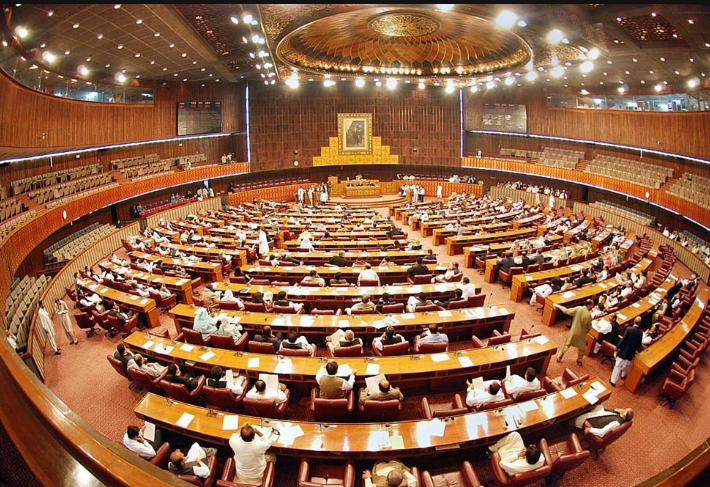
The National Assembly passed seven bills amid thin attendance, while a resolution condemning India’s alleged atrocities and unlawful actions in occupied Kashmir was deferred after an opposition lawmaker pointed out a lack of quorum, forcing the house to adjourn.
The legislation approved by the lower house included the Pakistan Study Centres (Amendment) Bill 2026, Federal Board of Intermediate and Secondary Education (Amendment) Bill 2026, Travel Agencies (Amendment) Bill 2026, Pakistan Tourist Guide (Amendment) Bill 2026, Pakistan Hotels and Restaurants (Amendment) Bill 2026, Motion Pictures (Amendment) Bill 2026 and National College of Arts Institutes (Amendment) Bill 2026.
During the proceedings, interim Pakistan Tehreek-e-Insaf (PTI) chairman Barrister Gohar Ali Khan rose to speak on a point of order. However, the speaker asked him to wait until the bills had been passed.
Subsequently, MNA Sohail Sultan drew attention to the lack of quorum, prompting the speaker to adjourn the session until 11am the following day.
Earlier, lawmakers expressed concern over the quality and relevance of answers provided during the question hour, particularly after Parliamentary Secretary Rabia Rahim responded to a query from MNA Syeda Amnah Batool regarding education policy.
The exchange triggered a debate over why questions were not being answered directly and why parliamentary secretaries were responding instead of the ministers responsible for the relevant departments.
Batool asked whether the government had a national strategy to align university degrees with labour market requirements. She also sought details about the number of universities offering skills-based education and whether mandatory internships or industry placements were being considered for selected degree programmes.
In response, Rahim said the government had introduced a policy under which the Higher Education Commission (HEC) would not verify the degree of a student who had failed to complete the required internship.
Another disagreement arose when MNA Shagufta Jumani sought information about the completion timeline and cost of the Neelum-Jhelum hydropower project. When a parliamentary secretary attempted to respond, the speaker objected, saying only the relevant minister or parliamentary secretary should answer questions related to their respective departments.
Federal Minister for Parliamentary Affairs Tariq Fazal Chaudhry cited parliamentary rules, arguing that parliamentary secretaries held ministerial status and were authorised to respond to questions on behalf of ministers.
The speaker questioned this arrangement, remarking that if parliamentary secretaries could handle the responses, there would be little reason for ministers to attend National Assembly sessions.
Law Minister Azam Nazeer Tarar acknowledged that ministers answering questions themselves would be preferable but clarified that the law permitted parliamentary secretaries to respond on their behalf.