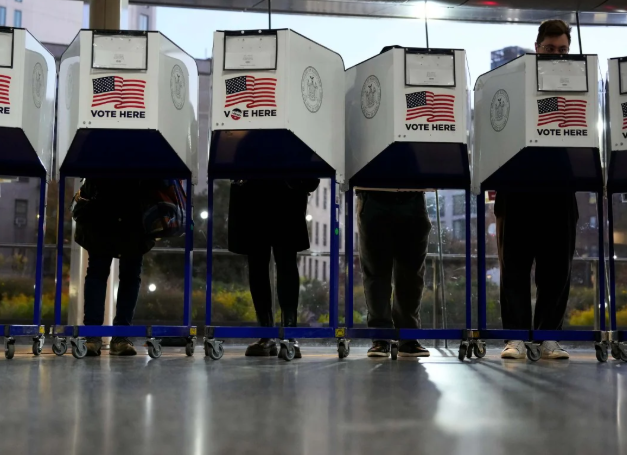
The outcome of the US midterm elections could significantly influence Washington’s relations with Beijing, as the Democratic Party’s increased control in Congress may limit President Donald Trump’s ability to pursue his foreign and trade policies during the remaining two years of his presidency.
Analysts believe the election results could affect US tariffs on Chinese imports, arms sales to Taiwan and the broader diplomatic relationship between the two global powers.
Democratic control of both chambers of Congress could create obstacles for Trump’s extensive use of tariffs against Chinese products, analysts say.
Trump had relied heavily on tariffs during the intense trade dispute between Washington and Beijing before both countries reached a temporary trade agreement, which is due to expire in January.
According to Wu Xinbo, Dean of the Institute of International Studies at Fudan University, restrictions imposed by Congress could weaken Trump’s ability to use tariffs as leverage in negotiations with China.
However, Democrats may face difficulties in challenging the tariff policy because of its support among certain American businesses, labour unions and small business owners.
Drew Thompson, a senior fellow at Singapore’s S. Rajaratnam School of International Studies, said Democrats were likely to challenge several of Trump’s policies over the next two years.
He added that the party would need to carefully consider the economic consequences of further restrictions on Chinese imports, particularly for workers and businesses that traditionally support Democrats.
Foreign policy expert Patricia Kim of the Brookings Institution said Congress would be less likely to support measures that significantly increase tensions with China if they risk raising costs for American consumers and businesses or increasing the possibility of military confrontation.
Taiwan is another major issue that could influence relations between Washington and Beijing following the US midterm elections.
China considers Taiwan part of its territory, while the United States remains the island’s key security partner and has supplied it with billions of dollars’ worth of military equipment to strengthen its defence capabilities.
However, Trump raised questions about Washington’s position in May when he suggested that arms sales to Taiwan could be used as a bargaining tool in negotiations with Beijing.
His administration has also delayed a $14 billion weapons package for several months.
Neil Shearing, Group Chief Economist at Capital Economics, warned that China could use the remaining years of Trump’s presidency to increase pressure on Taiwan, particularly if Beijing believes Washington is politically distracted or unwilling to intervene in a potential conflict.
Despite pressure from Democrats and some Republican lawmakers, Trump has so far resisted approving the delayed arms package.
Wu Xinbo suggested that a Democrat-controlled Congress could pressure the president to resume arms sales to Taiwan next year, a move that could further strain US-China relations.
However, Steve Tsang, Director of the SOAS China Institute, offered another perspective, suggesting that stronger American congressional support for Taiwan could encourage Beijing to adopt a more cautious approach towards the island.
Thompson noted that although Congress could introduce legislation requiring the administration to approve arms sales, the president would retain the authority to veto such measures or decline to implement them.
Despite Trump’s weakened political position following the midterm elections, analysts believe Beijing is unlikely to abandon its efforts to maintain direct engagement with the US president.
Patricia Kim said China would probably continue pursuing high-level diplomatic engagement with Trump and Chinese President Xi Jinping, viewing direct communication between the two leaders as a relatively cost-effective way to manage bilateral relations.
She added that neither Washington nor Beijing appeared to be expecting or actively pursuing a fundamental improvement in their relationship.
Steve Tsang, meanwhile, suggested that China could use Trump’s weakened political position to increase diplomatic pressure on his administration.
However, he noted that Beijing would likely remain cautious to avoid provoking unpredictable decisions from the US president.
The developments indicate that the US midterm election results could influence several key areas of US-China relations, including trade negotiations, Taiwan’s security and diplomatic engagement, during the final years of Trump’s presidency.