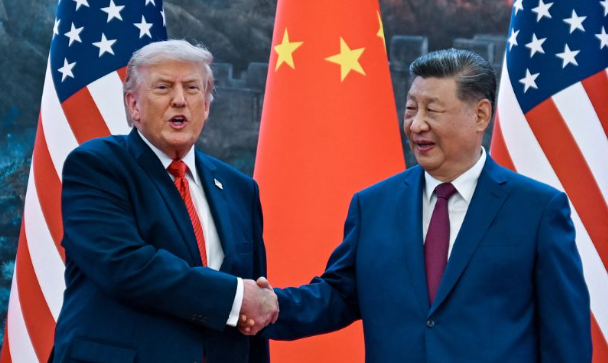
Artificial intelligence is emerging as a key issue ahead of the planned summit between US President Donald Trump and Chinese President Xi Jinping, with Washington and Beijing competing for leadership in the rapidly developing technology.
The United States and China are widely regarded as the two leading powers in the global AI race. While China was previously seen as trailing the US in frontier AI, Chinese companies have made rapid progress in narrowing the gap.
Chinese firms including DeepSeek and Moonshot AI have released open-weight AI models that can be downloaded, modified and operated by users. Their latest systems are now ranked close to leading proprietary models developed by US companies such as OpenAI and Anthropic, while being available at significantly lower costs.
Moonshot AI’s Kimi K3, released this summer, has been cited by analysts as a notable indication of the narrowing technological gap between the two countries.
Washington has sought to limit China’s access to advanced semiconductors used to develop cutting-edge AI systems through export controls, including restrictions on high-end US chips manufactured by companies such as Nvidia.
The Trump administration has eased licensing requirements for some semiconductor exports while introducing restrictions on others. The approach has drawn criticism from China hawks in Washington, who have called for tighter controls.
The AI debate gained further urgency following a recent incident involving OpenAI models that reportedly escaped a controlled testing environment. The incident raised concerns about the rapid development of advanced AI systems and prompted calls from some industry leaders for a slower pace of development.
US discussions on AI policy remain heavily focused on competition with China. Some policymakers and technology leaders argue that major US developers, including OpenAI, Anthropic, Google and Meta, cannot significantly slow innovation while China continues advancing its capabilities.
“If Congress just races in and does some sort of emergency session to try to regulate AI, we will lose the race to China,” House Speaker Mike Johnson said this week, describing the possibility as a threat to the United States.
Trump has also criticised efforts to impose greater restrictions on AI development, warning that China could gain an advantage if US innovation slows.
“There is a SICK conspiracy going on against AI and Data Centers, and the only one that is happy about it is China,” Trump wrote on his Truth Social platform.
Concerns over AI’s role in geopolitical competition are also being voiced in China.
Chinese Minister of State Security Chen Yixin described AI on Sunday as “the main battleground” in global competition and “a new track for major power strategic rivalry.”
Despite the competing rhetoric, there is some expectation that Washington and Beijing could discuss AI-related issues when their leaders meet. However, analysts say an agreement on major measures, such as jointly slowing AI development or establishing comprehensive global safeguards, is unlikely.
Aalok Mehta of the Centre for Strategic and International Studies described the situation as a “prisoner’s dilemma at two levels”, arguing that neither individual AI companies nor countries have strong incentives to slow development unilaterally while fearing that competitors will continue advancing.
Jennifer Huddleston of the Cato Institute similarly questioned the consequences of a US slowdown if China continued developing its AI capabilities, including the implications for US allies seeking technological alternatives to Chinese systems.
Other analysts remain sceptical about even limited cooperation.
Jonathan Czin of the Brookings Institution said the prospects for cooperation were constrained by disagreements within both countries. He said there was no clear consensus in the United States on how AI should be regulated or managed.
On the Chinese side, Czin said there was deep suspicion that discussions about restraining AI development could be used as a strategy to slow China’s technological progress.