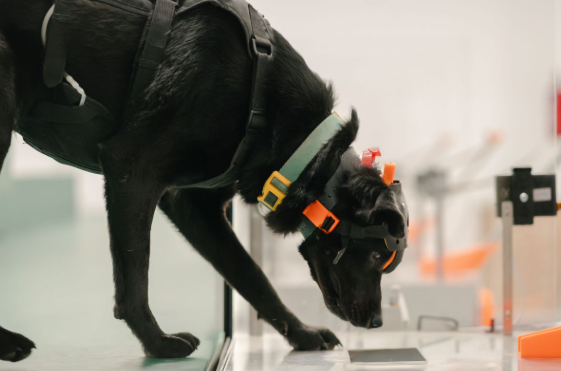
Rescue dog Chloe is part of an experimental effort in India to harness dogs’ powerful sense of smell for cancer detection, with artificial intelligence being used to analyse their responses to human breath samples.
At a farm outside Bengaluru, Chloe wears a 3D-printed helmet and harness fitted with sensors as she is trained to identify scents associated with cancer.
The Bengaluru-based startup Dognosis is combining trained dogs with AI to analyse their brain activity, breathing patterns and body language, converting their responses to scents into data.
Dognosis co-founder Akash Kulgod said dogs can perform thousands of sniffs in an hour, with each sniff potentially helping assess a sample.
Research around the world has indicated that dogs can be trained to detect cancer and other diseases, including Parkinson’s disease and Covid-19. Scientists believe illnesses can alter chemicals released by the human body, producing distinctive odours that dogs may be able to identify.
Dogs have about 300 million scent receptors, compared with roughly five million in humans, making their sense of smell particularly sensitive.
The testing process developed by Dognosis is designed to be non-invasive. Patients breathe into a cotton mask for around 10 minutes before it is sealed in a bag and sent to a laboratory for analysis. The patients do not come into direct contact with the dogs.
Dognosis recently conducted a study involving more than 1,500 participants across six hospitals in Karnataka. The company said the study recorded an accuracy rate of more than 90 per cent across seven major types of cancer. The findings were published in the Journal of Clinical Oncology, and the startup plans to conduct further trials in real-world settings.
Cancer specialists not involved in the project have welcomed the early findings but urged caution. Santhosh Kumar Devadas, head of oncology at Ramaiah Memorial Hospital, described the study as promising but said larger trials would be required before firm conclusions could be drawn.
Neelesh Reddy, a senior consultant oncologist at Manipal Hospitals, also said further evidence would be needed to determine how useful the technology would ultimately be for patients.
Early diagnosis can significantly improve cancer outcomes, but many patients in India are diagnosed only after the disease has progressed. Dognosis says its technology could eventually provide an affordable and accessible first-stage screening method to identify people who may require further medical testing.
The startup, which is backed by venture-capital firms including Accel India, is working with government medical institutions as it seeks commercial approval. It hopes to launch the technology commercially next year.
Around 15 dogs are currently being trained by Dognosis, most of them beagles along with Malinois and Shepherd mixes. The animals are selected through adoption or legal breeders and trained using positive reinforcement.
At the company’s training centre, dubbed “Sniffspace”, dogs examine human samples on platforms equipped with automatic feeders that dispense treats as rewards.
Co-founder Itamar Bitan, a former member of an Israeli special-forces canine unit, said the dogs respond differently when they identify a target scent. Some run towards the feeder, while others freeze or scratch the sample.
The company says its AI system focuses on consistently interpreting the dogs’ reactions rather than relying on a single behavioural response.
Dognosis says the dogs work only around 30 to 45 minutes a day, allowing them to maintain what Kulgod described as a healthy “work-life balance”.
The startup aims to use the combination of canine scent detection and AI to develop a scalable tool for early cancer screening while also advancing understanding of human-canine communication.