
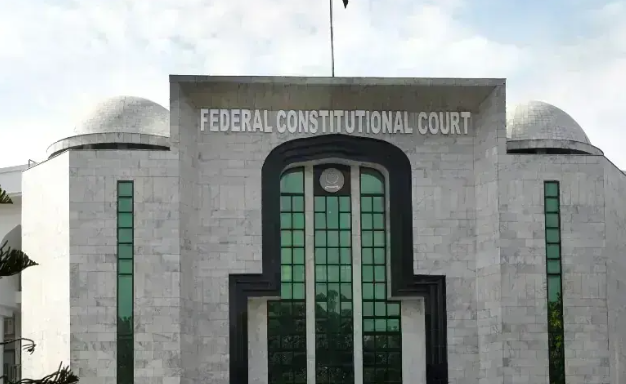
The Federal Constitutional Court (FCC) has observed that prison rules clearly establish the procedure for transferring inmates to hospitals, while hearing petitions filed by prisoners at Adiala Jail seeking treatment at private medical facilities.
The petitions were filed after the Supreme Court (SC) on Aug 18 directed authorities to transfer PTI founder Imran Khan to Shifa International Hospital for medical examination and treatment.
The prisoners had initially approached the Islamabad High Court (IHC), seeking similar relief. However, the IHC dismissed their petitions on Aug 31, ruling that prisoners do not have a legal right to be transferred to a private hospital of their choice. It held that responsibility for prisoners’ healthcare primarily rests with the state administration and government hospitals.
The inmates subsequently challenged the IHC decision before the FCC.
A three-member FCC bench headed by Chief Justice Aminuddin Khan, with Justice Ali Baqar Najafi and Justice Aamer Farooq, heard the petitions on Monday.
Advocate Akhtar Cheena represented prisoner Muhammad Ilyas Khan, while Mohammad Ismail Hussain and Owais Altaf were represented by Advocates Irfan Nasir Cheema and Syed Jaffer Baqir, respectively.
During the hearing, Justice Najafi questioned whether prisoners were being treated differently despite the provisions of the jail manual.
Justice Farooq asked why inmates were seeking treatment specifically at private hospitals instead of facilities such as the Pakistan Institute of Medical Sciences (Pims) or Poly Clinic Hospital, noting that Rule 197 of the Pakistan Prison Rules, 1978, provides a clear framework for transferring prisoners.
The rule sets out the procedure for transferring a prisoner to a hospital, with the associated expenses to be borne by the state.
When Advocate Cheena referred to the Supreme Court’s Aug 18 order concerning Imran Khan, Chief Justice Aminuddin Khan questioned why the lawyer had not sought to become a party to the related proceedings before the SC. The case is scheduled for hearing on Sept 16.
Cheena maintained that the current appeal had been filed under Article 175E of the Constitution against the IHC decision.
Article 175E gives the FCC original jurisdiction over disputes between the federal and provincial governments, with its authority limited to issuing declaratory judgments rather than directly enforcing decisions.
The counsel argued that similar relief had become necessary for other inmates following the Supreme Court’s Aug 18 order.
The FCC adjourned further proceedings until Sept 15, observing that the case involved interpretation of the relevant law.
One of the petitions argued that Rule 197 allows prisoners to be transferred to a civil hospital and challenged the government’s interpretation that the provision referred only to public hospitals.
The petition further argued that the wording distinguished civil hospitals from military and government hospitals. It claimed that, in light of the Supreme Court’s Aug 18 order, seriously ill prisoners should also be allowed to receive treatment at private hospitals, with the cost borne by their families.
The petitioner said the inmate suffered from severe internal bleeding and had been taken to a public hospital eight times during the previous two months.
The petition also expressed concern over the capacity of the public healthcare system to provide the required medical treatment.