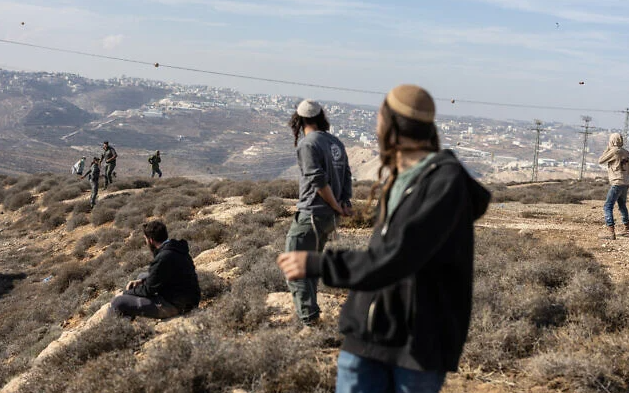
Israeli police have arrested 10 people suspected of involvement in recent attacks by Israeli settlers against foreign nationals in the occupied West Bank, marking an uncommon enforcement action amid growing international concern over settler violence.
Police said officers conducted raids at multiple locations across the occupied territory before dawn, seizing vehicles and potential evidence connected to the incidents.
Major General Moshe Finchi, the Israeli police commander responsible for the West Bank, said the operation followed a series of serious violent incidents over the weekend, including an assault on a media worker and suspected attacks on foreign civilians.
According to Finchi, those arrested are suspected of participating in violent incidents, violating military orders governing a restricted military zone and engaging in illegal construction.
Witnesses have reported an increase in attacks by Israeli settlers against Palestinians during the ongoing olive harvest, a season of considerable cultural and economic importance for Palestinian communities. Residents and activists say the violence is being used to intimidate Palestinians and take control of their land.
Israeli human rights organisation Yesh Din reported documenting 561 incidents of violence involving settlers or Israeli military personnel against Palestinians since September 27, averaging more than 26 incidents daily.
Rights groups have repeatedly criticised Israeli authorities for what they describe as a lack of accountability when Palestinians are victims of settler violence.
Prime Minister Benjamin Netanyahu, who is seeking to maintain political support ahead of a closely contested election, has faced criticism over his response to the recent attacks. His efforts to retain backing from Israel’s pro-settlement right wing have added to scrutiny of his government’s approach.
Netanyahu has questioned accounts of the incidents and suggested that Palestinian groups and far-left activists were contributing to tensions.
His remarks have prompted unusually strong criticism from opposition figures, who accuse him of damaging Israel’s international reputation.
US Ambassador to Israel Mike Huckabee, a strong supporter of Israel, condemned the beating of veteran photographer Heidi Levine on Friday, describing it as an act of terror and calling for those responsible to face punishment. He subsequently welcomed the arrests as a positive development.
Levine, 65, was reporting for The Washington Post when she was allegedly attacked by Israeli settlers. She was hospitalised with fractured vertebrae.
Israeli President Isaac Herzog and centre-left opposition leader Yair Golan visited her in hospital.
Following his visit, Golan said on social media that, if he came to power, he would work to end what he described as a situation in which Jewish supremacist violence terrorises others and damages the state of Israel.
The violence extended beyond the attack on Levine. A day later, Israeli settlers allegedly assaulted a convoy carrying European diplomats, including the French and Belgian consuls general in Jerusalem, as it travelled through the West Bank town of Taybeh on Saturday.
During the same incident, Bernard Baudoux, the 78-year-old mayor of Aulnoye-Aymeries in northern France, was reportedly beaten while taking part in an olive-harvesting goodwill visit. Baudoux was wearing a sash bearing the French tricolour at the time.
Netanyahu subsequently questioned the circumstances surrounding both incidents. Regarding Levine’s assault, he alleged that Palestinians and far-left activists were encouraging violence.
Concerning the attack on the diplomatic convoy, he highlighted the mayor’s support for the Palestinian cause and said the visiting diplomats should have coordinated their movements with the Israeli military.
Meanwhile, Riley Barnes, the senior human rights official at the US State Department, visited Taybeh on Sunday during a trip coordinated with the Israeli military. He was not harmed.
Growing international concern over settler attacks has also prompted strong criticism from British officials. British Foreign Secretary Ed Miliband accused Israel of pursuing an ethnic-cleansing campaign and referred to British sanctions targeting goods originating from Israeli settlements.
On Monday, as Israel’s deadline approached for accepting construction tenders for the proposed E1 settlement project, Miliband warned businesses about the potential legal and reputational risks of involvement.
The proposed development has raised concerns among Palestinians that it could divide the occupied West Bank into separate areas and undermine the prospects for a viable Palestinian state.
Miliband warned that companies could face serious consequences, including exposure to allegations of involvement in major violations of international law.
Israeli Foreign Minister Gideon Saar rejected the criticism, accusing the British government of maintaining what he described as an excessive preoccupation with Israel.
Saar said Israel would no longer quietly accept threats, sanctions or attempts by other governments to dictate its policies.