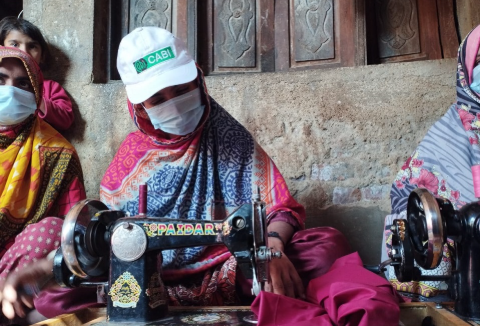
A physically challenged fashion designer has been working to equip underprivileged and housebound young women in Khyber Pakhtunkhwa with skills aimed at helping them achieve financial independence.
Having moved to Peshawar with her family several years ago, Ms Hasnin has devoted herself to teaching practical skills to young women who have limited access to formal education and vocational training.
Despite her own physical disability, she travels on foot to different neighbourhoods each day to provide training in garment designing, fabric manipulation, surface embellishment and traditional crafts.
Her voluntary initiative seeks to bring marginalised women into the economic mainstream by equipping them with skills that can help them earn a sustainable income. However, the lack of a dedicated training facility, equipment and basic teaching resources has limited the expansion of her programme.
“A fashion designer is someone who has the skills to design clothes for women, men and children,” Ms Hasnin said, adding that she had six years of experience in fashion designing and forecasting consumer trends.
She said her primary objective was to pass on her technical expertise to young women who lacked access to formal education or institutional training.
A graduate of Iqra National University, Ms Hasnin has expertise in concept sketching, draping, screen printing and patchwork. She also provides training in traditional handicrafts as well as modern digital design techniques.
She said professional fashion designing involved preparing sketches of clothes and accessories, monitoring market trends, coordinating creative teams and working with buyers to develop finished products.
“I want these young girls to master these same skills so they can generate sustainable incomes of their own,” she said.
Ms Hasnin urged parents of children with disabilities, particularly girls, to provide them with education and vocational training so they could become financially independent.
“When special persons are economically empowered, they can defend their rights, earn a respectable livelihood and avoid depending on others,” she said.
She plans to establish a permanent vocational centre, extend her training network to adjoining tribal districts and establish an artisan brand run by her students.
She said the long-term goal was to create an inclusive production hub where disabled and housebound women could design, produce and market their own products.
“With proper institutional support, we can turn these talented young women into successful fashion entrepreneurs who contribute to the national economy,” she added.