
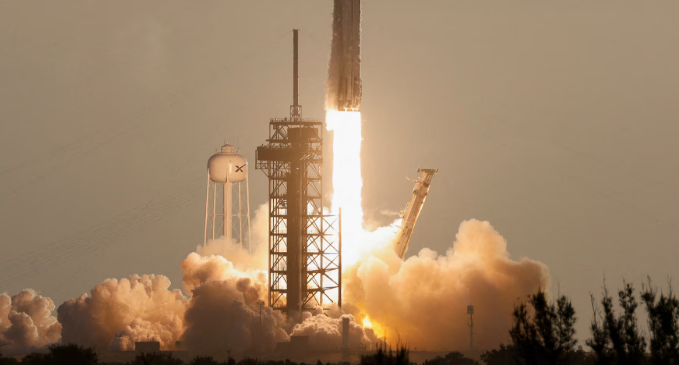
WASHINGTON: NASA launched its new flagship space telescope on Sunday, beginning a multi-year mission aimed at producing an unprecedented map of the universe and investigating some of the biggest unanswered questions in modern physics.
The Nancy Grace Roman Space Telescope, designed to survey vast areas of space, is expected to provide scientists with new insights into the structure and evolution of the cosmos.
US President Donald Trump said on Friday that the telescope would help scientists “unlock the secrets of the universe” during a ceremony at NASA headquarters in Houston.
The 12-metre-high observatory was launched from Kennedy Space Center in Florida aboard a SpaceX Falcon Heavy rocket.
Developed over more than a decade at a cost exceeding $4 billion, the telescope is named after American astronomer Nancy Grace Roman, who played a key role in establishing NASA’s space astronomy programme and became known as the “Mother of Hubble”.
While the Hubble Space Telescope helped establish that the universe is expanding at an accelerating rate, Roman will focus on several other major scientific questions, including the nature of dark matter and dark energy.
“Roman will give the Earth a new atlas of the universe,” NASA administrator Jared Isaacman said in April while unveiling details of the mission.
Roman has a field of view more than 100 times wider than Hubble’s and significantly broader than that of the James Webb Space Telescope. It will survey large portions of the sky from a position about 1.5 million kilometres from Earth, a journey expected to take roughly 100 days.
The telescope will work alongside other major observatories, including the James Webb Space Telescope, which provides greater sensitivity and precision for detailed observations.
Scientists expect Roman to identify thousands of exoplanets and tens of thousands of supernovae, the powerful explosions associated with the deaths of massive stars.
Roman technical manager Dave Content told AFP that the mission could produce the largest catalogue of astronomical objects ever compiled and help scientists determine how common planetary systems similar to our own are.
The telescope will also investigate dark matter and dark energy, two poorly understood components believed to account for around 95 per cent of the universe.
Dark matter is thought to provide much of the gravitational structure that holds galaxies and other cosmic systems together, while dark energy is associated with the accelerated expansion of the universe.
Using infrared observations, Roman will detect light from celestial objects that travelled for billions of years before reaching the telescope. This will allow scientists to study the universe’s distant past and improve their understanding of its evolution.
Roman’s observations will complement research being conducted by the Rubin Observatory in Chile and the European Space Agency’s Euclid mission.
Scientists are particularly interested in the telescope’s findings because they could provide new evidence about the structure of the universe and potentially challenge existing theories about how the cosmos has evolved.