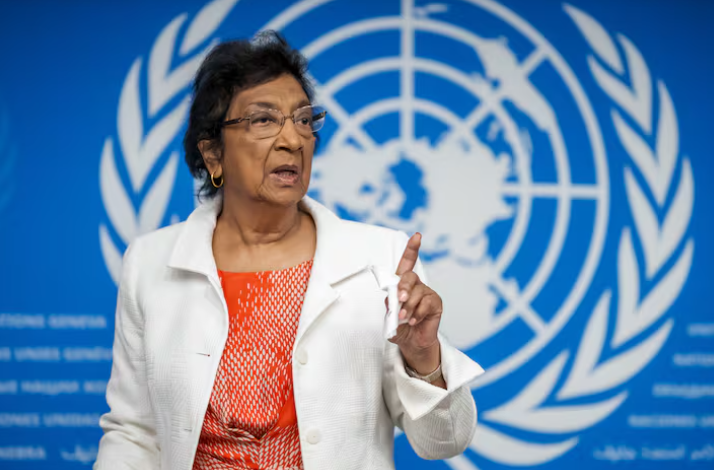
Navi Pillay, an 85-year-old South African human rights advocate and former United Nations High Commissioner for Human Rights, has built an influential international career spanning South African courts, the International Criminal Court (ICC) and the International Criminal Tribunal for Rwanda.
She gained international recognition for her outspoken criticism of government crackdowns on popular protests across the Arab world, including in Libya and Syria.
From 2021 to 2025, Pillay chaired a commission of inquiry established by the UN Human Rights Council to investigate the root causes of the Israeli-Palestinian conflict.
The commission, which operates independently and does not represent the United Nations as a whole, faced strong criticism from Israel. In 2025, Pillay told AFP that genocide was taking place and continuing in Gaza, holding the Israeli state responsible.
Pillay currently serves as an ad hoc judge at the International Court of Justice (ICJ) in a case examining whether Myanmar’s actions against the Rohingya violated the 1948 UN Genocide Convention. A ruling in the case is expected in the coming months.
Born in 1941 in Durban, South Africa, to a family of Tamil descent, Pillay grew up in a poor neighbourhood under the country’s apartheid system. Her father worked as a bus driver.
She studied law at the University of Natal before earning a master’s degree and a doctorate from Harvard University.
In 1973, Pillay secured legal representation for political prisoners held at Robben Island prison, where anti-apartheid leader Nelson Mandela was also incarcerated.
Following South Africa’s first democratic elections in 1994, she made history in 1995 by becoming the first woman of colour appointed to the country’s High Court.
Mandela later recommended her for a position at the United Nations International Criminal Tribunal for Rwanda, which prosecuted individuals responsible for the 1994 genocide.
In 1998, Pillay served among the judges who established a landmark legal precedent by recognising rape as an act of genocide in the tribunal’s proceedings.
A decade later, she was appointed UN High Commissioner for Human Rights, serving from 2008 to 2014. During her tenure, she became a prominent international voice on human rights violations, discrimination and government repression.
Pillay has attributed her commitment to fighting discrimination to her experiences growing up under apartheid, a system marked by racial segregation and institutionalised oppression.
In a 2023 interview with AFP, she recalled experiencing racial discrimination and mistreatment in South Africa, saying such experiences could either weaken a person or motivate them to resist injustice.
She said she had developed the confidence to confront discrimination by speaking out against it, a principle she continued to uphold during her work at the United Nations.
Her career has focused on defending vulnerable communities, challenging abuses of power and holding governments accountable for human rights violations.
Pillay married lawyer Gaby Pillay in 1965. He was a political prisoner whom she represented and who had suffered torture during detention under apartheid.
The couple later divorced, and Gaby Pillay died in the late 1990s. They had two daughters.
Throughout her career, Navi Pillay has remained a prominent figure in international human rights advocacy, contributing to legal precedents and investigations that have shaped global discussions on accountability, discrimination and justice.