Hundreds of Nepali migrant workers remain stranded in Saudi Arabia after security-related flight disruptions disrupted their travel plans, leaving many uncertain about when they will be able to return home for the Tihar festival.
Ganesh Rai, a Nepali worker preparing to travel home, had planned to leave Saudi Arabia shortly before Houthi rebels attacked King Khalid International Airport in Riyadh. The attack reportedly killed 13 people and injured more than 300, prompting the airport’s closure.
After learning that flights were operating from Jeddah, Rai travelled nearly 1,000 kilometres by bus, spending 13 hours on the journey and paying Rs7,000. However, he remains in a friend’s room, uncertain about when he can return home.
“I am neither in my company’s camp nor have I been able to reach home,” Rai said, adding that Dashain had already passed, Tihar was approaching and his approved leave was nearing its end.
Rai is among hundreds of Nepali workers whose journeys home have been disrupted. Between October 8 and 25, approximately 45 per cent of scheduled flights from Saudi airports were cancelled. At Riyadh’s King Khalid International Airport, cancellations reached 86 per cent.
Direct flights between Kathmandu and Dammam, frequently used by Nepali migrant workers, have also been suspended. Nepal Airlines and Himalaya Airlines have cancelled 18 scheduled services since October 11. Nepal Airlines operates weekly flights, while Himalaya Airlines runs two services per week. The latter has announced cancellations through November 4.
Around 400,000 Nepalis are employed in Saudi Arabia. According to Nepal’s Department of Foreign Employment, approximately 7,000 people receive labour permits, including renewals, every month. A total of 8,366 permits were issued between mid-September and mid-October.
The Nepali Embassy in Riyadh said workers whose employment contracts have expired are facing particular difficulties. It has urged employers to provide affected employees with food and accommodation until they can return home.
Although the embassy has no official count of stranded workers, it has received an increasing number of inquiries about available flights and alternative airports.
Labour counsellor Kabiraj Upreti said the embassy was assisting workers and responding to questions about travel arrangements.
Flight cancellations have affected several Saudi airports. Between October 8 and 25, 4,071 of the 4,736 flights scheduled at Riyadh airport were reportedly cancelled. The cancellation rate stood at 42 per cent in Dammam and 46.7 per cent in Abha. Nationwide, more than 7,800 flights, representing approximately 45 per cent of scheduled departures, were cancelled.
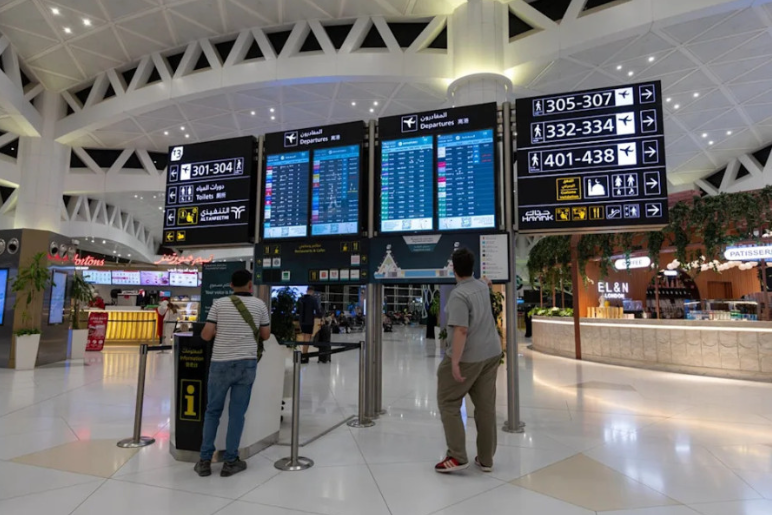
Saudi Arabia has 18 international airports. Although Riyadh airport has partially reopened, regular flight operations have yet to resume. Some Saudi carriers have restarted services, while several foreign airlines have reduced or suspended their operations. Airports in Jeddah and Dammam have also experienced cancellations and schedule changes.
Madhendra Rai, a Nepali worker in Dammam, said repeated cancellation notices had caused considerable mental stress. He complained that airlines were not providing clear information about refunds or alternative bookings.
He said passengers were often offered vouchers instead of refunds, while employers promised to explore alternatives only after cancellations were confirmed. The repeated changes, he added, were delaying workers’ reunions with their families.
Alternative routes through Air Arabia, flydubai and Indian carriers have also become difficult to secure. According to Rai, one-way tickets have reached Rs100,000, significantly increasing the cost of returning home.
Another Nepali worker, Dilip Baraili, said repeated cancellations had left passengers uncertain about their travel arrangements. He urged authorities to recognise the difficulties faced by overseas workers who save for months to celebrate festivals with their families.
Poor communication has further increased travel expenses. Ganesh Rai said his October 25 flight with Himalaya Airlines was cancelled and rebooked for October 30, but the replacement service was also called off. He added that the travel agency was not responding to his calls and that each unsuccessful trip to the airport cost him approximately Rs2,000.
Nepal Airlines said it had suspended flights to ensure passenger safety, adding that services would resume once conditions in Saudi Arabia returned to normal.
The airline said affected passengers could change their travel dates without additional charges or receive full refunds. Himalaya Airlines also attributed its cancellations to aviation safety concerns but said it could not provide a confirmed date for resuming operations.
Umesh Pandey, a Nepali worker in Dammam, said he had been waiting for 18 days to return home. He is considering travelling by road to Qatar or Bahrain but remains uncertain about visa requirements and border immigration procedures.
He said workers were unfamiliar with travelling through these alternative routes and needed clear guidance before making arrangements.
The situation is particularly difficult for workers whose exit permits are approaching expiry.
Hemanta Thapa, a Nepali worker from Jhapa employed in Najran near the Yemeni border, said his flight had been cancelled after the regional airport was closed. He now fears missing the Tihar festival.
To catch a flight from Dammam, Thapa would have to travel approximately 1,400 kilometres, a journey that could take between 17 and 18 hours by road.
He said he had spent two years planning to return home for Tihar but remained uncertain about when Dammam airport would resume normal operations.
Thapa had already left his company after obtaining an exit permit, a process that took six months. If the permit expires before his departure, he will have to apply for a new one through the embassy, a process that could take another three months and require him to bear the expenses.
Nepali workers have urged their government to arrange alternative travel options through neighbouring countries, including Kuwait, Qatar and Bahrain.
Shailesh Upadhyay said the government should facilitate flights home from these destinations, identifying Bahrain as a particularly suitable option.
Balaram Thapa, president of the Non-Resident Nepali Association in Saudi Arabia, also called for transport arrangements between Dammam and Bahrain. He said the neighbouring country could be reached by bus or taxi and urged the government and airlines to arrange buses and direct flights to Nepal.
Security concerns have also increased among Nepali workers in Saudi Arabia, particularly those based in Dammam and Jizan. A drone attack on the Shaybah oil field reportedly killed a Nepali and a Filipino worker on October 22, while a Pakistani and an Indian worker were injured.
The Nepali Embassy has advised citizens to follow official security alerts and verify flight schedules before travelling to airports.
Nepal’s Foreign Ministry spokesperson Lok Bahadur Paudel Chhetri said the embassy in Riyadh and the Consulate General in Jeddah were closely monitoring flight operations and facilities available to Nepali citizens. He added that diplomatic officials remained in regular contact with workers and community representatives.
The government, he said, would take appropriate measures while prioritising the safety and convenience of Nepali citizens.
The disruption has extended beyond direct services between Saudi Arabia and Nepal, with several international carriers also cancelling or suspending flights to the Kingdom.
IndiGo has suspended services to Riyadh, Jeddah, Dammam and Medina until November 14. Air India and Air India Express have also suspended flights to Riyadh and Dammam until November 7.
Etihad Airways has cancelled some services from Abu Dhabi to Riyadh, Dammam and Jeddah through November 5. Air Arabia has also cancelled selected flights to Riyadh, Dammam, Abha and Taif, with no confirmed resumption dates announced.
Qatar Airways has suspended services to Riyadh and Dammam while reducing the number of flights to Jeddah. No new dates have been announced for the resumption of its Riyadh and Dammam services following October 24.
With flight schedules remaining uncertain and alternative routes becoming increasingly expensive, Nepali workers continue to face the prospect of missing another major festival with their families.