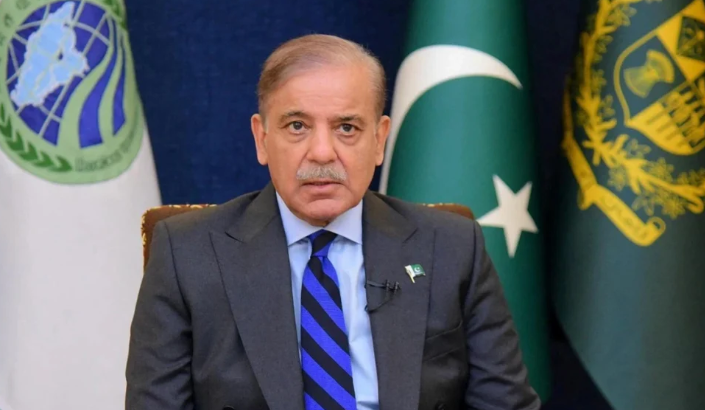
Prime Minister Shehbaz Sharif has condemned fresh Houthi attacks on Saudi Arabia, reaffirming Pakistan’s commitment to the kingdom’s sovereignty, territorial integrity and security under the Makkah Joint Defence Agreement.
The defence pact, which also includes Turkiye, was signed on August 7 to strengthen collective deterrence and establish the principle that an attack against one signatory would be treated as an attack against all members.
In a post on X, the prime minister condemned attacks targeting King Khalid International Airport in Riyadh and Abha International Airport, which reportedly resulted in civilian casualties.
He also praised the “vigilance and professionalism” of the Saudi armed forces and the Saudi-led coalition in Yemen for intercepting ballistic missiles.
Expressing “unwavering” solidarity with Riyadh, Shehbaz said Pakistan’s commitment to Saudi Arabia remained firm under the joint defence agreement and the recent decisions of its Strategic Political and Defence Committee.
“In line with the Makkah Joint Defence Agreement, and recent decisions taken by its Strategic Political and Defence Committee, our commitment to the Kingdom’s sovereignty, territorial integrity and security is resolute,” he said.
The prime minister added that Pakistan fully supported Saudi Arabia’s right to self-defence and urged the Houthis to immediately halt their attacks.
“We will continue to stand shoulder to shoulder with Saudi Arabia in the face of these threats,” he said.
On Thursday, Yemen’s Houthi group claimed responsibility for a ballistic missile strike targeting Riyadh’s main international airport, marking the latest attack on Saudi territory claimed by the group.
The attacks followed the Houthis’ announcement of a maritime blockade targeting the kingdom, including vessels operating in the Red Sea. Both sides have reported strikes against each other as tensions continue to escalate.
Saudi authorities said on Wednesday that three people had been killed and 36 injured in attacks targeting two international airports, including the facility in Riyadh. The casualties were reported after the Houthis claimed to have targeted both transport hubs.
Meanwhile, the Saudi-led coalition supporting Yemen’s internationally recognised government said it had destroyed the ballistic missile launch platform used in the attack on Riyadh.
The Houthis control much of northwestern Yemen and have been fighting Saudi-backed government forces amid renewed conflict. The fighting intensified in July, when the group captured large areas of coastal territory.
Yemen’s internationally recognised government announced a major counter-offensive this week, claiming its forces had pushed Houthi fighters out of strategic locations along the Red Sea and near the port city of Mocha.
The Houthis, however, maintain that they continue to hold their positions. Military sources from both sides have not reported any major changes on the ground.
Pakistan has repeatedly reaffirmed its support for Saudi Arabia amid the escalating conflict.
On October 5, Pakistan, Saudi Arabia and Turkiye agreed to facilitate the rapid deployment of military forces and capabilities in the kingdom during an emergency meeting of the Makkah Defence Alliance in Riyadh.
Defence Minister Khawaja Asif, who attended the meeting as part of Pakistan’s delegation, later said that Pakistan and Turkiye maintained a presence in the operational theatre, while Saudi forces were the only troops engaged in combat operations.
Speaking by telephone to Geo News’ programme Aaj Shahzeb Khanzada Kay Saath, Asif was asked about the potential operational role of Pakistan and Turkiye.
On September 18, Inter-Services Public Relations Director General Lieutenant General Ahmed Sharif Chaudhry said Pakistan was prepared to go to “any extent” to defend Saudi Arabia, describing Islamabad’s commitment to the kingdom’s security as “unconditional”.
Asif has also reiterated that Pakistan would support Saudi Arabia both practically and diplomatically if the conflict involving Yemen’s Houthi rebels escalated. He said Islamabad would fulfil its obligations under the Makkah Defence Alliance in accordance with the agreement’s terms.
Pakistan has also emphasised that the alliance is defensive in nature and designed to promote collective deterrence.