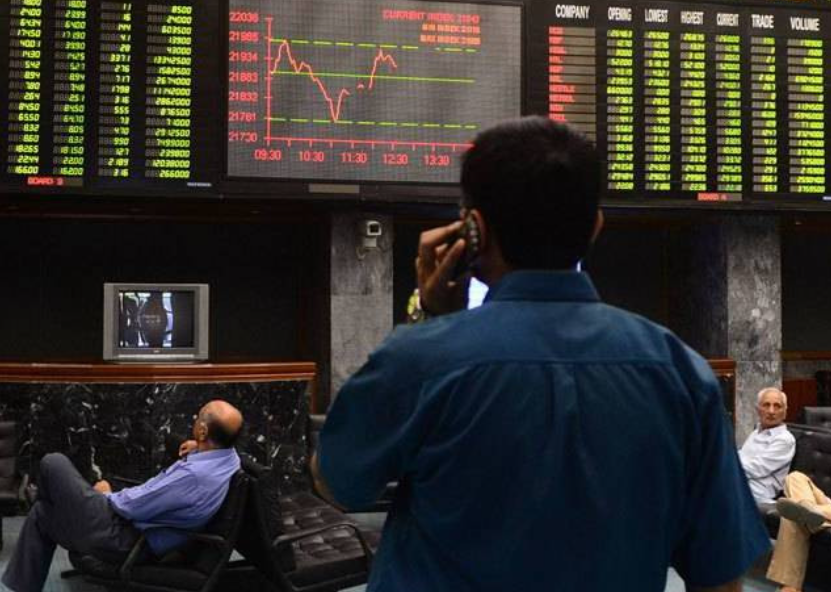
Pakistan’s benchmark KSE-100 index declined by 3,560 points, or 2.1 per cent, during October, closing the month at 166,409 points, according to Arif Habib Limited (AHL).
Topline Securities Limited attributed the monthly decline to geopolitical uncertainty, foreign portfolio outflows, profit-taking in heavyweight stocks and cautious investor sentiment amid volatility in international financial markets and domestic economic concerns.
However, the stock market staged a recovery towards the end of the month, supported by renewed diplomatic efforts to ease tensions between the United States and Iran, along with better-than-expected corporate earnings.
According to AKD Securities Limited, the KSE-100 index gained 4,034 points, or 2.5 per cent, during the outgoing week. Average daily trading volume surged 121 per cent to 1.095 billion shares.
Expectations of renewed diplomatic engagement, including Pakistan’s proposal for talks in Tehran between the Makkah Pact states and Iran, as well as reports of fresh US outreach to Tehran, contributed to the market’s recovery.
However, concerns over oil supplies following Houthi attacks on Saudi Arabia and tanker-related incidents near the Strait of Hormuz kept international crude prices elevated. Brent crude rose 0.7 per cent week-on-week to $117.10 per barrel on Friday.
On the domestic front, the State Bank of Pakistan (SBP) increased its policy rate by 50 basis points to 12 per cent on October 26, citing rising energy prices and geopolitical uncertainty and their potential impact on the inflation outlook. The increase marked the first rate hike since April.
Consumer Price Index (CPI) inflation eased to 10.26 per cent in September from 11.15 per cent in August. However, it remained significantly higher than the 5.76 per cent recorded in September 2025. The Finance Division projected inflation for October at 9.5 to 10.5 per cent.
Pakistan’s power generation increased 5 per cent year-on-year to 13,217 gigawatt-hours (GWh) in September, supported by higher generation from hydel, local coal, imported coal and wind sources.
Despite the increase in generation, average power generation costs surged 32 per cent year-on-year to Rs9.35 per kilowatt-hour. The rise was attributed to a greater reliance on re-gasified liquefied natural gas (RLNG), high-speed diesel and furnace oil, alongside elevated international oil prices. Consequently, distribution companies (Discos) sought a positive fuel cost adjustment of Rs2.56 per unit.
Meanwhile, the country’s current account deficit widened to $356 million in September, compared with $73 million in August.
Automobile sales also recorded a decline, falling 12 per cent year-on-year and 3 per cent month-on-month to 15,104 units, according to the Pakistan Automotive Manufacturers Association.
On October 8, Pakistan and the International Monetary Fund (IMF) reached a staff-level agreement on the fourth review of the $7 billion Extended Fund Facility (EFF) and the third review of the $1.4 billion Resilience and Sustainability Facility (RSF).
The agreement paved the way for the release of $1.21 billion, subject to approval by the IMF Executive Board.
The country’s liquid foreign exchange reserves stood at $26.8 billion as of October 23, comprising $21.5 billion held by the SBP and $5.2 billion maintained by commercial banks.
During the week, the central bank’s reserves increased by $33 million, while commercial banks’ holdings declined by $112 million. The country’s import cover remained at approximately three months.
The SBP also revised its foreign exchange reserve projections upwards, targeting $23 billion by December and $25 billion by June 2027. Its forecast for remittances in fiscal year 2027 was also increased to $45 billion from the earlier estimate of $44 billion.
In the fixed-income market, the government raised Rs1.8 trillion through treasury bills against a target of Rs1.7 trillion. Cut-off yields increased by 25 to 61 basis points across different maturities.
Strong corporate profitability provided some support to equities during the month. Companies accounting for 96 per cent of the KSE-100 index’s weight recorded a 26 per cent year-on-year increase in earnings to Rs1.638 trillion during the first nine months of calendar year 2026.
The growth was broad-based, with banking, fertiliser, cement, investment banking and exploration and production companies emerging as the leading contributors to the index’s weekly gains.
Fauji Fertiliser Company, MCB Bank, Engro Holdings, United Bank Limited and Oil and Gas Development Company were among the major positive contributors.
According to Topline Securities, average daily trading volume during October reached 600 million shares, representing a 27 per cent increase compared with the previous month. The average daily traded value also rose 19 per cent to Rs23 billion.
Meanwhile, petroleum prices continued to move upwards under the daily pricing mechanism. High-speed diesel prices increased by Rs8.90 to Rs400 per litre, while petrol prices rose by 85 paisa to Rs377.90 per litre on a week-on-week basis.
Market analysts expect investor sentiment to remain sensitive to developments in US-Iran relations and fluctuations in international oil prices.
AHL noted that the KSE-100 index was currently trading at a price-to-earnings ratio of 7.1 times, with a dividend yield of 7 per cent.