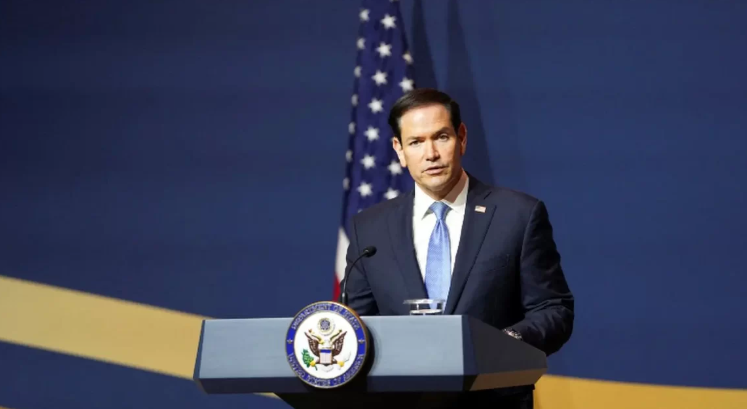
US Secretary of State Marco Rubio has acknowledged Pakistan’s concerns over terrorist attacks originating from Afghan territory, saying Washington is willing to play a constructive role in addressing tensions between Islamabad and Kabul if an opportunity arises.
Rubio made the remarks while responding to a question about escalating tensions between Pakistan and Afghanistan during a press interaction in Atlanta.
He said Pakistan had expressed concerns that terrorist attacks were being carried out from Afghan territory and believed the Afghan Taliban administration had not taken sufficient measures to prevent such incidents.
Rubio said Washington had taken note of Islamabad’s concerns and opposed terrorism regardless of its origin or intended targets.
He added that the United States did not maintain particularly close relations with the Afghan Taliban but remained aware of the attacks highlighted by Pakistan.
The US secretary of state said Washington did not want Pakistan to become a target of terrorism and would be willing to contribute constructively if it could help resolve the situation.
Islamabad has repeatedly called on the Afghan Taliban administration to take verifiable action against terrorist groups operating from Afghan territory, particularly the banned Tehreek-i-Taliban Pakistan (TTP), which Pakistan accuses of carrying out attacks inside the country.
The Afghan Taliban, however, have rejected allegations that their territory is being used to launch attacks against Pakistan and have avoided taking a clear public position on the TTP.
On Saturday, Pakistan’s Ministry of Information criticised the Afghan Taliban administration over what it described as its continued failure to address terrorist activities originating from Afghan soil.
The ministry’s response followed remarks by Afghan Taliban spokesperson Zabihullah Mujahid, who blamed Islamabad’s policies for preventing progress towards resolving bilateral tensions and maintained that Kabul was not responsible for the security challenges.
In its statement, the Pakistani ministry said the Afghan leadership was shifting responsibility to Islamabad while failing to address what Pakistan considers a major source of strained bilateral relations.
Islamabad reiterated that the Afghan Taliban’s alleged unwillingness to take action against militant groups remained a major obstacle to restoring normal relations between the two countries.
Several rounds of negotiations between Pakistan and Afghanistan, facilitated by Qatar and Turkiye last year, failed to produce a lasting agreement, with Islamabad maintaining that the Afghan side had not provided assurances on key security concerns.
Subsequent diplomatic efforts involving China also failed to achieve a breakthrough.
Meanwhile, Russia has renewed its offer to facilitate dialogue between the two countries if both sides request its involvement.
Moscow’s Special Envoy for Afghanistan, Zamir Kabulov, reiterated the proposal last month following the latest Moscow Format consultations on October 5, which concluded without a joint statement due to differences between Pakistani and Afghan Taliban representatives over references to militant groups operating from Afghan territory.
Responding to questions about possible Russian mediation, Foreign Office spokesperson Sajjad Haider Khan previously said that Pakistan’s engagement with Afghanistan could not be unconditional.
He rejected claims that Islamabad was unwilling to hold talks with Kabul, adding that Pakistan would welcome sincere diplomatic efforts by friendly countries to help resolve the dispute.
However, he said he was not aware of any separate formal Russian mediation initiative under consideration.
Meanwhile, tensions along the Pakistan-Afghanistan border have persisted, with intermittent exchanges of fire reported in recent months.
In September, fresh clashes erupted between the two sides, prompting Pakistan to carry out targeted airstrikes in border areas following terrorist attacks in Khyber Pakhtunkhwa.
Further incidents were reported in October, when Pakistani security forces responded to alleged unprovoked firing from across the Afghan border in Kurram and Angoor Adda in Lower South Waziristan, according to security sources.
The continued security incidents and lack of progress in diplomatic negotiations have further complicated efforts to restore stable relations between Islamabad and Kabul.