
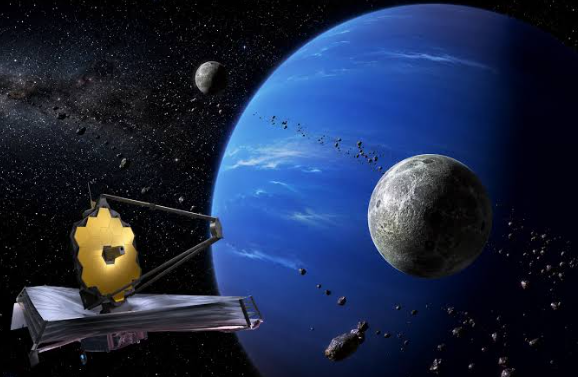
WASHINGTON: New observations of Neptune’s moons and rings suggest that a massive cosmic collision occurred billions of years ago around the solar system’s outermost planet, with a Pluto-sized object potentially triggering a violent celestial disruption.
Researchers using NASA’s James Webb Space Telescope have found evidence that Neptune’s moons and inner rings may be remnants of a massive cosmic catastrophe billions of years ago.
The study, published in Science Advances, examined Neptune’s small inner moons Proteus, Larissa and Galatea along with its dusty inner rings. Scientists detected magnesium-rich clay minerals that normally form through prolonged interaction between liquid water and rock, suggesting the material came from the deep interior of a much larger ancient world.
Researchers believe the destruction was linked to Triton, Neptune’s largest moon, which likely originated in the distant Kuiper Belt before being captured by Neptune’s gravity during the solar system’s early history.
According to the scientists, Triton’s capture may have disrupted Neptune’s original moons, triggering collisions that destroyed them and scattered their interiors. Neptune’s present inner moons and rings may have later formed from the resulting debris.
Triton’s unusual orbit, which moves opposite to Neptune’s rotation, further supports the theory that it was captured rather than forming alongside the planet.
Scientists say Neptune’s satellite system is unique among the giant planets, as its large moons are not arranged in the orderly pattern seen around Jupiter, Saturn and Uranus.