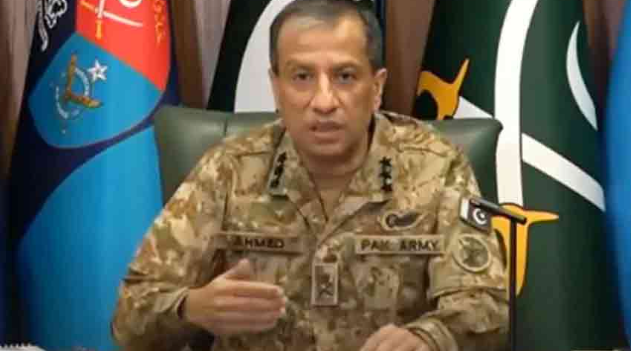
Director General Inter-Services Public Relations (DG ISPR) Lt Gen Ahmed Sharif Chaudhry has said the Makkah Defence Pact between Pakistan, Saudi Arabia and Turkiye is a defensive arrangement aimed at collective deterrence and has no aggressive or regional ambitions.
Speaking in an interview with Al Arabiya English, Lt Gen Chaudhry said the agreement formalised Pakistan’s longstanding ties with Saudi Arabia and Turkiye in the areas of collective defence and deterrence.
Asked whether the pact represented the beginning of a broader strategic alliance, he said its purpose was defensive.
“It is defensive. There’s nothing aggressive. There are no regional aspirations. It is collective deterrence,” he said, describing the agreement as complementary to the three countries’ existing international relationships.
On whether the pact included mutual defence obligations, the military spokesperson said the publicly released text clearly outlined the commitments of the three countries.
However, he said details about how those commitments would be implemented in the event of an attack would remain classified.
“Operationalisation of defensive commitments” was not normally disclosed publicly, he explained, adding that the three countries would determine the specific response if any member came under aggression.
Asked whether the agreement could affect Pakistan’s relationship with China, Lt Gen Chaudhry said the defence pact complemented Islamabad’s ties with Beijing.
He said Pakistan’s relations with Saudi Arabia and Turkiye were longstanding and had not emerged suddenly with the signing of the agreement.
According to the DG ISPR, the three countries have strong relations with China, while the defence pact is intended to contribute to regional stability and peace.
Lt Gen Chaudhry said the agreement was not specifically established as a military alliance for Muslim countries.
“There is nothing in the pact that states that it is a Muslim alliance,” he said, adding that its focus was regional peace, stability and security.
He said the alliance could potentially include other willing countries that shared its principles of non-aggression, non-interference and collective deterrence.
However, he stressed that any decision regarding expansion would rest with the leadership of Pakistan, Saudi Arabia and Turkiye.
The joint defence agreement was signed on August 7 and states that an attack on one member would be treated as an attack on all three. The alliance held its inaugural meeting in Istanbul on August 31, where Pakistan was selected to initially lead its secretariat for three years.
Discussions about expanding the alliance have emerged since its formation, including suggestions that Egypt could eventually join. Cairo, however, has not confirmed any decision regarding membership.
Pakistan’s leadership has repeatedly described the agreement as defensive and said it could remain open to other countries that support its core principles.
During the interview, Lt Gen Chaudhry also discussed Pakistan’s efforts to facilitate dialogue between the United States and Iran amid the ongoing Middle East conflict.
He said the defence pact would not complicate Pakistan’s position towards Tehran, describing it as a formalisation of longstanding strategic relationships.
Asked why Pakistan was seeking to mediate between the two sides, he said the objective was regional peace.
He said Pakistan had a “unique position” because of its policy of engagement and alignment with countries across the international community, allowing it to potentially act as an objective and impartial mediator.
Lt Gen Chaudhry said neutrality was essential to successful mediation and that Pakistan’s political and military leadership was engaging with all parties in an effort to encourage a negotiated settlement.
He maintained that a peaceful, negotiated outcome was preferable to a military solution and said mediation efforts should continue as long as they could contribute to resolving the conflict.
Pakistan confident of protecting its borders
Asked about the possibility of the conflict spreading towards Pakistan’s western borders, the DG ISPR said the country was confident in its ability to protect its borders, territorial integrity and sovereignty.
He acknowledged that conflicts could expand geographically and have wider regional consequences, adding that the current crisis was already affecting countries beyond those directly involved.
However, he said Pakistan was prepared to deal with any threats arising from the conflict.
Lt Gen Chaudhry said Pakistan’s broader objective was regional peace and stability, which he described as essential for economic development, prosperity and the well-being of people across the region.
He added that Pakistan would continue supporting mediation efforts whenever they could contribute to peace.