Russia’s parliamentary election has been held for all seats in the lower house, marking the first such vote since the country launched its full-scale invasion of Ukraine in 2022.
The election was conducted amid restrictions on anti-war political groups, with opposition parties facing barriers to participation. Voting also took place in Ukrainian territories occupied and claimed by Russia.
Voter turnout is being closely watched as an indicator of public sentiment toward the ongoing war, one of the most destructive conflicts in Europe in decades.
With more than 71 per cent of ballots counted, the ruling United Russia party had secured around 57.5 per cent of the vote. The Communist Party was in second place with about 14 per cent, followed by the LDPR with approximately 8.7 per cent.
The results indicated that the ruling party was on course to retain a two-thirds majority in the 450-member State Duma. Such a majority would allow lawmakers to approve constitutional amendments. Official results and final turnout figures were expected to be released after counting was completed.
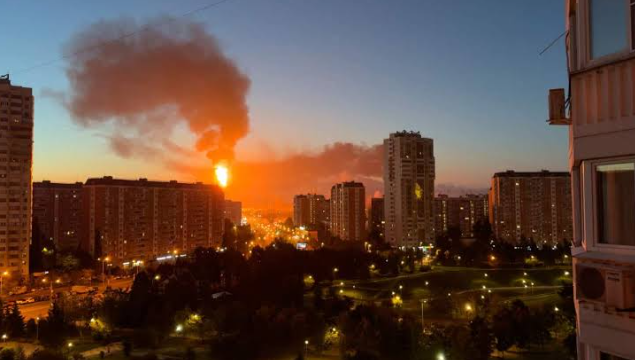
The final day of voting was accompanied by a major wave of drone attacks targeting Moscow and surrounding areas. The attacks reportedly killed two people and caused a fire at an oil facility.
Russian authorities said they would intensify strikes against Ukrainian targets in response, accusing Ukraine of attempting to disrupt the electoral process.
An exit poll conducted by a state-run polling organisation put the ruling party at around 49.4 per cent, broadly similar to its result in the previous parliamentary election.
The drone assault was described as the largest targeting Moscow since the beginning of the war. Russian authorities said around 1,600 drones had been intercepted across the country, including hundreds directed toward the capital.
Images from the Moscow region showed damage to a multi-storey residential building and heavy smoke rising from an area believed to be an oil facility.
Ukrainian authorities said their long-range attacks had caused significant damage in the Moscow region. Both sides have continued to target infrastructure during the war despite diplomatic efforts aimed at ending the conflict.
At least two people were reported killed in separate incidents, while a fire caused by a drone strike on a residential building resulted in the evacuation of hundreds of residents.
Ukraine has repeatedly targeted Russian infrastructure with drones, describing the attacks as a response to Russian strikes on Ukrainian cities and infrastructure.
The election was also marked by restrictions on opposition participation. A liberal political party that had called for an end to the war was barred from contesting the federal list, although some of its candidates remained eligible in individual constituencies.
Russia’s leadership had urged citizens to participate in the election, presenting the vote as an expression of support for the country and its military.
Many prominent opposition figures have been forced into exile or barred from political activity, while the death of a leading opposition figure in prison in 2024 further reduced the space for organised political opposition.
Anti-war activists abroad also organised gatherings outside Russian diplomatic missions in several European cities during the election.
Cyberattacks Target Election Infrastructure
Russia’s electoral authorities reported a wave of cyberattacks targeting infrastructure involved in the voting process.
Officials did not identify those responsible but said the attacks appeared to involve coordinated and technically sophisticated groups.
More than 1,000 waves of distributed denial-of-service attacks were reportedly recorded against systems connected to the electoral process. Such attacks attempt to overwhelm digital systems with large volumes of internet traffic, disrupting normal operations.
Authorities also reported disruptions to communication lines in parts of Russia’s Far East, which they said appeared intended to interfere with voting.
The cyberattacks, drone strikes and restrictions on political participation added to concerns surrounding the security and conduct of the election.