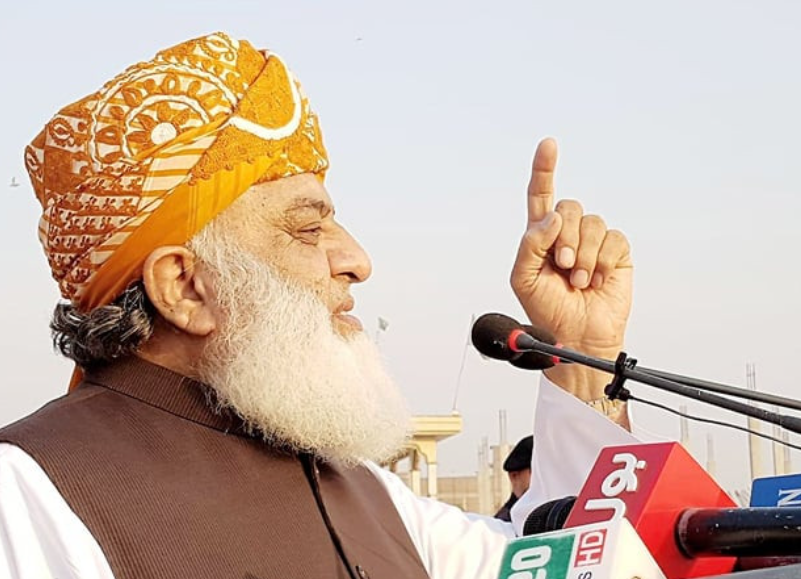
Jamiat Ulema-i-Islam-Fazl (JUI-F) chief Maulana Fazlur Rehman has accused the federal government of reneging on its commitments after seeking his mediation to resolve the political standoff with Pakistan Tehreek-e-Insaf (PTI).
Addressing a press conference in Islamabad on Sunday, Fazl said opposition leaders approached him after his return from Umrah on October 7, requesting his intervention to ease tensions between the government and the PTI. He added that federal ministers also contacted him the following day to seek his assistance.
Political tensions escalated after the PTI announced a long march towards Islamabad, demanding the release of its incarcerated founder, Imran Khan. Negotiations between the government and the opposition failed to make progress last week, prompting the PTI to launch its march, which remained within Khyber Pakhtunkhwa (KP).
Meanwhile, federal ministers discussed the possibility of imposing an emergency and governor’s rule in KP, citing security concerns and the provincial government’s alleged lack of cooperation in counterterrorism efforts.
Fazl claimed that the PTI had agreed to keep its march away from Islamabad at his request, while the government had postponed its plan to impose an emergency after its representatives approached him.
He said Prime Minister Shehbaz Sharif subsequently invited him to the Prime Minister House for discussions, despite his concerns that the government had already made up its mind.
According to Fazl, the government wanted the PTI to call off its march before negotiations could proceed, while the opposition demanded access to Imran Khan in jail and implementation of a court order concerning his transfer to a private hospital for medical treatment.
He said both sides insisted that the other take the first step, prompting him to offer his services as a mediator and seek authorisation from both parties to facilitate a resolution.
Fazl said he held a conference call with KP Chief Minister Sohail Afridi, PTI Chairman Barrister Gohar Ali Khan and senior party leader Asad Qaiser, among others. During the conversation, he asked Afridi whether the PTI would end its march if its demands were accepted.
According to Fazl, Afridi responded that the party would call off the march if its demands were met.
The JUI-F chief said he conveyed the PTI’s position to the prime minister and requested assurances that the party leadership would be allowed to meet Imran Khan and that the jailed former premier would receive the necessary medical care.
Fazl added that he intended to travel to Peshawar for further consultations with Afridi and other stakeholders. He also proposed involving two representatives each from the PTI and the Pakistan Muslim League-Nawaz (PML-N) in negotiations under his supervision.
However, Fazl said Deputy Prime Minister and Foreign Minister Ishaq Dar contacted him during Sunday’s cabinet meeting and informed him that the government intended to impose an emergency in KP due to the security situation.
Questioning the proposed move, Fazl argued that the security situation in Balochistan was worse than in KP, yet the federal government had not imposed governor’s rule in that province.
He accused the government of abandoning its commitments despite agreeing to a proposed course of action and questioned why his mediation had been sought if the cabinet intended to make the final decision independently.
Asked who was responsible for the breakdown of negotiations, Fazl said the question should be directed to Prime Minister Shehbaz Sharif, adding that the government had created obstacles in the negotiation process.
Fazl also strongly opposed the federal government’s decision to impose an emergency and governor’s rule in KP, describing the move as an attack on democracy and the rights of the people.
He said his party rejected the decision and would challenge it through all available constitutional and democratic forums, including Parliament and the courts.
The JUI-F chief reiterated his commitment to defending the Constitution, human rights and democratic freedoms, vowing not to accept what he described as unconstitutional measures.
He also criticised the Pakistan Peoples Party (PPP), alleging that its role in the matter had undermined constitutional and democratic principles.
Referring to successive military operations carried out from the tenure of former military ruler General (retd) Pervez Musharraf to the present day, Fazl argued that the strategy had repeatedly failed to deliver the desired results.
On the performance of the KP government, he said that if the provincial administration had failed, the situation in Balochistan was even worse.
When asked whether opposition parties would resign from the assemblies, Fazl said the matter would be considered if and when the situation arose.