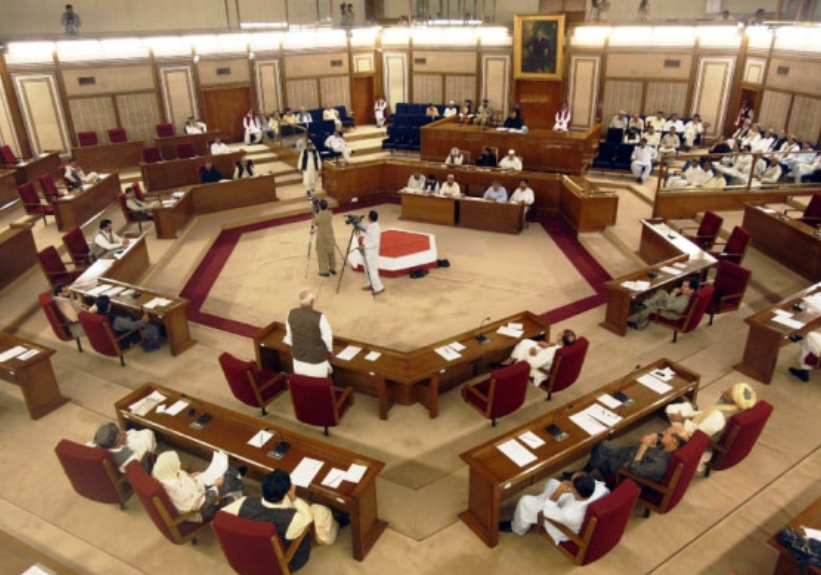
Pakistan’s Senate has blocked a proposed amendment seeking to withdraw diplomatic passport privileges from ministers of state, advisers, special assistants to the prime minister, federal secretaries other than the foreign secretary, and director generals.
The bill was introduced by Pakistan Tehreek-e-Insaf (PTI) Senator Faisal Saleem Rehman, who chairs the Senate Standing Committee on Interior, along with Senators Samina Mumtaz Zehri and Saifullah Abro.
Opposing the legislation, Minister of State for Interior Tallal Chaudhry argued that the proposed amendment would interfere with the authority of the federal cabinet.
In response, Senator Faisal Saleem Rehman said the legislation aimed to ensure that diplomatic passports were issued according to official responsibilities rather than distributed broadly among public officeholders. Pakistan Peoples Party (PPP) Senator Zamir Hussain Ghumro, however, maintained that ministers of state were also representatives of Parliament.
The proposed legislation sought to amend the Passports Act 1974 by introducing a new Section 12A. Under the amendment, holding the office of minister of state, adviser to the prime minister, special assistant, federal secretary—except the foreign secretary—or director general would no longer automatically qualify a person for a diplomatic passport.
It also proposed that individuals already holding such passports surrender them to the relevant authority within 30 days of the law coming into force.
The bill clarified that the proposed restrictions would not prevent eligible individuals from obtaining ordinary or official passports. Nor would they affect diplomatic passport entitlements arising independently from another office, appointment or lawful diplomatic assignment.
The statement of objects and reasons said the Passports Rules 2021 allowed diplomatic passports for various categories of public officeholders, including ministers of state and officials of equivalent status.
The bill argued that diplomatic passports should primarily reflect the requirements of diplomatic and state functions rather than serve as an automatic privilege attached to political rank. Its stated objective was to establish a transparent, purpose-based system that clearly distinguished diplomatic responsibilities from political status.
The Senate witnessed a heated exchange between PML-N Senator Nasir Butt and PPP Senator Sherry Rehman during proceedings on the Consumer Protection (Amendment) Bill 2026.
The legislation, introduced by Senator Samina Mumtaz Zehri of the Balochistan Awami Party, was passed despite opposition from the government led by PML-N.
During the debate, Butt questioned the PPP’s position, prompting PPP senators to walk out of the House.
The bill received 10 votes in favour and four against after a vote was conducted for a second time.
Tallal Chaudhry opposed the legislation, while Zehri criticised the government for resisting the proposed law, accusing it of neither taking action itself nor allowing others to proceed.
The Senate unanimously passed legislation to amend the Islamabad Capital Territory (Prohibition of Plastic Book Covers) Act 2026, aiming to remove an exemption clause that could undermine the law’s intended purpose.
The amendment was moved by PPP Senator Faisal Saleem Rehman. The original legislation was introduced to regulate and prohibit plastic book covers in Islamabad, but concerns had emerged over exceptions contained in Section 3.
Rehman said plastic covers continued to be used by some major bookshops in the federal capital despite the existing restrictions.
She added that shopkeepers often claimed their products were biodegradable, while the Ministry of Interior had indicated that the country lacked the necessary laboratory facilities or testing standards to verify such claims.
Rehman said the amendment was intended to eliminate legal ambiguity and establish a comprehensive ban on plastic book covers in Islamabad without exemptions.
The Senate also approved an amendment to the Code of Criminal Procedure (CrPC) while deferring consideration of the Islamabad Metro Bus Service Bill 2026.
PTI parliamentary leader in the Senate, Barrister Syed Ali Zafar, expressed concern over revisions to the descriptions of several National and Provincial Assembly constituencies in Khyber Pakhtunkhwa.
He alleged that the changes had been made without properly hearing public objections and called on the Election Commission of Pakistan (ECP) to explain the legal basis for its decisions.
Zafar said constituency boundaries and descriptions directly affected political representation and must be revised through a transparent process in accordance with the law.
Referring to Section 22 of the Elections Act 2017, he maintained that the prescribed legal procedures could not be disregarded and demanded clarification over who would be held accountable if any violations had occurred.
The PTI senator also questioned the delay in appointing a successor to the chief election commissioner, whose five-year term expired on January 26, 2025.
Although Article 215 of the Constitution provides for the incumbent to continue until a successor assumes office, Zafar argued that the provision should not justify an indefinite delay in filling the constitutional position.
He urged the government to address the concerns, ensure compliance with electoral laws and require the ECP to provide a clear legal explanation for its actions.
Responding to the criticism, Parliamentary Affairs Minister Tariq Fazal Chaudhry said the concerns appeared to be based on a media report. He asked lawmakers to provide an official notification and said he would seek further information from the ECP.
The Senate unanimously adopted a resolution reaffirming Pakistan’s support for the right to self-determination of the people of Indian-administered Jammu and Kashmir ahead of Kashmir Black Day, observed on October 27.
The resolution was moved by Minister for Kashmir Affairs and Gilgit-Baltistan Amir Muqam.
It described the entry of Indian forces into Jammu and Kashmir on October 27, 1947, and the subsequent occupation of the territory as a pivotal development in the longstanding dispute.
The resolution paid tribute to the people of Kashmir for their continued struggle and sacrifices, reiterating that the dispute should be resolved peacefully in accordance with relevant United Nations Security Council resolutions.
It stressed that a lasting settlement must take into account the aspirations of the Kashmiri people and their right to determine their own future.
The House also called on the international community to take notice of reported human rights violations in the region and play an effective role in protecting the fundamental rights of its residents.
The resolution urged Pakistan’s government to continue providing political, moral and diplomatic support to the Kashmiri people and intensify efforts to raise the issue internationally.
The Senate reaffirmed its commitment to supporting the Kashmiri people’s right to self-determination and their pursuit of a peaceful and lasting settlement.