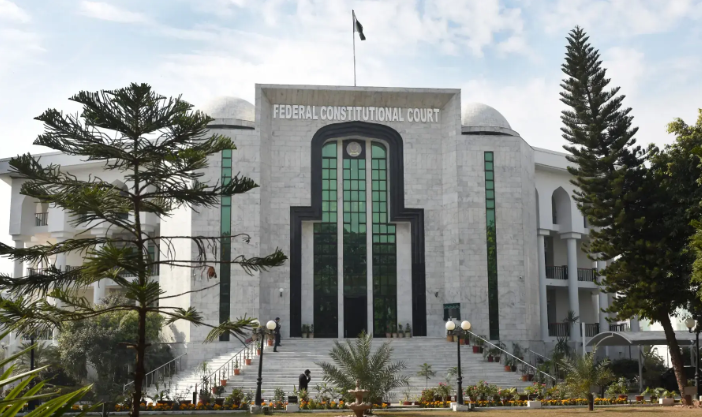
The Federal Constitutional Court (FCC) has rejected a claim seeking ownership rights over protected agricultural land leased by the government, ruling that public property held in trust for the community cannot be transferred into private ownership in violation of the law.
Chief Justice Aminuddin Khan, heading a two-member bench that also included Justice Ali Baqar Najafi, observed that courts could not overlook legal restrictions preventing authorities from transferring state-owned property.
The bench heard an appeal filed by the member (colonies) of the Punjab Board of Revenue against a 2016 Lahore High Court (LHC) judgment that had ruled in favour of Rasheeda Bibi, who has since died.
The dispute concerns 49 acres, five kanals and 13 marlas of agricultural land in Chak No. 2/KB, Pakpattan. The land had been leased to the respondent under the Temporary Cultivation Lease Scheme for the period from Kharif 1968 to Rabi 1978, with subsequent extensions.
The leaseholders later applied for proprietary rights under a government notification issued on September 3, 1979. However, their request was rejected on May 14, 2001, on the grounds that the land fell within a prohibited zone.
Following a series of appeals and remands, the executive district officer (revenue) in Pakpattan accepted the ownership claim in 2008 and directed that a payment challan be issued for depositing the land’s price.
The decision was subsequently reviewed with the approval of the member (colonies) of the Board of Revenue. On August 24, 2011, the authorities again rejected the claim. The LHC later overturned that decision, leading to the appeal before the FCC.
During the proceedings, the constitutional court examined whether the disputed land qualified for the grant of proprietary rights under the September 3, 1979, notification and whether the executive district officer (revenue) had the authority to review the order issued on October 28, 2008.
Chief Justice Aminuddin Khan observed that procedural requirements could not be used to sustain an unlawful transfer of government property. He said courts were obliged to consider legal restrictions evident from official records and ensure that public assets were not transferred through administrative mistakes, omissions or acquiescence in violation of the law.
The FCC ruled that a temporary cultivation lease did not create an absolute or permanent entitlement to ownership. Any claim to proprietary rights remained subject to the conditions laid down in the 1979 notification, particularly the restriction on land located in prohibited zones.
The court also held that a successor revenue officer could review an order passed by a predecessor, provided the applicable statutory requirements were met and prior approval was obtained under Section 163 of the Punjab Land Revenue Act, 1967.
The chief justice emphasised that the dispute had to be decided in accordance with the relevant laws and government policy, rather than on the basis of prolonged possession, repeated lease extensions or payment of government dues.
The judgment distinguished between a temporary cultivation lease and the permanent transfer of ownership. While a cultivation lease allows a person to occupy and farm land without affecting the state’s ownership, granting proprietary rights permanently transfers the property out of public ownership.
Rejecting the leaseholders’ reliance on their original cultivation agreement, the FCC set aside the Lahore High Court’s judgment.