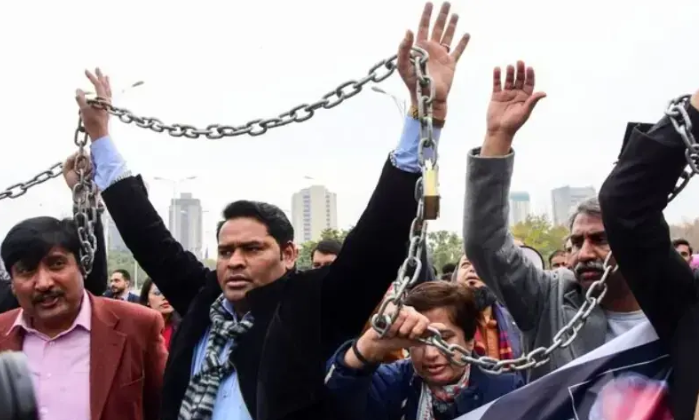
Journalists in Pakistan continue to face threats, physical attacks and legal pressure, with the growing use of legal proceedings against media professionals emerging as a major concern, according to Freedom Network’s annual Impunity Report 2026.
Titled “From Violence to Lawfare: Process as Punishment for Journalists,” the report recorded an average of around 10 cases involving media personnel per month. It warned that a decline in the number of reported violations does not necessarily translate into improved safety, particularly given the geographical spread and severity of incidents.
Prepared with technical assistance from International Media Support (IMS), the report was authored by journalist Adnan Rehmat and Freedom Network Executive Director Iqbal Khattak. It highlights how impunity has expanded beyond the failure to prosecute those responsible for violence to include broader forms of pressure and coercion against journalists.
The report was released on Thursday ahead of the International Day to End Impunity for Crimes against Journalists, observed annually on November 2.
Khattak expressed concern that attacks and legal intimidation against journalists persist despite the existence of two laws designed to address impunity for crimes against media workers. He said the findings raised questions about the effectiveness of the federal and Sindh journalist safety commissions established under these legal frameworks.
The report documented incidents between October 2025 and August 2026, including one work-related killing, three attempted assassinations, 18 threats of murder or physical harm, 11 assaults, 13 legal actions and 32 threats of legal proceedings.
Punjab accounted for 49 cases, representing slightly more than half of the total recorded incidents. Khyber Pakhtunkhwa, Islamabad and Balochistan were among the other areas where violations were reported.
Digital and independent journalists were identified as the most frequently targeted groups. Victims or their families alleged that government authorities and officials were responsible for initiating nearly two-thirds of the documented cases.
The report identified the Prevention of Electronic Crimes Act (PECA) and its use against journalists by the National Cyber Crime Investigation Agency (NCCIA) as major concerns for online journalism and freedom of expression.
An examination of selected PECA-related cases revealed a recurring pattern in which allegations involving defamation, misinformation, harassment and reputational damage were pursued through cybercrime procedures. Some cases concerned journalistic reporting on public spending, corruption and the conduct of government officials.
According to the report, journalists may face significant consequences even when a formal First Information Report (FIR) has not been registered or a conviction has not been secured. These include official summonses, scrutiny of electronic devices, travel expenses, legal fees, detention, repeated court appearances and damage to professional reputations.
The report further noted that relief in such cases often comes in the form of bail or procedural protection rather than a final decision clearing the journalist of the allegations.
It also outlines guidelines for journalists and other media professionals facing PECA-related proceedings, aiming to help them reduce the potential harm caused by legal action.
The report raised concerns over the limited effectiveness of institutional safeguards for media workers despite the establishment of two high-level journalist safety commissions at the federal level and in Sindh.
It described the federal journalist protection mechanism as effectively dysfunctional. While acknowledging greater visibility of the Sindh Commission, the report said its reach and demonstrated impact remained limited beyond Karachi.
The findings highlight the need for stronger journalist protection mechanisms and effective safeguards to ensure that legal processes do not become instruments of intimidation against media professionals.