Pakistan Peoples Party (PPP) Chairman Bilawal Bhutto-Zardari has urged the Pakistan Tehreek-e-Insaf (PTI) to abandon what he described as “extremist politics” and revise its political strategy, warning that the party’s current approach is disappointing its supporters and weakening its political position.
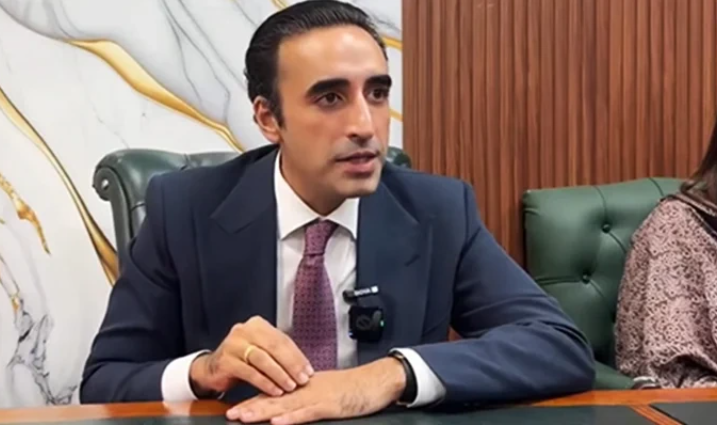
Addressing an event in Karachi, Bilawal said the PTI had a public support base but continued to disappoint people through its decisions and confrontational political approach.
“The PTI is a party that has public supporters, but it keeps disappointing the people because of its decisions and extremist politics,” he said.
Bilawal warned that if the party continued with its current political strategy, it could also lose its position in Khyber Pakhtunkhwa (KP), where it currently governs.
His remarks came as the PTI proceeded with its long march, demanding the release of its jailed founder and former prime minister Imran Khan, despite warnings from the federal government against gatherings in Islamabad.
The PPP chairman criticised the PTI for prioritising what he termed politics of hate over governance and public welfare. He said the party should focus on addressing the problems of KP and fulfilling its responsibilities towards the province’s residents.
Bilawal also claimed that the federal government and relevant institutions had been prepared to impose an emergency in KP a week earlier. He maintained that imposing an emergency or introducing governor’s rule was constitutionally and legally possible but should only be considered as a last resort.
Describing such measures as a “legal atom bomb”, he stressed that they should not be used unless absolutely necessary.
Referring to efforts to promote political dialogue, Bilawal said political parties, including opposition groups, had reached an understanding, but the chief minister of one province had opted for what he called negative politics instead of negotiations.
He argued that confrontational politics ultimately harmed the country, the province concerned, its people and young people, while also damaging the PTI itself.
Bilawal urged the PTI to reconsider its approach and participate constructively in the political process. He said he was willing to help improve the political environment if the party abandoned its current strategy.
He added that Karachi’s political landscape was primarily shaped by the PPP and the PTI, but criticised the latter for engaging in confrontations with political parties, the federal government, Parliament, the judiciary and the establishment.
According to Bilawal, the PTI’s absence from parliamentary proceedings was also undermining its ability to address political concerns and represent its supporters effectively.
He said the Pakistan Muslim League-Nawaz (PML-N) had agreed after several months to establish a parliamentary committee on electoral reforms. However, he questioned whether the PTI would participate in the committee despite frequently raising allegations of electoral rigging.
Bilawal said meaningful participation in parliamentary forums was necessary to address electoral concerns and prevent irregularities in future elections.
The PPP chairman reiterated that his party had repeatedly urged the PTI to abandon its “extremist politics”, arguing that doing so would create opportunities for dialogue and allow the party to pursue its political objectives.
He also referred to Imran Khan’s imprisonment, saying that being jailed did not necessarily mean a person would remain behind bars indefinitely. Citing President Asif Ali Zardari’s prolonged imprisonment, Bilawal warned that the PTI’s current political approach could further complicate efforts to secure relief for its founder.
He said the party could achieve its political goals and prevent its workers from becoming disillusioned by changing its strategy and pursuing dialogue.
Turning to the country’s economic situation, Bilawal said public hardships were increasing amid rising poverty and unemployment. He cited the World Bank’s assessment of the challenges facing Pakistan, claiming that the country was experiencing a particularly heavy burden of poverty and unemployment in the region.
Bilawal said the PPP wanted the federal government, regardless of who held the office of prime minister, to succeed in delivering relief to the public.
He stressed that political stability was essential for improving economic conditions and could only be achieved through cooperation among political parties on key national issues.