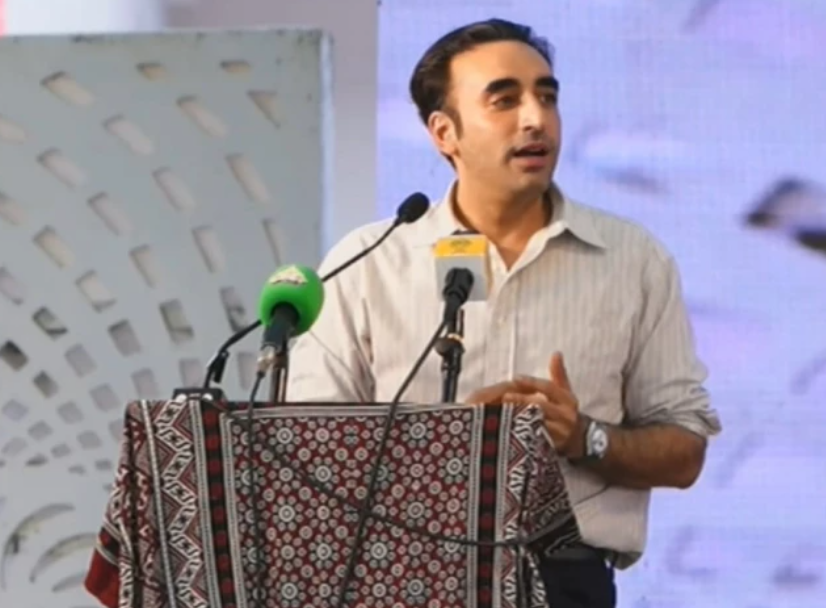
Pakistan Peoples Party (PPP) Chairman Bilawal Bhutto-Zardari has said the federal government could reconsider the imposition of governor’s rule and emergency in Khyber Pakhtunkhwa (KP) if the opposition engages in dialogue with the Centre and agrees on a joint strategy to combat terrorism.
Bilawal made the remarks while speaking to the media during a visit to the Karsaz Monument in Karachi on the 19th anniversary of the Karsaz bombing.
His statement comes a week after the federal government imposed governor’s rule and emergency in KP, accusing the provincial administration of deliberately distancing itself from counterterrorism efforts. The decision followed a Pakistan Tehreek-e-Insaf (PTI) mobilisation campaign and protest march demanding the release of its jailed founder, Imran Khan.
“If they really want to fight terrorists, and if they want that emergency and governor’s rule in KP to end, they should engage with the federal government and politicians and discuss a united policy regarding the fight against terrorism,” Bilawal said, referring to the PTI-led opposition.
He added that the measures could be withdrawn if the opposition demonstrated its commitment to combating terrorism and both sides reached an agreement on a comprehensive plan.
Criticising KP Chief Minister Sohail Afridi, Bilawal questioned his willingness to confront militant groups, saying the PPP was prepared to participate in efforts to protect the province.
He said the PPP had supported the federal government’s decision to impose governor’s rule because of the security situation, adding that his party was willing to work with all political forces to defeat terrorism.
The PPP chairman warned that Pakistan was experiencing terrorist attacks across multiple regions, from Khyber to Khuzdar, highlighting the nationwide scale of the security challenge.
He criticised the policies adopted after the Taliban returned to power in Afghanistan in 2021, alleging that the then-government had allowed militants based in Afghanistan to return to Pakistan and settle in Swat, Malakand and the former tribal districts.
Bilawal appeared to refer to the previous government’s efforts to facilitate the return and resettlement of members of the Tehreek-e-Taliban Pakistan (TTP). He also alleged that militants held in Pakistani prisons had been released, arguing that the country was now facing the consequences of those decisions.
He warned that attempts to undermine Pakistan’s authority in Swat, alongside attacks on security personnel, law enforcement officials and civilians, demonstrated the urgency of a coordinated national response.
Bilawal expressed concern that KP, which continues to experience a high number of militant attacks, was facing serious security challenges while its provincial leadership had allegedly shown reluctance to confront the threat.
Reflecting on the Karsaz bombing, he said the greatest damage occurred when terrorist incidents were not treated with the seriousness they demanded.
He recalled that the PPP government in 2008 had worked to build public support for counterterrorism operations. Following the introduction of the National Action Plan (NAP), he said, the party supported a broader approach involving institutional reforms to strengthen the country’s response to militancy.
Bilawal maintained that counterterrorism efforts could succeed only when citizens, political parties and state institutions worked together.
He said the PPP would continue to promote national unity and seek agreement on a renewed counterterrorism framework.
Bilawal said Pakistan was facing a historic economic crisis, warning that the situation could deteriorate further if urgent action was not taken.
He argued that addressing the economic downturn also required confronting terrorism, as persistent insecurity could undermine national stability and recovery.
The PPP chairman also called for improvements to Pakistan’s democratic and electoral systems, saying political consensus was necessary to strengthen governance.
He said his party had advocated a new National Action Plan and invited opposition parties to participate in developing a shared counterterrorism policy.
Bilawal added that the federal government had decided to establish an electoral reforms committee in the National Assembly and had invited the opposition to contribute to its work.
“If they say that democracy is weak in this country, they should help us to strengthen it,” he said, adding that political cooperation would create better conditions for tackling terrorism.
Discussing KP Governor Faisal Karim Kundi, Bilawal said the PPP had nominated him for the position, but his constitutional role now required him to represent the federal government. He added that he would continue offering advice to Kundi despite the governor’s responsibility to work with the Centre.
Responding to questions about the possibility of reaching an understanding with the opposition, Bilawal defended political compromise as an essential part of democratic practice.
He said former prime minister Benazir Bhutto had consistently sought compromise throughout her political career, recognising that protests and revolutionary rhetoric alone could not resolve the country’s challenges.
According to Bilawal, the PPP’s previous compromises had contributed to the end of General Pervez Musharraf’s military rule and helped facilitate major constitutional developments, including the 1973 Constitution and the 18th Amendment.
He noted that the PPP was neither part of the federal government nor in possession of a parliamentary majority, arguing that political parties must work within the available political space to achieve progress.
On the question of establishing new provinces or administrative units, Bilawal said Interior Minister Mohsin Naqvi was aware of the positions held by the PPP and President Asif Ali Zardari.
He maintained that the creation of new provinces required constitutional and legal procedures, including the necessary presidential approval.
The issue has sparked debate following Naqvi’s remarks in July advocating new provinces and changes to the existing governance structure.
The PPP, which governs Sindh, has strongly opposed any attempt to divide the province. The Sindh Assembly recently adopted a resolution rejecting proposals to split Sindh or establish new administrative units.
Bilawal clarified that the PPP did not oppose the creation of provinces in principle, provided the process followed the Constitution and had the support of the relevant provincial assembly.
He cited Gilgit-Baltistan as an example, noting that its legislative assembly had unanimously passed a resolution seeking constitutional rights for the region.
The PPP chairman argued that proposals for new provinces should be pursued only where there was genuine local consensus and no hidden political agenda.
Bilawal urged politicians from both government and opposition benches to avoid politicising terrorism or creating unnecessary controversy around counterterrorism measures.
He also addressed criticism from Jamiat Ulema-i-Islam-Fazl (JUI-F) chief Maulana Fazlur Rehman, saying the opposition leader had every right to disagree with government policies.
However, Bilawal stressed that political differences should not prevent leaders from condemning militant violence.
He defended the PPP’s record of imposing emergency measures through constitutional and legal procedures, citing the 2008–2013 period when emergency rule and governor’s rule were imposed in Balochistan amid security concerns, despite the PPP’s own political interests being affected.
He argued that the decision demonstrated the party’s willingness to prioritise national security over political considerations.
Bilawal noted that JUI-F had also suffered from terrorist attacks and expressed hope that Fazlur Rehman would condemn militant groups even while continuing to criticise the government.
He concluded that constructive engagement between the government and opposition could help build political harmony and strengthen the national effort against terrorism.