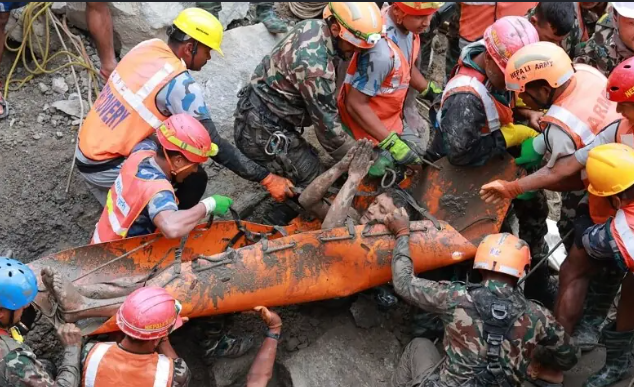
A joint rescue team comprising Nepal Army personnel and foreign experts rescued a Chinese national from a tunnel in Nepal’s Rasuwa district, 10 days after he was trapped by catastrophic flooding, the military said.
The man, identified as Luhaitao, was found 225 metres inside the tunnel of the Upper Trishuli-1 Hydropower Project. A photograph released by the Nepal Army showed him being escorted out by two rescuers.
Luhaitao appeared alert when he was rescued, although his hands were covered in thick mud. The army said his health was being assessed while rescue teams continued searching for other survivors.
He was among hundreds of hydropower workers reported missing after a tsunami-like surge of water and mud swept across the China-Nepal border on August 26 following a massive glacial and rock collapse.
Two Nepali hydropower workers were rescued alive from the Trishuli 3A tunnel on Friday, where search operations continued alongside several other sites. The floods destroyed at least 12 hydropower projects.
According to Nepal’s national disaster agency, 1,344 bodies have so far been recovered, while around 5,000 people remain missing. In China, state media reported 31 deaths and 531 people missing.
The combined death toll from the disaster has reached 1,375, with more than 5,500 people still unaccounted for.
Nepal Army spokesman Raja Ram Basnet said rescue operations were continuing inside several tunnels in an effort to locate more survivors.
The government had initially estimated that more than 100 workers could still be alive inside the blocked tunnels.
The rescue of Luhaitao came a day after two Nepali workers were pulled alive from the Trishuli 3A tunnel, nine days after they became trapped by the flooding. The two men, who were covered in mud, were taken to hospital and were reported to be in stable condition.
Experts from India, China, Australia and South Korea have been assisting Nepali rescue teams in searching the blocked tunnels for survivors.
With morgues overwhelmed by the number of victims, Nepal Police said around 1,030 bodies had been buried in mass graves after DNA samples were collected for future identification.
Prime Minister Balendra Shah has pledged to provide safe and comfortable accommodation for thousands of people displaced by the disaster and currently staying in temporary relief camps.
Acknowledging the difficult conditions in the camps, Shah said the government would work to restore an environment in which displaced people could rebuild their lives and plan for the future.