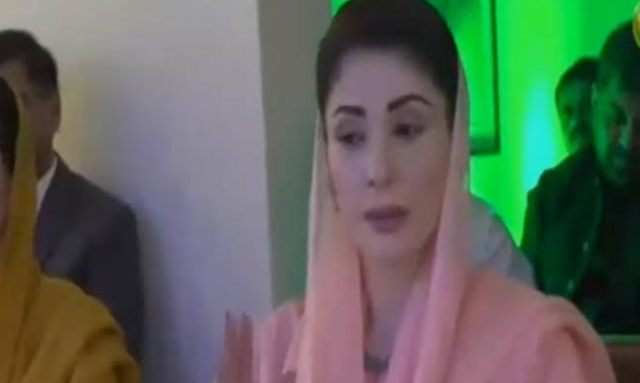
Punjab Chief Minister Maryam Nawaz has said the province faces a greater security threat from neighbouring provinces than from neighbouring countries, attributing recent security challenges to militant activity crossing provincial borders.
Speaking at an artificial intelligence technology event in Lahore, the chief minister said terrorism was entering Punjab through its provincial borders and that the province continued to face threats from multiple directions.
“Punjab remains safe,” she said, while claiming that the law and order situation had improved significantly since her government came to power in 2024.
Maryam identified organised crime and religious intolerance among the major challenges facing Punjab. In an apparent reference to the banned Tehreek-i-Labbaik Pakistan (TLP), she alleged that some groups used religion to spread hatred while operating as political parties.
She said religious events were now being held peacefully, contrasting the current situation with what she described as religious polarisation in the province a few years ago.
The chief minister also highlighted the Punjab government’s investment in artificial intelligence and security technology, describing Punjab as the country’s “most AI-enabled province”.
Maryam said she found upon assuming office that militant groups possessed more advanced technology than the government, including night-vision equipment, and were carrying out attacks using sophisticated planning.
She said the provincial government had since developed a comprehensive security system, including bulletproof surveillance cameras, thermal cameras and drones at checkpoints and joint checkpoints.
According to Maryam, attacks on security checkpoints had previously resulted in several casualties, sometimes claiming the lives of up to 10 people. While attacks continued, she said investment in fortification and technology had significantly reduced fatalities.
Referring to the katcha areas along the provincial border, Maryam said the region had previously become a centre of terrorism and organised crime, including kidnappings for ransom and so-called honey-trap operations.
She credited cooperation between the Punjab government, military and Sindh government with improving the security situation, claiming that the area had become largely crime-free and that the writ of the state had been restored.
The chief minister also announced that her government had decided to take action against elements involved in corruption.
Clarifying that she was not referring specifically to government or police officials, Maryam said corruption had become deeply embedded in society and had, in some cases, become part of everyday practices.
She said the provincial government had established a mechanism to ensure swift action against corrupt elements, stressing that public trust in state institutions was essential for a country’s progress.
Pakistan Tehreek-i-Insaf (PTI) Central Information Secretary Sheikh Waqas Akram criticised Maryam’s remarks, describing them as reckless and arguing that national security should not be viewed through the lens of provincial politics.
In a statement issued by the party’s Central Media Department, Waqas said terrorism remained a national challenge and required unity, collective responsibility and cooperation among all federating units.
He accused the chief minister of promoting a selective political narrative and said attempts to portray one province as a greater threat than another could undermine national efforts against terrorism.
Waqas also referred to previous remarks by Prime Minister Shehbaz Sharif, saying that his appeal to militants to spare Punjab had similarly been irresponsible and could be interpreted as encouraging attacks elsewhere in the country.
He said Pakistan’s security challenges could not be addressed by blaming a particular province while overlooking broader national and regional factors.
The PTI leader called for leadership that looked beyond provincial boundaries and treated the security and rights of citizens across the country equally.