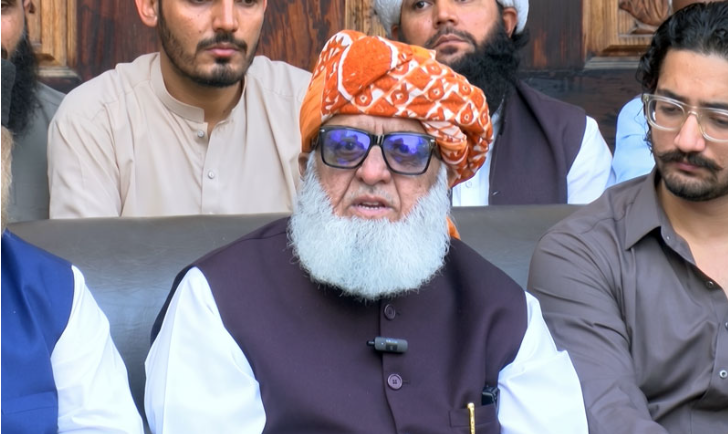
Jamiat Ulema-e-Islam-Fazl (JUI-F) chief Maulana Fazlur Rehman has accused the federal government of misusing the Constitution by imposing governor’s rule and an emergency in Khyber Pakhtunkhwa (KP), arguing that political change should be driven by public opinion rather than force.
The federal government imposed governor’s rule and an emergency in KP on October 11, citing what it described as the provincial government’s lack of cooperation in the fight against terrorism. The decision drew criticism from opposition parties and Fazl, who had previously attempted to ease tensions between the Centre and the provincial administration.
Speaking in the National Assembly on Wednesday, Fazl said the government had justified its decision on constitutional grounds but argued that the provisions had been misused.
“The government has misused the Constitution,” he said, comparing the alleged misuse of constitutional provisions to the misuse of laws.
The JUI-F chief maintained that imposing governor’s rule amounted to transferring power through force rather than public consent. Although he said he had reservations about the KP government, he stressed that political change should come through the electorate.
He also criticised Defence Minister Khawaja Asif, accusing him of failing to uphold the constitutional authority of Parliament.
Responding to Fazl’s criticism, Parliamentary Affairs Minister Dr Tariq Fazal Chaudhary said governor’s rule had been imposed for a period of six months, while emergency measures applied only to districts affected by terrorism.
The minister argued that political leaders needed to take a clear position on the country’s security challenges, referring to the Tehreek-i-Taliban Pakistan (TTP) and developments in Afghanistan.
Chaudhary also contrasted the situation in KP with that in Balochistan, alleging that KP Chief Minister Sohail Afridi, from the Pakistan Tehreek-e-Insaf (PTI), was using provincial resources to organise a march towards Islamabad. He further accused Afridi of defending militants.
The government’s position has been that the measures were necessary because of security concerns and the provincial administration’s alleged failure to cooperate in counterterrorism efforts.
During his address, Fazl urged political parties to develop a new Charter of Democracy to prevent unconstitutional measures and avert the risk of political violence.
He warned that tolerance within Parliament was declining and political tensions were worsening.
The JUI-F chief also questioned the simultaneous application of governor’s rule and emergency provisions in different parts of the same province, describing the arrangement as unusual. He referred to governor’s rule in one part of KP and emergency measures in 12 districts administered under a special council arrangement.
Fazl recalled his efforts to mediate between the government and opposition during the PTI’s planned march towards Islamabad. He said PTI leaders had approached him to help resolve the dispute.
According to Fazl, he subsequently held discussions with senior Pakistan Muslim League-Nawaz (PML-N) and PTI leaders before meeting Prime Minister Shehbaz Sharif. The prime minister, he said, asked that the proposed march be called off.
However, Fazl recalled receiving a call from Deputy Prime Minister and Foreign Minister Ishaq Dar the following day, informing him that the cabinet did not support the proposal and wanted governor’s rule imposed in KP.
He said he was contacted again on October 11, when he was informed that his mediation efforts had been discussed during a cabinet meeting before the government decided to proceed with the emergency measures.
Fazl said his efforts had been aimed at preventing bloodshed and expressed disappointment that the government had abandoned the possibility of a negotiated settlement.
He also questioned the federal government’s ability to maintain law and order, pointing to security concerns in Balochistan and reported incidents involving the kidnapping of commissioners.
Fazl also responded to those questioning his patriotism, saying his party had made substantial sacrifices in the fight against terrorism and that the contributions of its workers and martyrs should not be dismissed.
The JUI-F leader had previously criticised the federal government for what he described as an attempt to undermine provincial rights. He also questioned the claim that inadequate cooperation from the KP government had justified the imposition of governor’s rule.
Following criticism from federal ministers, Fazl clarified that his party’s objections were directed at government policies rather than state institutions. He said the purpose of his criticism was to encourage corrective action, not to undermine the sacrifices made against terrorism.
“My party is a party of martyrs,” Fazl told the National Assembly, lamenting that the sacrifices of his party members were being overlooked.
He maintained that Pakistan belonged to all its citizens and not to any single individual. He also raised concerns about the debate surrounding the country’s mineral resources and accused the government of encroaching on political and provincial rights.
Fazl warned that his party would resist what it considered government overreach, adding that it was prepared to face confrontation if the authorities pursued that course.
He urged the government to abandon coercive policies, warning that political disputes should not be allowed to undermine the country’s future.
Comparing the state to a mother, he argued that it should treat all citizens and provinces fairly.
The federal government imposed emergency measures and governor’s rule in KP on October 11 after President Asif Ali Zardari approved the federal cabinet’s recommendations under Articles 232 and 234 of the Constitution.
The decision prompted criticism from opposition figures, including Fazl, Mehmood Khan Achakzai and Raja Nasir Abbas of the Tehreek-i-Tahafuz-i-Ayin-i-Pakistan.
Political tensions between the Centre and opposition parties had already been escalating following the PTI’s announcement of a march towards Islamabad to demand the release of its jailed founder and former prime minister, Imran Khan.
Separately, Interior Minister Mohsin Naqvi alleged on October 16 that a political party leader was unhappy about being denied the position of KP governor and a role in the province’s new political arrangement. His remarks were widely interpreted as referring to Fazl.
Naqvi also alleged that the politician had relied on the establishment for decades to advance his political career.
The dispute over governor’s rule has added another dimension to the ongoing confrontation between the federal government and opposition parties, with constitutional authority, provincial autonomy and counterterrorism policy remaining central points of contention.