
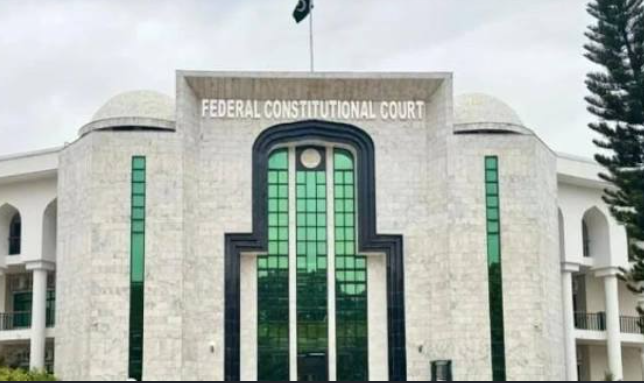
A three-member bench of the Federal Constitutional Court (FCC), comprising Justice Aamer Farooq, Justice Muhammad Karim Khan Agha and Justice Syed Arshad Hussain Shah, has dismissed a petition challenging a 2019 Lahore High Court (LHC) intra-court appeal judgment.
The petition was filed by Altaf Hussain, who had sought admission to the MPhil programme at Punjab University on the basis of an MBA degree obtained from Allama Iqbal Open University (AIOU).
Although Hussain cleared both the GAT-General and Punjab University’s admission test, the university denied him admission because his MBA comprised 20 courses carrying 60 credit hours, while the university required 25 courses with a minimum of 75 credit hours.
Representing the petitioner, Advocate Sheraz Zaka argued that the Higher Education Commission (HEC), being the competent statutory authority, had issued an equivalence certificate for the degree. He maintained that under Article 143 of the Constitution, federal statutory authority on equivalence should prevail over provincial university requirements.
Punjab University’s counsel, Saad Rasool, argued that degree equivalence and admission eligibility were separate matters. He said the HEC certificate established general academic comparability, while universities retained the statutory authority to set programme-specific admission requirements, including minimum credit hours.
In its judgment authored by Justice Shah, the FCC observed that HEC equivalence certificates themselves clearly state that admission decisions rest with the concerned university.
The court held that an HEC equivalence certificate establishes general academic comparability but does not override a university’s authority to impose uniform and non-discriminatory academic requirements for specialised postgraduate programmes.
The FCC also rejected the petitioner’s argument that federal and provincial laws were in conflict, finding no statutory contradiction in Punjab University enforcing its academic criteria.
Finding no jurisdictional error or illegality in the LHC judgment, the FCC dismissed the petition and declined leave to appeal.