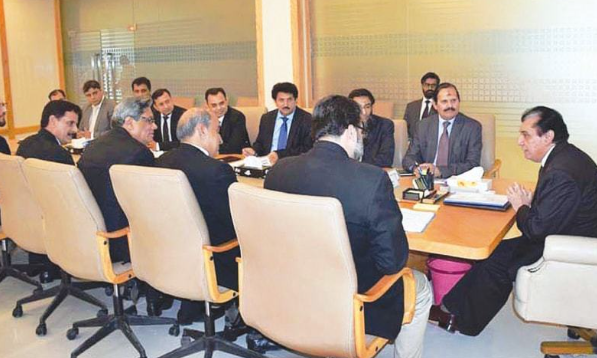
National Accountability Bureau (NAB) Chairman Lt Gen (retd) Nazir Ahmad said cooperation between the anti-graft watchdog and the Khyber Pakhtunkhwa government was “satisfactory”, stressing the need for stronger measures to identify, protect and recover state land in the province.
During a briefing on land revenue matters, the responsibilities of revenue authorities and the legal and administrative framework governing the leasing of state land, the NAB chairman said a substantial amount of public land in KP required effective measures for its identification, protection and recovery.
He said NAB, in coordination with the provincial administration, could help strengthen institutional mechanisms and address governance gaps affecting the lawful and effective management of public resources.
Ahmad stressed that government officials must exercise their authority strictly in accordance with the law and ensure compliance with all relevant statutory and legal provisions.
He acknowledged that shortcomings may have occurred in the past but said the focus should now be on corrective measures, institutional reforms and legal compliance.
“A comprehensive roadmap and mechanism should be developed to address the issues identified during the workshop and translate its recommendations into practical measures,” he said.
KP Chief Secretary Shahab Ali Shah, who attended the session, welcomed the initiative and said such collaborative efforts could help improve mechanisms for recovering and protecting state land.
He said the findings and recommendations of the workshop could also assist in reviewing and drafting legislation to address existing legal and administrative gaps.
According to the statement, the NAB chairman established the Land Directorate in 2025 to address the usurpation, illegal allotment and fraudulent transfer of state assets. The bureau said it recovered 2.98 million acres of land across the country in 2025, with the recovered assets valued at Rs5.976 trillion. It added that further recoveries involving millions of acres were being made in 2026.
The session was informed that efforts to replicate the system in KP had revealed major discrepancies between data held by deputy commissioners and departmental records, largely due to the absence of a central repository for state land.
The statement said there was also uncertainty over actual departmental utilisation rights, along with cases involving unauthorised leases, mortgages and occupations carried out without approval from the Board of Revenue.
To address these gaps, NAB KP developed the State Land Management System, a software platform designed to consolidate provincial state land records into a central, searchable database.
A detailed presentation on the legal framework governing land revenue matters in KP and the responsibilities of revenue and other concerned departments was delivered by Ahmed Ali Zafar, adviser to the NAB chairman on land matters.
He outlined the historical background and existing legal framework governing land revenue in the province.
The session examined several issues, including the appointment and functions of revenue officers, the jurisdiction of civil courts in revenue matters, and ambiguities surrounding the exercise of discretionary powers by provincial and local governments concerning state land.
NAB Director General (Operations) Amjad Majeed Aulakh presented the bureau’s findings on land leasing in KP. He highlighted weaknesses in the existing system and proposed measures to improve transparency, institutional oversight and the management of state land leases.
Another session, titled “Superior Court Judgements on Responsibilities of Land Revenue Authorities Regarding State Land”, was conducted by NAB Prosecutor General Syed Ihtesham Qadir Shah.
He said state land constituted a public trust and stressed the need to protect it through strict compliance with legal and judicial requirements.
Shah discussed relevant judgments of the Supreme Court and Sindh High Court, saying the rulings not only resolved disputes but also provided guidance to revenue authorities on the lawful management and disposal of public land through transparent and fair-market mechanisms.
The workshop concluded with an agreement that good governance and anti-corruption measures were complementary elements of effective public administration. Participants said stronger coordination between NAB and provincial authorities could help unlock additional public resources for provincial development and the wider public interest.