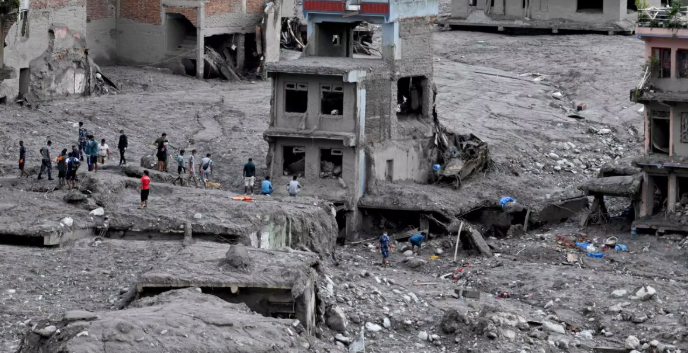
The death toll from devastating floods and landslides in Nepal and China has surpassed 1,000, with more than 4,400 people still missing as rescue operations entered their seventh day.
Chinese state media reported that 16 people had been killed in Tibet, taking the overall death toll from the disaster to 1,003.
In Nepal, the number of missing people fell to 3,916 as rescue teams continued searching affected areas and recovered more bodies. China reported 546 people missing, bringing the combined number of missing people in the two countries to 4,462.
Among those missing in Nepal are 583 foreign nationals from more than 30 countries, while 261 foreigners from 23 countries are reported missing in China.
Indians account for one of the largest groups of missing foreigners in Nepal, with New Delhi reporting 275 Indian citizens and 128 people of Indian origin missing. The US State Department said 85 American citizens were also missing.
Reports also listed 62 Ukrainians, 51 Malaysians, 42 Australians and 33 British nationals among those missing.
Meanwhile, authorities in India’s Uttar Pradesh state recovered 17 bodies from rivers flowing from Nepal. Officials believe the bodies may belong to victims of the floods but said they had yet to be identified. The bodies have not been included in the official death toll.
Nepali Prime Minister Balendra Shah has described the disaster as an extraordinary event linked to climate change and called for stronger international action to address the growing risks faced by Himalayan communities.
“The flood in the Bhote Koshi River in Rasuwa was not an ordinary flood,” Shah said in a social media post on Monday.
He said the disaster was among the region’s major catastrophes and was triggered by an avalanche of snow and ice in the Himalayan region.
Although the precise cause of the collapse remains unclear, scientists have warned that rising global temperatures are accelerating glacier melt and increasing the risk of disasters in mountainous regions.
Shah said the incident demonstrated that climate-related risks in the Himalayas were growing and urged Nepal to raise the issue at the international level.
Nepal, a largely rural country of around 30 million people, contributes relatively little to global greenhouse gas emissions but remains highly vulnerable to the effects of climate change.
The glaciers of the Himalayan and Hindu Kush ranges provide a vital source of water for around 240 million people living in mountainous areas and another 1.65 billion people in river valleys across South and Southeast Asia.
UN Secretary-General Antonio Guterres had previously warned that rapidly melting glaciers were putting Himalayan communities at increasing risk. Following the latest disaster, UN climate chief Simon Stiell described it as a stark reminder of the vulnerability of mountain ecosystems.
Rescue teams in Nepal have built temporary bridges and cleared debris to reach isolated communities and hydropower facilities in the Himalayas.
Nearly 300 workers trapped at hydropower projects have been rescued, while around 600 people remain stranded at several damaged facilities, which have become a major focus of ongoing rescue efforts.
Prime Minister Shah said more than 11,000 people had been rescued across the affected region and that electricity and communication services had been restored in some areas.
Road links to Nuwakot, one of the worst-hit districts, have also been restored, allowing rescue teams to reach affected communities and deliver relief supplies.
Police official Bipin Regmi said rescuers recovered 24 bodies from a house in Betrabati village in Nuwakot district.
“We are reaching new areas and recovering bodies,” Regmi said.
Shah said aid worth more than $42 million had reached Nepal following the disaster, with further assistance expected.
India and China, Nepal’s two neighbours, have also joined relief efforts, including the construction of temporary Bailey bridges to provide access to areas cut off by the floods and landslides.