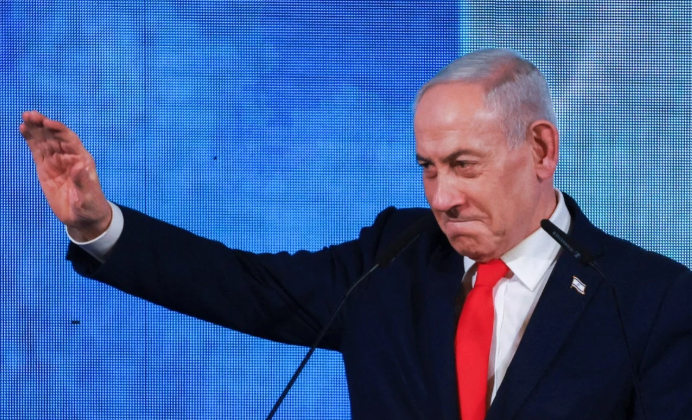
Israeli Prime Minister Benjamin Netanyahu is set to remain in a caretaker role after preliminary election projections indicated that neither major political bloc had secured a clear path to forming a government.
With nearly 86 per cent of votes counted on Wednesday, Israel’s three major broadcasters projected that Netanyahu’s alliance of right-wing, far-right and ultra-Orthodox parties would secure 53 seats in the 120-member Knesset. The opposition bloc led by Gadi Eisenkot was projected to win 48 seats.
Parties representing Arab citizens of Israel were projected to capture a combined 19 seats, potentially giving them a significant role in determining the next government. However, Eisenkot would face considerable political obstacles in securing their support, as many Jewish political leaders oppose formal alliances with Arab parties.
Although counting was still underway and the figures could change, the initial projections fell short of pre-election surveys that had suggested a closely contested race.
Netanyahu is expected to continue serving as caretaker prime minister during coalition negotiations and could remain in the position until another election, potentially next year. While caretaker governments are generally expected to exercise restraint, they retain significant executive authority, including powers related to national security and the ongoing conflict with Iran.
Guy Lurie, a research fellow at the Israel Democracy Institute, said a caretaker government formally possessed the same powers as a regular administration but was also subject to a duty of restraint and had less discretion in certain matters.
Addressing supporters of his Likud party after 3am, Netanyahu called for the establishment of a “strong, right-wing national government”.
He highlighted Israel’s military operations and suggested that Israel and its ally, US President Donald Trump, could have another opportunity to take joint action against Iran. Netanyahu described the situation as a “singular historical opportunity” to eliminate what he called the Iranian threat “once and for all”.
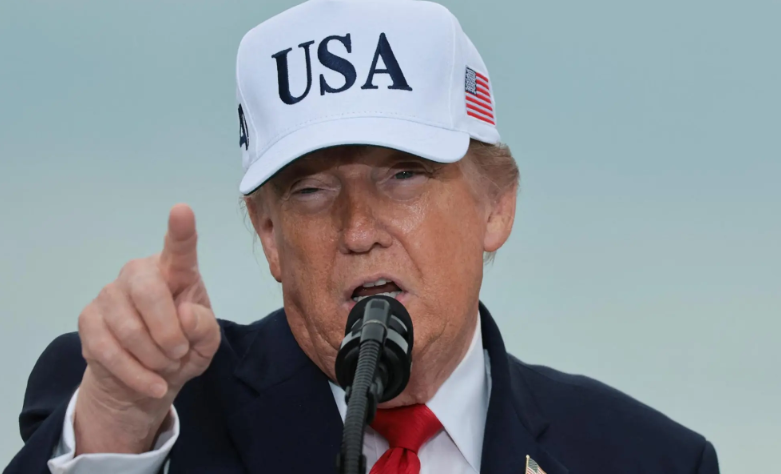
Trump, who had publicly encouraged Israeli voters to keep Netanyahu in office to allow both leaders to “finish the job” in Iran, said Netanyahu had performed “very well” and claimed his endorsement had significantly helped the Israeli leader.
Eisenkot acknowledged that Netanyahu would remain caretaker prime minister but warned against using security matters for political purposes.
He urged security officials and civil servants to remain firm against any attempt to challenge their authority, arguing that Netanyahu lacked a fresh mandate and public trust.
Netanyahu’s office has previously rejected accusations that he was exploiting the conflict with Iran for political gain. His office did not immediately respond to a request for comment following the election projections.
The uncertain political outcome also affected Israeli financial markets. The shekel weakened by around 1.6 per cent to 3.10 against the US dollar, while Tel Aviv’s main stock market indexes declined by more than three per cent.
The preliminary results highlighted the growing influence of right-wing politics among Jewish Israeli voters during Netanyahu’s long period as the country’s dominant political figure. The centre-left, which played a major role in Israel’s early political history, has seen its influence diminish considerably.
Nearly all major Jewish political parties now oppose the establishment of an independent Palestinian state, despite the proposal remaining central to internationally backed peace initiatives since the 1990s.
The election was Israel’s first since the Hamas-led attacks of October 7, 2023, in which approximately 1,200 people were killed and 251 others were taken hostage. The attacks triggered an extended regional conflict involving Gaza, Lebanon and Iran.
Israel’s military campaign in Gaza has devastated large parts of the territory and, according to Gaza health authorities, killed approximately 74,000 Palestinians. The conflict has also contributed to growing international criticism of Israel.
Netanyahu faces an arrest warrant issued by the International Criminal Court over alleged war crimes, accusations he rejects. He is also facing corruption charges in Israel, which he has dismissed as politically motivated.
Meanwhile, the Joint List, an alliance of several Arab political parties, welcomed the election projections with applause and celebrations. Joint List candidate Faten Gattas said the alliance opposed occupation and racism and would continue to represent its supporters.
Voter turnout reached 77.7 per cent, its highest level in more than two decades. Participation was particularly strong among Palestinian-descended citizens of Israel, who account for more than one-fifth of the population.
Many Arab voters were motivated by opposition to what they view as racist rhetoric from Netanyahu’s government, which includes a party leader previously convicted of inciting racial hatred against Arabs.
A previous coalition that removed Netanyahu from office depended on support from a small Arab party. However, the opposition’s weaker-than-expected performance means Eisenkot may need backing from the Joint List to secure a parliamentary majority.
Such an arrangement remains politically difficult because most Jewish political leaders have historically avoided formal partnerships with Arab parties.
Earlier partial results had suggested that Eisenkot’s bloc might have been able to secure a majority through a coalition agreement with Arab lawmakers. However, several opposition figures had expressed reluctance to pursue that option during the election campaign.
Yair Golan, leader of a prominent left-wing party aligned with Eisenkot’s bloc, called on Wednesday for a change in that approach.
Golan argued that Netanyahu’s division between Jewish and Arab voters should no longer be accepted and said the opposition had an opportunity to form a new government in partnership with Arab citizens of Israel.
Eisenkot had previously said he would not form a government with Israeli Arab lawmakers, reflecting a position also advanced by Netanyahu, who has questioned the legitimacy of an administration dependent on Arab political support.
Final election results were expected by Thursday evening or Friday morning.
Speaking to supporters in Tel Aviv, Eisenkot warned Netanyahu against using national security concerns to advance his political interests. He reiterated that the prime minister was serving in a caretaker capacity without a renewed electoral mandate.
Although Eisenkot shares several of Netanyahu’s security positions and has supported Israel’s military offensive in Gaza, he has pledged to promote greater inclusion within Israeli society, improve the country’s international standing and curb violence by Israeli settlers in the occupied West Bank.
Eisenkot also opposed holding another election and said he would work quickly to establish a government.
He argued that voters had expressed a desire for political change and urged Netanyahu to acknowledge the result by stepping away from political life.