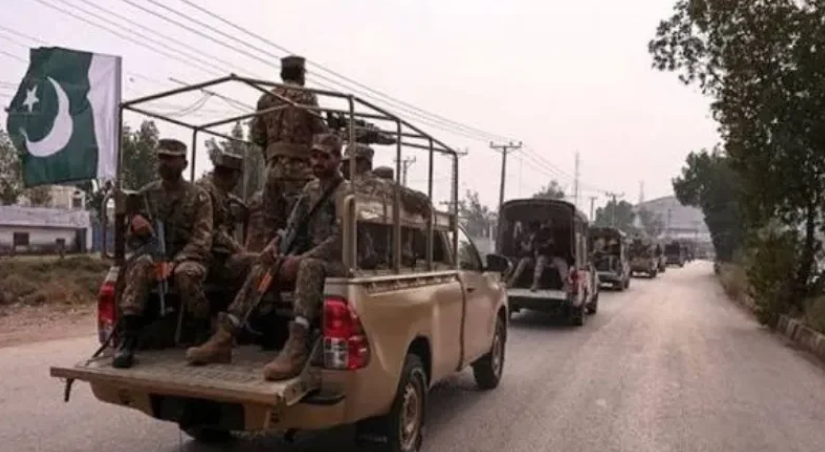
The federal government has authorised the deployment of Pakistan Army troops and military assets in Khyber Pakhtunkhwa (KP) to assist the civil administration following the imposition of an emergency and governor’s rule in the province.
The authorisation was issued by the Ministry of Interior through a Statutory Regulatory Order (SRO) on Sunday, citing Article 245 of the Constitution.
According to the notification, the deployment aims to protect human life, ensure the safety of citizens and their property, and secure government installations across the province.
The authorisation will remain effective for the duration of the proclamation concerning the imposition of an emergency and governor’s rule.
KP Governor Faisal Karim Kundi, in consultation with the Military Operations Directorate at General Headquarters (GHQ) in Rawalpindi, will determine the number of troops and military assets required, the notification stated.
Copies of the order were circulated to relevant officials and institutions, including the president’s secretary, the prime minister’s adviser, the KP governor’s secretary, the KP home secretary, the provincial inspector general of police and the registrar of the Peshawar High Court.
The development follows a meeting between Prime Minister Shehbaz Sharif and President Asif Ali Zardari to discuss the country’s overall security situation.
The move comes amid escalating tensions between the Pakistan Muslim League-Nawaz (PML-N)-led federal government and the Pakistan Tehreek-e-Insaf (PTI)-led administration in KP.
The two sides have disagreed over several issues, particularly the federal counterterrorism strategy. Differences over the policy, access to incarcerated PTI founder Imran Khan and the conduct of security operations contributed to the breakdown of negotiations held on October 3.
The PTI has alleged that it was excluded from decisions concerning security in the province, a claim rejected by the federal government. The party has called for a review of the counterterrorism policy and opposed military operations.
Meanwhile, the federal government has criticised the KP administration’s counterterrorism efforts and its position on negotiations with the Afghan Taliban.
Security arrangements were significantly reinforced across Peshawar following the imposition of the emergency, with shipping containers placed at several locations to restrict traffic and access to key government installations.
Containers were positioned near the city’s railway station to block routes leading towards Khyber Bazaar, Shoba Bazaar and adjoining areas. Access to Jail Road and Malik Saad Shaheed Flyover was also restricted near Edwardes College, while Sher Shah Suri Road was reported closed.
A substantial police presence was deployed around Governor House, with additional personnel brought in from other districts.
Police officers and other law enforcement personnel, including plainclothes officials, were seen patrolling roads leading to Governor House, the Central Police Office, Peshawar police headquarters and other government buildings concentrated in the city’s Red Zone.
Armoured personnel carriers, police vans and other security vehicles were also visible in the cantonment area, where movement was significantly reduced.
Road closures were reported at several major intersections. Containers blocked Grand Trunk (GT) Road near Firdous Chowk, while pedestrian movement was permitted in some areas.
Access towards Mall Road was restricted near Bala Hisar Fort and the Pakistan International Airlines office on Arbab Road. Only official vehicles were reportedly permitted to travel between Governor House and Chief Minister’s House.
Royal Artillery Bazaar was closed, while Saddar remained partially accessible. Several stations of Peshawar’s Bus Rapid Transit (BRT) system were also reported shut.
Khyber Road, a major route connecting GT Road with University Road, experienced restrictions that contributed to traffic congestion on alternative routes.
Although the section linking Khyber Road with University Road and Airport Road near Aman Chowk remained open, traffic was light and police deployment was heavy. Containers placed at Tehkal blocked University Road, while restrictions at Stadium Chowk narrowed traffic to single-file movement in both directions.
The Red Zone contains several key government and security installations, including the Corps Commander’s House, Civil Secretariat, Central Police Office, Chief Minister’s Secretariat and residences of the chief minister and governor.
Telecommunications services, including landline and DSL connections, were reported suspended in parts of the provincial capital.
The disruption followed a mobile network blackout lasting nearly 48 hours in the city days earlier, when PTI supporters were present for a long march.
The suspension of communications created difficulties for residents attempting to access banking services, with ATMs reportedly remaining out of service throughout the day.
However, conditions were described as relatively normal in several peripheral areas, including Kohat Road, Charsadda Road, GT Road beyond Pir Zakorhi Bridge and areas bordering Khyber district.
Military vehicles were reportedly patrolling cantonment areas, while police personnel were deployed in large numbers along Kohat Road, GT Road, University Road and Warsak Road.
The deputy commissioner of Peshawar announced a one-day closure of all public and private educational institutions across the district on Monday, October 12, 2026.
The notification stated that schools, colleges and universities within Peshawar’s territorial jurisdiction would remain closed for the day.
The decision came amid heightened security arrangements and concerns over the potential impact of the prevailing situation on public movement.
Before the emergency was imposed, KP Inspector General of Police Zulfiqar Hameed directed district police officials to remain alert for possible violent protests and sabotage.
The directive instructed police officers in Peshawar, district police officers (DPOs), sub-divisional police officers (SDPOs) and station house officers (SHOs) to personally monitor developments and maintain public order.
District police chiefs were authorised to issue instructions for regulating demonstrations and protecting public safety. In the event of violence, officers were directed to take appropriate legal action.
The instructions also emphasised a graduated approach to the use of force, requiring police to warn protesters against violence before resorting to forceful measures.
In Islamabad, the opposition alliance Tehreek-i-Tahafuz-Ayin-i-Pakistan (TTAP) was forced to reconsider its arrangements for a press conference after KP House was sealed.
The alliance had initially planned to hold the media briefing at KP House, a venue frequently used by opposition leaders. It subsequently approached the National Press Club but was reportedly denied permission despite offering to pay the required fee.
TTAP spokesperson Akhunzada Hussain Ahmed Yousafzai said the alliance had decided to move the press conference to Jamia Al Wilaya near Bhara Kahu on the Murree Expressway.
The developments came as security restrictions and political tensions intensified following the federal government’s decision to impose an emergency and governor’s rule in KP.