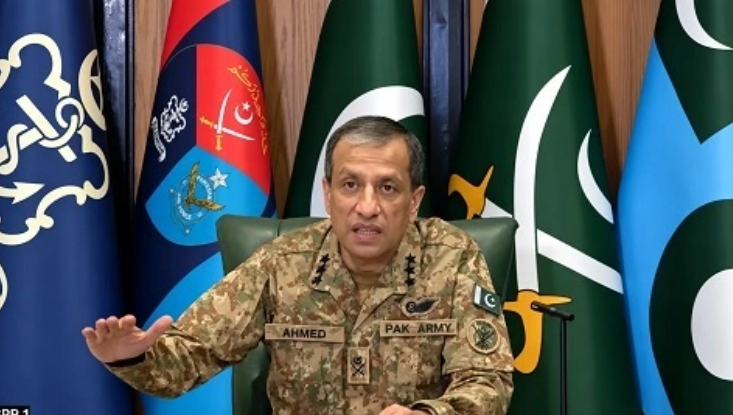
Pakistan is providing and will continue to extend whatever assistance Saudi Arabia requires to protect its sovereignty, territorial integrity and security, particularly that of Islam’s two holiest sites, Director General of Inter-Services Public Relations (DG ISPR) Lieutenant General Ahmed Sharif Chaudhry has said.
In an interview with Independent Arabia broadcast on Sunday, the military spokesperson stressed that Pakistan’s commitment to Saudi Arabia’s security was unconditional and that there could be no compromise over the protection of the kingdom and the Two Holy Mosques.
His remarks come amid deadly attacks by Yemen’s Houthi movement on Saudi Arabia in recent weeks. Islamabad and Riyadh have entered into a Strategic Mutual Defence Agreement, while Pakistan, Saudi Arabia and Turkiye are also parties to the Makkah Joint Defence Alliance, which aims to strengthen collective deterrence.
Responding to a question about Pakistan’s military assistance to Saudi Arabia in the wake of the attacks, Lt Gen Chaudhry said the kingdom’s sovereignty, territorial integrity and security — especially that of the Two Holy Mosques — were of paramount importance to Pakistan.
“Whatever support is needed to do that is being provided and will be provided,” he said, adding that defence alliances generally do not publicly disclose the precise nature or scale of assistance extended to their members.
The DG ISPR said the Houthi attacks had triggered anger across Pakistan, from ordinary citizens to the country’s political and military leadership.
He questioned why anyone would target or threaten Saudi Arabia or create the impression that the holy sites were under threat. According to him, the security of the sacred places was an issue on which Pakistan would not accept any conditions or reservations.
Asked whether Pakistan’s assistance would remain defensive if the attacks continued, Lt Gen Chaudhry said all three members of the Makkah alliance were clear that the arrangement had no offensive objectives and was designed exclusively for defence.
Referring to Article 51 of the United Nations Charter, which recognises the right to individual and collective self-defence, he said the alliance sent a clear message to forces contributing to instability in the region.
He warned that any direct or indirect attack on one of the three member states could trigger a collective response. If deterrence failed, he added, the participating countries would take the necessary steps to restore it using the capabilities available to them.
Commenting on whether Pakistan had warned Iran over the Houthi attacks, particularly after Saudi officials linked Tehran to the situation, the military spokesperson said Islamabad had been engaging with all relevant parties, including Iran.
He said Pakistan’s efforts were focused on exercising restraint, reducing tensions and preventing further escalation.
Lt Gen Chaudhry described the regional conflict as a cycle in which tensions periodically ease before disruptive actors reignite hostilities. He argued that widening the confrontation to include the Houthis or other locations would not resolve the underlying conflict but would instead benefit those seeking instability in the region.
He reiterated that Pakistan was sending a strong message that the collective deterrence mechanism was already in effect. Islamabad, he said, would take all necessary measures to safeguard Saudi Arabia’s security and territorial integrity, including the protection of the Haramain Sharifain.
The DG ISPR also clarified that the Makkah alliance was not directed against any particular country, including Iran or Israel, and had no offensive purpose.
Instead, he said, the arrangement was intended to promote regional peace, stability and security. Any actor threatening those objectives would fall within the scope of the alliance’s collective deterrence framework.
Addressing concerns over threats to shipping through the Bab al-Mandeb Strait and the Strait of Hormuz, Lt Gen Chaudhry referred to Saudi Arabia’s establishment of a multinational maritime defence coalition. A Pakistani naval officer serves as the coalition’s deputy commander.
He also urged Saudi Arabia and the wider Muslim world to strengthen unity and avoid expanding regional conflicts.
“We need to stop attacking each other,” he said, stressing that neither individual countries nor the region as a whole would benefit from an escalation of hostilities.
Pakistan, he added, had been conveying the same message to the parties involved since the US-Iran war began. He warned that if diplomatic efforts failed and the situation developed into a wider military confrontation, the Makkah alliance’s collective deterrence mechanism would come into play.
Responding to criticism of the Makkah pact, the DG ISPR said opposition to the alliance largely came from those uncomfortable with its formation. He emphasised that relations among the participating countries had developed over many years and that the alliance had evolved rapidly.
He said the door remained open to other countries that supported collective deterrence and shared the members’ objectives of regional peace and security.
Asked about reports that Egypt and Syria were interested in joining, he said any decision on expansion would rest with the political, strategic and military leadership of the three existing members.
Earlier this month, Pakistan, Saudi Arabia and Turkiye held an emergency meeting under the Makkah Defence Alliance and agreed to facilitate the rapid deployment of military forces and capabilities in Saudi Arabia. The announcement did not identify a specific threat, although it came amid the reported Houthi attacks on the kingdom.
Signed on August 7, the Makkah defence pact seeks to strengthen collective deterrence, with its members treating an attack against one participating country as an attack against all.
On September 18, Lt Gen Chaudhry had said Pakistan would go to “any extent” to defend Saudi Arabia, describing Islamabad’s commitment to the kingdom’s security as unconditional. Pakistani officials have also repeatedly maintained that the alliance is defensive in nature and intended to deter aggression.