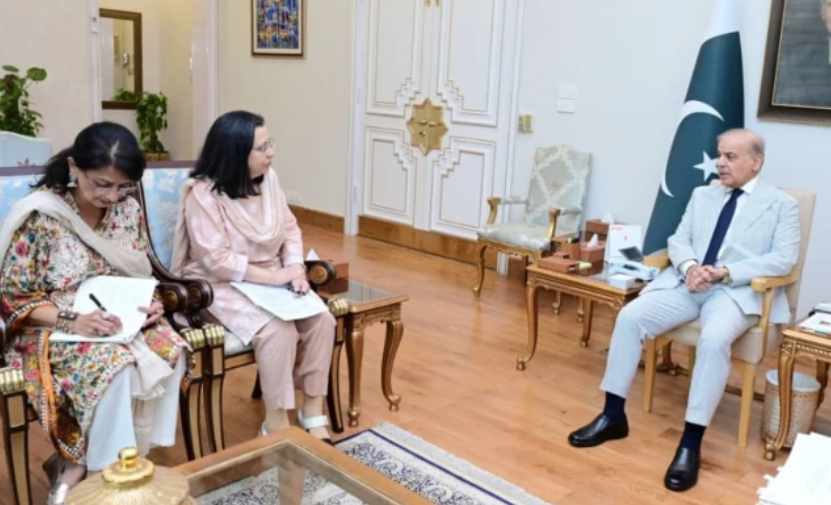
Prime Minister Shehbaz Sharif on Thursday met a delegation of the Gates Foundation in Islamabad to discuss strengthening cooperation in key areas, including polio eradication, health, nutrition and financial inclusion, according to the Prime Minister’s Office.
The delegation comprised Gates Foundation representatives Kalpana Kochhar and Anita Zaidi.
The prime minister appreciated the foundation’s continued support and partnership with Pakistan in addressing the country’s development challenges.
Shehbaz reaffirmed the government’s commitment to completely eradicating polio, saying the National Polio Eradication Programme had the patronage of the highest level of government.
He also acknowledged the Gates Foundation’s contribution to polio eradication, healthcare, nutrition, financial inclusion and the welfare of vulnerable segments of society.
The prime minister said digital payments, food security, maternal and newborn health, poverty alleviation and climate change were among the key priorities under the government’s governance reform agenda.
He described the transition towards a cashless economy as a key component of the government’s broader transformation agenda, saying it would make everyday transactions easier for citizens, improve transparency in government systems and help ensure public funds reached deserving people without delays or wastage.
Shehbaz said digital payments were expanding through joint efforts by the government and the Gates Foundation. He stressed that financial assistance for deserving women should be delivered directly, securely and with dignity.
The prime minister also expressed interest in partnering with the Gates Foundation on targeted initiatives aimed at improving women’s financial inclusion and economic empowerment.
The meeting also covered measures to further strengthen cooperation and partnership between Pakistan and the Gates Foundation.
Pakistan remains one of only two countries in the world, alongside Afghanistan, where wild poliovirus continues to circulate.
The country has reported three polio cases so far in 2026. Since the launch of the Polio Eradication Initiative in 1994, Pakistan has reduced reported polio cases by 99.8 per cent, from an estimated 20,000 cases in the early 1990s to 31 in 2025.
After recording a sharp decline in cases from 147 in 2019 to one in 2021, Pakistan has witnessed a resurgence in poliovirus transmission. Polio activity has increased since September 2023, particularly in Karachi.
Overall transmission has shown signs of decline, with cases falling from 74 in 2024 to 31 in 2025 and three so far this year. However, poliovirus circulation continues in parts of southern Khyber Pakhtunkhwa.
Pakistan has conducted three nationwide polio vaccination campaigns in 2026, protecting approximately 45 million children.
The next nationwide campaign, scheduled for this month, is expected to cover more than 31 million children across 115 districts in Balochistan, Gilgit-Baltistan, Islamabad, Khyber Pakhtunkhwa, Punjab and Sindh.
Polio is a highly contagious viral disease that can cause permanent paralysis and, in severe cases, death. Although there is no cure, it can be prevented through safe and effective vaccination.