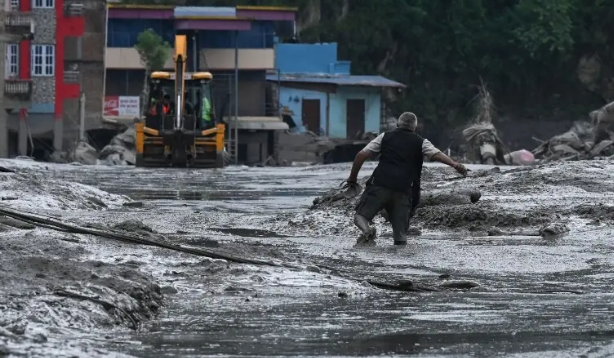
A massive wall of mud and debris swept through parts of Nepal and Tibet on Wednesday, destroying buildings, vehicles and homes and leaving more than 1,000 people missing, including hundreds of foreign tourists.
Surveillance footage from the Chinese side of the border showed torrents of mud and debris crashing over a multi-storey building as people fled the area. Buses and cars were swept away by the force of the floodwaters.
The disaster struck communities along the Bhote Koshi and Trishuli rivers. Nepali authorities said they had recovered 162 bodies, while Chinese state media reported three deaths at Gyirong Port in Tibet.
Officials said many of those missing were foreign nationals. Nepal’s Tourism Ministry reported that 468 tourists, including 393 foreigners, remained unaccounted for a day after the disaster. Nepal has not yet released an estimate of the number of local residents still missing.
On the Chinese side, 558 people, including 260 foreign nationals, were reported missing, according to officials cited by state broadcaster CCTV. Nepal’s tourism authorities said those out of contact included citizens of India, Australia, Britain, Malaysia, the Netherlands, Portugal, South Africa, South Korea and the United States.
The disaster devastated several communities as floodwaters and debris moved downstream. Environmental historian Ruth Gamble of La Trobe University described the surge as resembling an “inland tsunami” that travelled nearly 170 kilometres down the Bhote Koshi valley into central Nepal.
The area is a major route for international travellers travelling between Kathmandu and Lhasa. David Fisher, Nepal head of the International Federation of Red Cross and Red Crescent Societies, said entire villages and market areas had been destroyed.
The Red Cross said it was sending emergency supplies, including blankets, first-aid kits, stretchers and body bags, to support relief efforts.
In Tibet, authorities mobilised nearly 800 emergency workers, 150 vehicles, sniffer dogs and speedboats for search and rescue operations, according to China’s state-run Xinhua news agency.
The US Geological Survey said the disaster was triggered by a glacial collapse rather than an earthquake, as initially reported.
The agency said the event was first recorded as a magnitude 4.4 earthquake. Further analysis of seismic data and satellite imagery, however, indicated that a glacial collapse and subsequent debris flow had caused the catastrophic flooding in Nepal and Tibet.
Scientists have warned that rising global temperatures are accelerating glacier melt and increasing the risk of glacial collapses and glacial lake floods. Experts also cautioned that blockages left in rivers could trigger further flooding.
Nepali police images showed powerful floodwaters carrying away houses and other structures, while photographs from the affected areas showed buildings almost completely buried in mud.
Rasuwa district in northern Nepal was among the first areas hit. Floodwaters then moved downstream, with deaths reported across seven districts as far south as Chitwan, near the Indian border.
The floods also struck Syabrubesi, a gateway to popular trekking routes, and areas used by pilgrims travelling towards Mount Kailash, a site considered sacred by Buddhists and Hindus.
The Nepali Army deployed aircraft for rescue operations and evacuated dozens of people, while residents living in vulnerable areas along the river were instructed to move to safer locations.
Chinese President Xi Jinping called for maximum efforts to locate and rescue those still missing, CCTV reported.
Authorities in Tibet’s Shigatse warned that roads in the region remained unsafe because of the risk of further mudslides.
Qianggong Zhang, head of climate and environmental risks at the Kathmandu-based International Centre for Integrated Mountain Development, also warned that another flood could occur if water remained trapped behind debris.