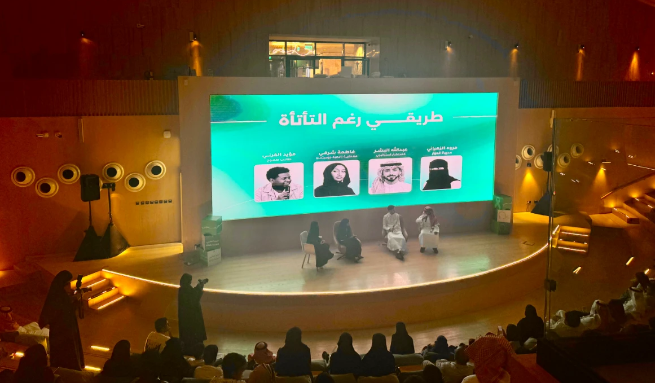
A young participant at an event marking International Stuttering Awareness Day in Riyadh delivered a powerful message about confidence and self-expression, saying his words deserved to be heard even when speaking was difficult.
Fourteen-year-old Moayed Al-Qarni told the audience, “My words are important, and they deserve to be repeated.”
His remarks resonated with attendees, including people who stutter, their families and speech specialists who gathered to discuss a condition affecting millions worldwide that is often misunderstood.
The event featured personal accounts, panel discussions and an open-mic session, giving participants an opportunity to share experiences that are frequently accompanied by embarrassment, anxiety and social pressure.
Fatima Sharfi, a 25-year-old architect and jiu-jitsu athlete, said one of the most important lessons she had learned was not to let her stutter define her identity or limit her opportunities.
“When you reduce my opportunities to stutter, you reduce my opportunities to express myself,” she said.
Sharfi explained that she grew up in a supportive environment where her speech did not make her feel different from others. However, her perspective changed during her final years of school, when she noticed that some teachers treated her differently.
She said the experience made her more conscious of how others perceived her, but it also strengthened her commitment to self-acceptance.
Sharfi believes that the way people view themselves can influence how they are perceived by others. By learning to respect and accept herself, she said, she gradually gained greater confidence and acceptance.
Pushing herself to speak despite her stutter also helped her overcome the fear of failure and become more willing to explore new opportunities.
She added that the confidence she developed extended beyond communication and positively influenced other areas of her life.
For Al-Qarni, the severity of his stutter varies depending on the environment. He said he experiences fewer difficulties when speaking at home or school but finds conversations with unfamiliar people more challenging.
Nevertheless, he remains determined to pursue his ambitions.
“My dream is to be a famous, successful doctor, and stuttering isn’t an obstacle to my big dreams,” he said.
Another participant, Renad Al-Jurayyad, said she began stuttering after a distressing experience at school when she was in second grade.
At the time, she explained, her parents did not fully understand what she was experiencing. Although professional assistance was helpful, she said greater awareness within her family made a significant difference.
As her family members learned to listen without interrupting her, she began to feel more understood and supported.
Al-Jurayyad described social relationships as one of the most exhausting aspects of living with a stutter. Over time, however, she learned to recognise which environments made her feel comfortable and supported.
Reflecting on her experiences, she said the challenges had helped her develop psychological resilience.
The event was organised by Mutalathem, a Saudi initiative founded by Saad Al-Munajem in 2021 to support people who stutter through community activities, peer-support groups and programmes for young people.
Al-Munajem said the initiative initially focused on establishing support groups but gradually expanded its activities beyond Saudi Arabia. Its online groups now attract participants from across the Arab world.
One of the initiative’s major developments has been the introduction of camps for children and teenagers who stutter.
According to Al-Munajem, the programmes emphasise evidence-based approaches and help participants understand that effective communication does not depend entirely on speaking fluently.
He said the initiative aims to ensure that younger generations receive the understanding and support that many people who stutter struggled to find in the past.
Discussions at the event highlighted that stuttering varies significantly from one person to another. Some individuals experience greater fluency while singing, speaking rhythmically or talking alone, while bilingual speakers may notice differences depending on the language they use.
Participants stressed that there is no single experience of stuttering, as its triggers, effects and coping strategies can differ considerably.
They emphasised the importance of creating supportive environments where people can communicate at their own pace without being interrupted, judged or pressured to speak fluently.
For many attendees, the central message of the gathering extended beyond speech difficulties to the importance of being listened to and accepted.
Al-Munajem encouraged people who stutter not to allow the condition to prevent them from pursuing their goals.
“I want to be an example to others,” he said, adding that his own experiences demonstrated that stuttering did not have to stand in the way of achievement.
Al-Jurayyad also credited the initiative’s founder with encouraging her to speak more openly and participate in activities she might previously have avoided.
The event reinforced a broader message of inclusion: people who stutter deserve equal opportunities to express themselves, pursue their ambitions and participate confidently in society.