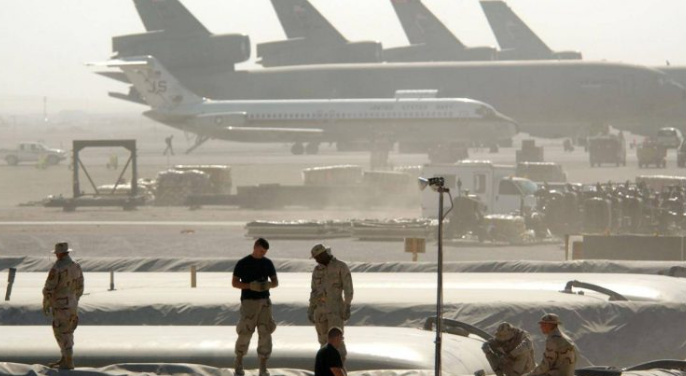
WASHINGTON: The United States has extended the deployment of several military units in and around the Middle East into 2027 as the conflict with Iran continues, according to The Wall Street Journal.
The deployment extensions, ordered by Secretary of War Pete Hegseth, affect US Army units, air-defence forces, fighter squadrons and Navy personnel operating in the region.
The US military currently has around 50,000 troops deployed across the Middle East.
Citing a letter sent by military commanders to soldiers’ families, The Journal reported that elements of the Army’s 82nd Airborne Division, one of the US military’s main rapid-response forces, could remain in the region well into 2027.
“We do not share that lightly, and we understand that a longer tour weighs heavily on every household, including our own,” the letter said.
The extended deployments mark a significant departure from expectations at the start of the US military campaign against Iran. Hegseth had initially portrayed the operation as a swift and decisive action, but six months into the conflict, the Pentagon is now preparing for deployments lasting a year or longer.
Army air-defence units tasked with intercepting Iranian missiles and drones have also seen their deployment periods extended. Standard nine-month rotations have, in some cases, been extended to a full year, while units originally assigned to Europe or the Pacific have spent more than a year in the Middle East.
The prolonged deployments have raised concerns over their potential impact on military readiness.
Tom Karako, director of the Missile Defence Project at the Centre for Strategic and International Studies, said air-defence units had already been operating at one of the highest operational tempos in the US military before the conflict.
He warned that extended deployments could contribute to troop fatigue, delay equipment maintenance and hinder longer-term efforts to modernise the US armed forces.
US Navy personnel are also facing increased pressure as fighting in the region has disrupted normal resupply operations. The Navy has been forced to rely more heavily on the remote US base at Diego Garcia in the Indian Ocean.
As a result, sailors aboard some warships have had fewer opportunities to receive mail and care packages and spend time away from their vessels.
The US Navy currently has around 19 warships operating as part of the regional military posture, while additional aircraft and air-defence systems remain deployed to protect US troops and bases.
The Pentagon’s open-ended deployment framework is intended to preserve the president’s military options as the conflict evolves. It does not necessarily mean that all forces currently stationed in the region will remain there continuously until 2027. Instead, it provides commanders and the White House with a baseline force that can be maintained or expanded as required.
The extended deployments come amid uncertainty over the future of the conflict. US President Donald Trump has privately discussed with advisers whether to declare the war with Iran over, even as American and Iranian forces continue to exchange direct strikes.
As the conflict persists, US military commanders face the challenge of maintaining enough forces to protect American personnel and preserve the president’s strategic options while limiting the strain caused by prolonged deployments, which can affect troop readiness, family life and the maintenance and modernisation of the wider military.