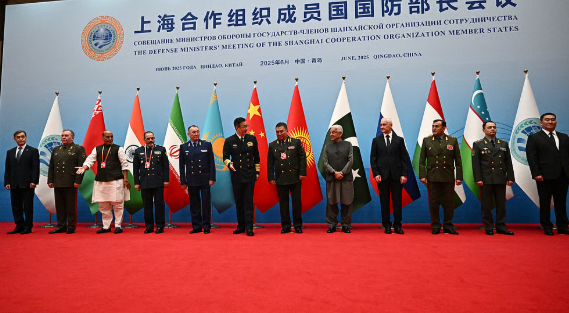
Around a dozen heads of state are expected to gather in Bishkek, Kyrgyzstan, for a summit marking the 25th anniversary of the Shanghai Cooperation Organisation (SCO).
The bloc comprises Russia, China, India, Pakistan, Iran, four Central Asian states and Moscow-aligned Belarus.
The summit comes more than four years after Russia launched its invasion of Ukraine and six months into the conflict between the United States and Iran. Iran will be represented by President Masoud Pezeshkian.
Russian President Vladimir Putin, Chinese President Xi Jinping, Pezeshkian, Indian Prime Minister Narendra Modi and Prime Minister Shehbaz Sharif are scheduled to attend a plenary session chaired by Kyrgyz President Sadyr Japarov.
Kremlin spokesman Yuri Ushakov said Putin was also expected to hold bilateral meetings with Pezeshkian, Xi and other participating leaders.
Russia and Iran, both among the world’s most heavily sanctioned countries, have significantly expanded their military and economic cooperation since the outbreak of the Ukraine war.
US President Donald Trump has warned Moscow and Beijing against providing military support to Iran.
Putin’s expected meeting with Pezeshkian comes days after CIA Director John Ratcliffe made a rare visit to Moscow, prompting speculation in US media that discussions with Russian officials may have focused on the Ukraine and Iran conflicts.
The SCO has traditionally focused on economic cooperation but has gained greater prominence in recent years under the leadership of Russia and China.
Its founding declaration states that the organisation is “not an alliance directed against other states”.
The Bishkek summit is being held as several SCO members face armed conflicts or trade disputes, including the wars in Ukraine and Iran and escalating trade tensions following US tariffs on Chinese and Indian goods.
International relations expert Mohammad Hassan Najmi told AFP that Tehran views its membership and active participation in such alliances as a potential means of easing the impact of US and European sanctions.
However, he said the bloc’s practical benefits for Iran remained uncertain, noting that such alliances had rarely enabled Tehran to overcome major challenges during periods of crisis.
The SCO represents countries accounting for around 40 per cent of the global population and 25 per cent of the world’s GDP. Despite its growing influence, the grouping remains diverse, with differences and competing interests among its members.