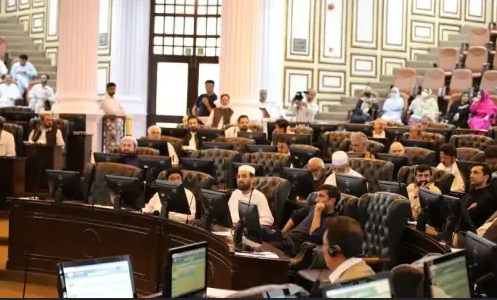
Chairing a session of the Khyber Pakhtunkhwa Assembly, Speaker Babar Saleem Swati said the KP Child Protection Act would be renamed after five-year-old Ayat Noor, who was kidnapped, sexually assaulted and killed in Haripur last month.
He said the proposed Ayat Noor Protection Act would introduce tougher punishments for violence against children and provide for speedy justice through special courts.
“We will introduce the maximum possible punishment in child rape and murder cases, including death by hanging, and that, too, in public,” the speaker said.
Mr Swati said two similar cases had recently been reported in Haripur and Swat, with police successfully tracing the alleged perpetrators. He added that four suspected gang rapists had also been killed by their associates in Peshawar.
The speaker’s remarks came after treasury member from Swat Sharafat Ali raised concerns over the sexual assault and murder of a child in his constituency.
Mr Ali said he had initially decided not to raise the matter in the assembly but changed his mind after an opposition member brought it up. He said details had previously been withheld to protect the privacy of the victim and her family.
He said a committee headed by a special prosecutor had been formed to investigate the case and vowed that those responsible would be dealt with strictly to deter similar incidents in the future.
The speaker also criticised a recent statement by Punjab Chief Minister Maryam Nawaz regarding militancy, saying it had hurt the sentiments of people in KP and Balochistan.
“Remember, we don’t follow those who say everything is fair in love and war. As Muslims, we follow the teachings of our faith only,” he said.
Mr Swati said lawmakers could criticise the policies of the Punjab chief minister, the prime minister and their alignment with the military establishment, but neither Islam nor Pakhtun traditions permitted personal attacks or character assassination.
“We [Pakhtuns] have been protecting you [Punjabis] for the last 250 years. We are a buffer zone and this is the reason why there is no law and order situation in Punjab,” he said.
The speaker said every family in KP had members who had sacrificed their lives for the country and urged political leaders to exercise caution before making statements about the province.
He also called on the Punjab chief minister to acknowledge and appreciate the sacrifices made by KP residents for the country.
During question hour, opposition PML-N member Shehla Bano criticised the education department for allegedly responding to her question by “copying and pasting” outdated data.
PPP lawmaker Ehsanullah Khan said he had requested data on government schools that had been closed across the province but received incomplete information.
He said the department’s response showed that 30 per cent of girls’ schools in his Dera Ismail Khan constituency were closed, while information regarding boys’ schools was not provided.
Parliamentary Secretary Rajab Ali Abbasi said some school projects had been completed and made functional, while work on others was in its final stages.
Opposition JUI-F MPA Adnan Khan said Government High School Bannu City-II had been established in 1932, with rooms donated by members of the Hindu community, but was demolished in 2022 despite having around 3,000 enrolled students.
He questioned the justification for demolishing the historic school.
Mr Abbasi said the building had been in such poor condition that it posed a risk of collapse and had therefore been demolished.
ANP member Mohammad Nisar questioned why 1,685 male teacher posts and 701 female teacher posts remained vacant in government schools across Bajaur tribal district.
He also said that despite Bajaur having a population of around 1.8 million, the district had only one higher secondary school for girls.
ANP lawmaker Arbab Usman also raised concerns over wheat production and flour supply in KP, describing flour as a basic necessity.
He said annual per capita flour consumption in KP stood at 124kg, while wheat production in the province was around 760kg per acre, compared with 1,200kg in Balochistan and 1,440kg in Punjab.
Special Assistant to the Chief Minister for Food Mohammad Israr said the lawmaker’s question had already been answered but offered to hold a detailed discussion if there were concerns about the figures.
He said Punjab produced around 20 million metric tonnes of wheat and consumed approximately 15 million tonnes, with surplus supplies sent to Sindh and KP.
Mr Israr said the Punjab chief minister had imposed a ban on the transportation of wheat to KP.
Meanwhile, MPA Naik Mohammad Wazir of North Waziristan criticised the repeated imposition of curfews in his district and said the law and order situation was deteriorating rapidly.
He said the issue had been repeatedly raised in the assembly, but effective corrective measures had yet to be taken.
The lawmaker also complained that internally displaced persons from Tirah Valley had received compensation, while displaced people from North Waziristan had been waiting for basic facilities for a long time.
The chair later adjourned the sitting until Tuesday afternoon.